Philadelphia, Pa., – The Associate Editor for The AfricaPaper, James Kokulo Fasuekoi, has been subpoenaed by the United States Federal Court in Philadelphia, Pa., to serve as a key witness in the upcoming war crimes trial, United States of America vs. Mohammed Jabbateh.
Covering Wars
Fasuekoi, who covered the more than decade-long civil war in Liberia, that left thousands dead and more than 700,000 displaced, will appear at the Eastern District Court of Pennsylvania this week.
Jabbateh, a businessman and resident of East Lansdowne, Pa., was arrested in April last year by the Feds for charges ranging from alleged immigration fraud, perjury, to 10 Counts of war crimes, including, “the murder of civilian non-combatants,” “recruitment of child soldier,” and “kidnapping and sexual enslavement of women,” which prosecution lawyers argued, he committed during Liberia’s bloody civil war between December 1989-1996.
Testify
A writ dated September 20, 2017, and signed by Attorney Linwood C. Wright, Jr., who represents the US Attorney’s Office that is prosecuting the case, “United States of America vs. Mohammed Jabbateh,” ordered The AfricaPaper’s Associate Editor, to appear at the referenced trial location in the city of Philadelphia, PA, “to testify in this criminal case” at the date and time indicated in the subpoena.
The decision by the United States District Court to subpoena the former Associated Press West Africa correspondent comes following numerous unsuccessful attempts by prosecutors on the Jabbateh case to have him testified voluntarily. Fasuekoi had earlier rejected requests by US investigators to testify at the trial and cited reason for his refusal to testify as “very personal.”
Violations
“You are a human rights journalist who covered the civil war; you should think about the gross human rights violations connected to this case and testify so justice can be served,” said Nelson S. T. Thayer, Jr., one of the attorneys representing the US government when he met with Mr. Fasuekoi last December.
Mr. Fasuekoi said the US attorney showed him graphic massacre photos of the Firestone, Harbel-Carter Camp genocide of June 1993. The images were taken by Mr. Fasuekoi and were published in “Rape, Loot & Murder, Liberian Civil War: A Journalist’s Photo Diary.” After a brief discussion, Fasuekoi said Mr, Thayer, Jr., urged him to view his expected “testimony as a civic duty.”
Subpoena
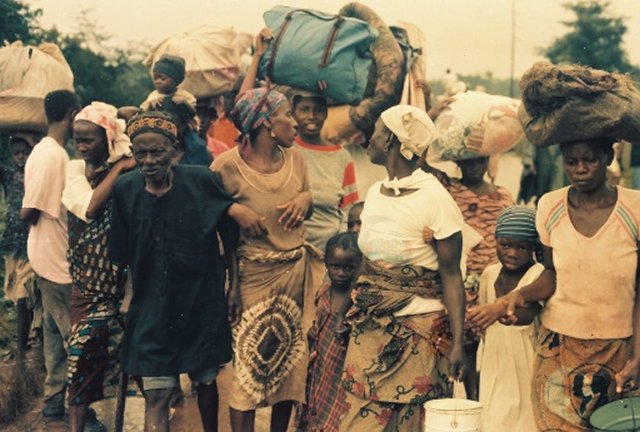
Mass exodus from ULIMO war after fleeing NPFL-ULIMO gun battle in Tubmanburg in August 1992. Photo: (c) James Fasuekoi/The AfricaPaper
Two US Attorneys Linwood C. Wright Jr, and Nelson S.T. Thayer Jr., from U.S. Department of Justice, accompanied by Homeland Security special agent, Mark Gilland, had flown to Minneapolis, Minn. to serve the writ. The latest subpoena, signed by court clerk, Kate Barkman, replaces one served earlier on Fasuekoi on December 5, 2016, in Minnesota, by the three US legal officials.
Prior to Liberia’s war, Fasuekoi worked for most of Liberia’s leading independent dailies as photo-journalist and extensively covered mainstream ULIMO wars before and after the faction’s split 1994. During this period, Jabbateh served as ULIMO’s Zebra Battalion commander, an elite unit of the movement whose task was to provide the faction’s leader Alhaji Kromah, and the Tubmanburg headquarters, with security protection, Mr. Fasuekoi said.
Scholar
Fasuekoi, an award-winning journalist, and twice in 2017 Bush Foundation Scholar, is known for his coverage of dangerous news assignments in many West African nations including his native Liberia and neighboring Sierra Leone. The fearless journalist, has covered military coups, and was one of the first journalists to meet and interview ULIMO rebel soldiers after they arrived at Monrovia’s Po River in August 1992, having overrun Taylor’s Libyan-trained NPFL rebel army bases in western Liberia. It was in Tubmanburg, ULIMO’s headquarters in 1993, that he photographed the accused, Jabbateh, who was surrounded by jubilant fighters, a photograph now used in the trial as a “key evidence, ” Mr. Fasuekoi said.
Testimony
This is not the first time Mr. Fasuekoi is coming face to face with the law and government regarding his work as a civil war journalist. In 1994, he came close to being subpoenaed by the Republic of Liberia in connection to giving testimony in the famous treason case against Charles Julue in Liberia. Julue, probably the most feared army general in Samuel Doe’s government, had attempted to overthrow a transitional administration and apparently have himself installed as president.
Fasuekoi had taken photographs while he and two other colleagues, D. Emmanuel Nah, and A. John Kollie, (both deceased), interviewed Gen. Julue at the presidential palace in Monrovia in the middle of the coup. State’s securities and the military high command of the West African Peacekeeping Force, ECOMOG, requested copies of photographs taken at the Mansion but Fasuekoi said he and is paper, the daily Liberian Inquire, refused to give out any picture beyond those already published by the paper, due to ethical reasons.
Fasuekoi said Jabbateh’s United Liberation Movement for Democracy, fought Mr. Charles Taylor’s Libyan-Burkinabe trained guerrillas, initially to protect Mandingoes (Jabbateh’s ethnic group), and Krahns ( of slain Pres. Doe), two tribes that had been targeted by the front.
Warring Factions
Mr. Fasuekoi said in early 1994, a misunderstanding erupted among ULIMO’s officials over power-sharing in an interim government and this feud was exacerbated by disagreement regarding which side was to control proceeds from lucrative gold and diamond mining going on in the faction’s territories. The feud resulted to a serious division, causing the death of both civilians and fighters on either sides.
At the trial Mr. Fasuekoi would perhaps throw lights on his account covering one of the world’s leading crimes against humanity.
The AfricaPaper’s reporters and editors are covering the story from all angles as the leading media of records on Africa. As part of the Africa Institute for International Reporting (AIIR) the paper holds one of the largest collections of West Africa’s war photographs. Some have never been published.
World Copyright
The AfricaPaper, USA, 2017. All rights reserved. Photos and text may not be published, broadcast, rewritten, redistributed or used in any form without the written permission of The AfricaPaper, and AIIR. We take legal action for any copyright infringement.
By James Kokulo Fasuekoi & Issa Mansaray | The AfricaPaper
Philadelphia, PA – A Liberian man, charged with immigration fraud and perjury, will appear in US Federal Court this week in Philadelphia, Pa., in one of the most anticipated trials involving war crimes outside the West African nation.
Mohammed Jabateh, 50, who was arrested last year, will appear in the Eastern District of Pennsylvania on Oct., 2, to answer questions regarding his role in Liberia’s civil war that left thousands dead and many displaced, and for lying to federal officials.
From all indications the United States of America seems poised to prove its case against the accused, as prosecutors have said they have over 30 witnesses, probably more than they needed. All are ready to testify against the defendant. A catalog of Jabateh’s alleged crime, can be compared to other West African war criminals such as the jailed former leader of Liberia, Charles Taylor.
Documents
The trial according to court documents obtained by The AfricaPaper, was first set for Jan. 17, 2017, with Judge Legrome D. Davis expected to preside, but was eventually postponed, and rescheduled for Oct. 2. The new judge in the case is now Paul S. Diamond according to court papers. The nature of this trial makes it first of its kind and will attract scores of local and international human rights groups, community leaders, activists, and the media.
Jabbateh aka “Gen. Jungle Jabbah,” was arrested mid April 2016 by US Federal agents who first charged him with committing immigration fraud, followed by 10 other counts associated with war crimes. They included: “the murder of civilian noncombatants,” “the sexual enslavement of women,” “the public raping of women,” “the torturing of civilian noncombatants,” “the enslavement of civilian noncombatants,” “the conscription of child soldiers,” and “the execution of prisoners of war.”
Jabbateh served as commander of Zebra Battalion for the United Liberation Movement for Democracy (ULIMO) in Liberia, a rebel movement that battled Charles Taylor’s belligerent National Patriotic Front of Liberia (NPFL) in a war from 1989-1996 for political power and control of the country’s mineral wealth. ULIMO occupied western Liberia for much of the war and during that period, Jabbateh was placed in charge of the region’s key gold and diamond belt that include Lofa Bridge and Weasua.
Defense and Lies
During a brief court appearance last year, Jabbateh’s lawyer Gregory Pagano denied charges against him and said his client was “deeply religious, peaceful and intensely loyal to the United States.”
Stories of Jabbateh’s alleged torture and murder as well as instituting “forced labor” upon civilians to mine gold and diamond for him are abound in eyewitnesses’ testimonies in a pre-trial memorandum obtained by The AfricaPaper. The stories are ghastly, and sometimes sounding surreal. According to court records, some of the eyewitness-victims, were about 16 years old and in their early 20s at the time of the war and told investigators that their tasks under Jabbateh and his rebel troops, apart from mining, included transporting ammunition and farming for him.
Horrors of War
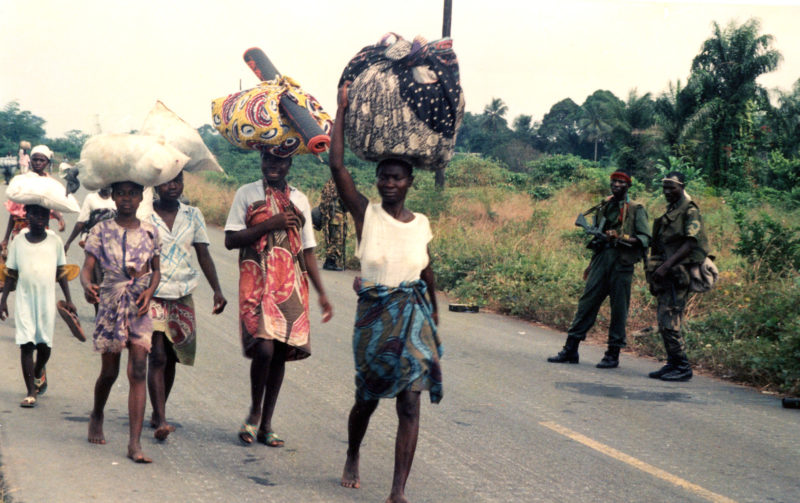
Civilians heading to Monrovia after fleeing NPFL-ULIMO gun battle in Tubmanburg in August 1992. Photo: (c) James Fasuekoi/The AfricaPaper
Meanwhile, a special review of Jabbateh’s alleged crimes by The AfricaPaper contained in a US “Government Pretrial Memorandum,” eerily reveals some horrors of an African tribal war where Mohammed Jabbateh is portrayed as a heartless rebel commander who doesn’t give mercy to even pregnant women and their fetuses.
In one particular incident for example, that occurred 1993, in Fasama, a once Lofa County forest town, now part of Gbarpolu, the document states: “ULIMO soldiers” executed four civilians in the town square after “Jabbateh” had earlier shot dead, Witness C’s uncle who had hidden underneath a bed. During the same episode, Witness C said, his personal friend named “Jaffo,” a “light-skinned black youth,” among those allegedly killed that day, had been ordered by “Jabbateh” to be sacrificed. “Witness C later saw Jaffo’s head on a stick at a ULIMO checkpoint.”
In yet another reported macabre episode, around “1993 or 1994,” Witness D, explained, at about 16 years old, he lived and attended school in Fasama, a ‘ULIMO’s headquarters in Lofa County.’ He told investigators the story of one of Jabbateh’s alleged victims, a 30 years old young pregnant woman who he said had been murdered by Jabbateh after he discovered the woman’s son had been a fighter for the National Patriotic Front of Liberia (NPFL), a rival rebel faction that largely targeted people of Jabbateh’s Mandingo tribe as well as Krahns of late Liberian president Samuel K. Doe.
Unspeakable Crimes
“At about noon every day Witness D, and others would walk to a village outside of Fasama to work on a farm. One day on the way back from the farm, Witness D and the other workers were stopped on the road by Jabbateh and ULIMO soldiers under Jabbateh’s command. One of the workers was a pregnant woman in her late 30s whose son was a known NPFL soldier. Jabbateh announced to the group that the pregnant woman’s son killed Mandingos and that she would have to pay his debt,” stated the document.
It further continued: “To this end, Jabbateh made the pregnant woman lie on her back while he cut her clothes off exposing her stomach. He then cut open her stomach and removed both some of her intestines and the viable fetus. Both the woman and the fetus died. Jabbateh then beheaded the woman and put her head on a stick. Her intestines were used as rope at a ULIMO checkpoint.”
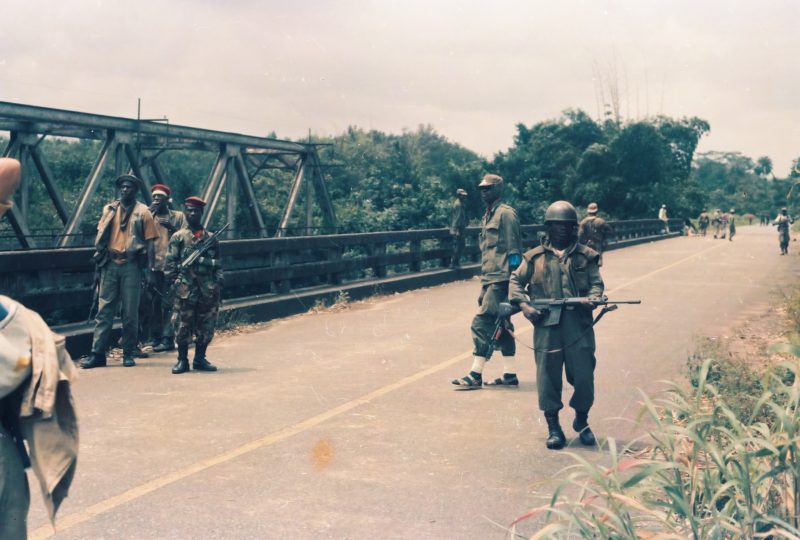
The Po River Bridge on the outskirt of Monrovia, looked tense in this August 24, 1992 photograph, the day mainstream ULIMO fighters stormed the area from Taylor’s NPFL. Photo: (c) James Fasuekoi/The AfricaPaper.
According to the document, young girls kidnapped by Jabbateh and his fighters, are assigned daily chores and have to perform such tasks under the closed watch of heavily armed child soldiers who provide escort as the women fetched water, woods or go on fishing expedition. The tasks for the women also include cooking food for Jabbateh and his fighters whom it stated, used the captured women as “sexual slaves.”
From the charges, much of the alleged humiliation of civilians occurred in Lofa Bridge, Weasua, Fasama, and Bopolu, a dense forested area which is rich in gold, diamond and timber which could also be reason why that region became hotly contested zone by rival warring factions during the war.
By sheer coincidence, this vast forest region annexes Vahumn and Foya Kamala (both in Lofa) that was controlled by another ULIMO-K commander, Alieu Koshis, arrested by Swiss authorities in Bern, Switzerland November 2014 and charged with a slew of war crimes, including the murder of civilians, recruitment of child soldiers as well as terrorizing non-Mandingo local citizens in Lofa County during his movement’s nearly five years occupation of the region.
Eyewitnesses
Eyewitnesses, and victims alike expected to testify against the accused are not only confined to the Vai, Gola, Kpelle, and Bella inhabitants of this war affected region but some come from other ethnic group like the Krahn that forged a coalition with Mandingo), and most of all, Jabbateh’s own Mandingo tribe. Accordingly, for example, Witness “A” and Witness “B” who are among the first group of witnesses are Mandingoes and the both had served as child soldiers, one with ULIMO’s Alligator Battalion while the other fought for Jabbateh’s Zebra Battalions during the accused’s reign of terror.
The list of eyewitnesses to “Gen. Jungle Jabbah’s” alleged murder spree against civilians is staggering-the court’s memorandum identifies its witnesses through alphabets perhaps, to conceal the person’s true identity for now. However, after counting runs and passes “Witness Z,” it re-start naming witnesses as “Witness AA”, “Witness BB,” “CC”, and so on.
The memorandum also lists a couple of expert witnesses in the pending trial whom the prosecution team noted are understand the “history of Liberia and its conflicts.” Others include former war-correspondents and press-photographers who covered much of Liberia’s bloody wars, especially from 1989-97 before leaving the country.
Liberians, and human rights organizations around the world are eagerly awaiting Jabbateh’s trial and for many, “the crimes are unspeakable!” The alleged indiscriminate gruesome murder of civilians by the accused and his fighters, as depicted by prosecution lawyers, will no doubt leave an indelible imprints in the minds of viewers worldwide and could serve as an eye-opener into ethnic conflicts in faraway Africa and could possibly change the way Americans view war in continental Africa.
“Execution”
The memorandum in a 40 page dossier, extensively cites alleged arbitrary “execution” and severe beating near death, carried out by Jabbateh and his men as the most common punishment for people recruited or compelled to perform compulsory labor for him Jabbateh in the event they workers are suspected by the rebels of secretly trying to hid or stack diamonds in their mouths. Fathers, sons, and daughters, are allegedly commandeered from their farms and other works such as gold and diamond mining, trucked to ULIMO’s subregional headquarters and made to perform compulsory duties per the request of their supposed new “master”, Jabbateh.
A father attempting to stop Jabbateh’s men from raping his young daughters, is also shot to death allegedly. Witness M, fearing for her life, decides to submit to the rebel’s demand and is “forced to have sex with five different soldiers” on the “first night that ULIMO-K controlled her village.” Her her sister, “Mary,” who resisted the rebels was allegedly shot and killed. This incident is reported to have occurred around 1995, in Diamond Congo, Grand Cape Mount County, another iron ore mining town decimated by a landslide in 1983. Witness M was born in Liberia’s provisional city of Kakata, Margibi County, document states, and she had moved to Congo with her aunt, father, sister and uncle who was a “diamond prospector.”
The account also showed that locals found to be sympathetic to the NPFL, or whose relatives had military tie to the faction, were punished some of the most cruel styles. It is stated that during Jabbateh’s alleged reign of terror, starting from 1992, through the movement’s breakup in 1994, and after, alleged “POWs”, of the NPFL, and later, the breakaway Krahn rival ULIMO-J faction, died by execution by ULIMO fighters reportedly under Jabbateh’s command.
From reading eyewitnesses account, one can’t help but conclude that a local didn’t have to even wink his eyes in order to incurred Jabbateh’s wrath. It said, Jabbateh and his men would invade a town or village, allegedly kill a group of people, and moments later, he would order his men to seize beautiful women of their choosing, or “gang-rape” the women and beat the men as he watched on. Witnesses claimed that during some of the raids, the ex-rebel commander would divide “captured people” into two groups and then dispatch one to “camp for military training” while others they said, were taken to mines to dig gold and diamond for Jabbateh.
Captured Women Escape
Witnessed S whose father had been allegedly captured by Jabbateh’s troops and made to work at Lofa Bridge, a diamond trade point, where he said he and his parents lived when “still relatively young,” informed investigators that “Some of the captured women, besides doing whatever domestic work that ULIMO demanded, were also turned into sex slaves.” In this state of anarchy some of the young girls are lucky to survive by escaping their captors at dawn but others aren’t so lucky as some even pregnant, experienced miscarriages, or died of bleeding following bouts of raped episodes due to complete lack of health facilities in this remote parts of Liberia.
What even perhaps made it difficult for enslaved men and women to escape to safety, is that though the region possesses abundant mineral resources like gold, diamond and timber, yet ironically, most remote parts of the newly formed Gbarpolu County, extending to the Belle forest town name Belle Yellah, the site of the country’s notorious prison, lacked a common feeder road network thereby making the areas only accessible by air about two decades ago.
Beating and Looting
Local business residents like gold and diamond dealers, the report maintained, were identified by Jabbateh’s soldiers and targeted. According to Witness N, one of Jabbateh’s alleged former “sex-slaves” (victims), who later manage to escape, [Jabbateh’s] fighters “told him that there is a woman in that town who had a lot of money, as evidenced by the fact that she was buying diamonds.” She alleged that “On Jabbateh’s orders the woman was stripped naked and beaten with gun butts.” Though she said the woman survived the beaten, the incident she noted forced her escape. Witness N named the year as 1994, at the time she was about 21 years old and worked as “goods trader” in Israel, Grand Cape Mount.
The document indicated that Jabbateh would pick a fine woman from amongst wives of his alleged “forced laborers” working in the gold and diamond field, sleep with her for a night or two and if he’s pleased, he Jabbateh would keep her for as long as he wanted in total disregard to the woman’s husband who had to live with such condition. Though the document doesn’t it such humiliation evidently tore families apart. Most of the witnesses explained that the mistreatment of people in Jabbateh’s controlled area intensified when ULIMO split in March 1994, leading to reprisal killings of Krahn civilians and fighters by Mandingo of ULIMO-K.
Fighter Escapes Death
Witness F, who is said to belong to the ethnic Krahn and had joined ULIMO in 1992, explained that he, unlike many of his fellow Krahn ULIMO fighters, heading Tubmanburg, (ULIMO’s former headquarters) narrowly escaped death at the Po River Bridge checkpoint by quickly escaping into the bush when “Jabbateh ordered ULIMO soldiers (who were Krahn) and civilians off the bus in which they were travelling,” to be killed by his Jabbateh’s Mandingo ULIMO fighters. He noted When his [Jabbateh’s] soldiers hesitated to shoot their former colleagues, Jabbateh grabbed an AK-47 from one of his bodyguards, and executed between four and six ULIMO Krahn soldiers.”
Witness F said this incident occurred during the period the inter-tribal conflict had just begun. He told investigators that while he was being treated for combat wounds at the nation’s largest hospital in the capital, JFK, Mandingo fighters at the same hospital had initially informed him of a tribal conflict brewing within the movement that would target his people, Krahns, including civilians. Armed with such information he wasted no time to escape into the bush at Po River the moment Krahn fighters and civilians were asked by Jabbateh to step down from a commercial bus.
Witness F, a former member of ULIMO’s Alligator Battalion, a rebel unit that fought alongside Jabbateh’s Zebra Battalion at certain stage to defend Monrovia to stop Taylor’s NPFL “Operation Octopus”, assisted by INPFL of Gen. Prince Johnson, from overrunning the capital, maintained that he managed and hide from a safe distance where he heard Jabbateh ordered his troop to kill the Krahns. But his story doesn’t end at the Po River. He manages to reach Tubmanburg, the epicenter of the ensuing inter-ethnic conflict that would yet lead to more killings including civilians from both sides.
UMILO Generals Arrested
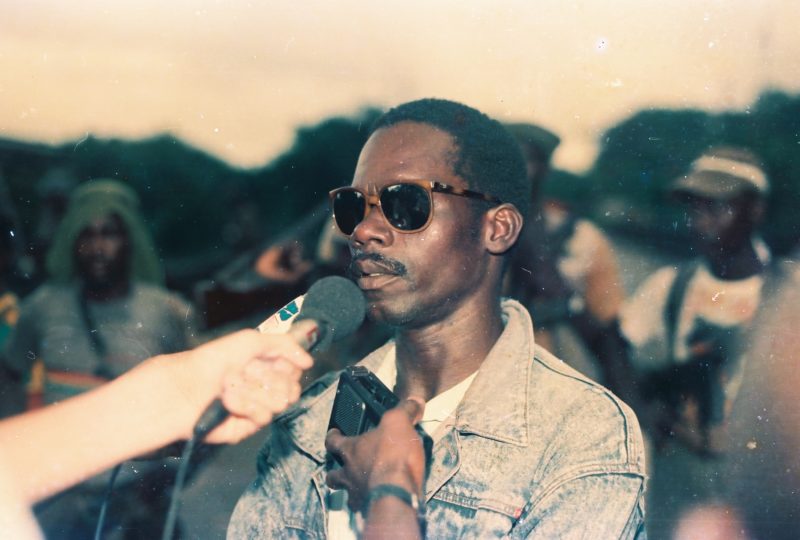
ULIMO’s Gen. T-Karler speaks to local and international journalists at Po River after ULIMO captured the area. Photo: James Fasuekoi/The AfricaPaper.
In the old mining town of Tubmanburg which till the fracas, had served as the movement’s headquarters, the document stated Witness F again observed a gunbattle that erupted when Jabbateh and a group of loyal Mandingo fighters tried to disarm a Krahn ULIMO General known as “Clarko.” In the end, Jabbateh’s group is said to have prevailed over Clarko’s men as his bodyguards, ultimately, “outnumbered” Clarko’s.
The campaign to arrest Krahn Generals of the faction, according to Witness F, was extended to “Gen. Sako-see” and “Gen. T-Kahla,” (actually spelled, “T-Karler”). Gen. T-Karler was a former soldier of AFL, the country’s national army prior to the war. He headed ULIMO’s Alligator Battalion which took control of the Kakata-Bong Mines region, a strategic point NPFL once occupied. Jabbateh, Witness F, said, was joined by Gen. Abu Keita, and Gen. Pepper & Salt. (“Gen. Pepper & Salt” gained notoriety for his alleged mistreatment and murder of civilians and “POWs” during the ULIMO internal war).
Gen. T-Kahla’s Wife Tina Killed
In a separate firefight, Gen. Sako-see, Witness F says, was killed by an RPG fired by Jabbateh. Gen. T-Kahla, shot thereafter by Jabbateh after he walked out of the faction’s headquarters building, managed to escape into the nearby bush. The document said, Witness F, “then left the area to tell T-Kahla’s wife that T-Kahla had been shot and fled.”
“Upon arrival at T-Kahla wife’s house, Witness F saw Jabbateh arrive with ULIMO soldiers in three vehicles. One of the vehicles was a black Jeep. The soldiers were shouting “Operation No More Stupid, No More Jesus, Only Allah.” The soldiers pulled Tina [Gen. T-Kahla’s wife, pregnant then] out of her house. They held her with her legs and arms spread while Jabbateh shot her between the legs with an AK-47, killing her. Another woman was also taken out of the house and shot to death.”
War Crimes Court
Liberia fought an intermittent brutal civil war during the 1990s through 2003, and with a death toll estimated at 300,000 people. Most rebel commandos suspected of committing genocides in the war have never been held accountable for their crimes-that has made the healing process and the search for genuine reconciliation impossible.
To the disappointment of many Liberians and foreign residents, presidential candidates vying in the upcoming general elections haven’t done much to tackle key issue such as setting up a war crimes court in Liberia-similar to Sierra Leone’s Special Court-that would try alleged war criminals. As a result fear looms over Liberian communities that a new incoming government is likely to follow the same path as Ellen Sirleaf’s and may not seek retributive justice for Liberian war victims.
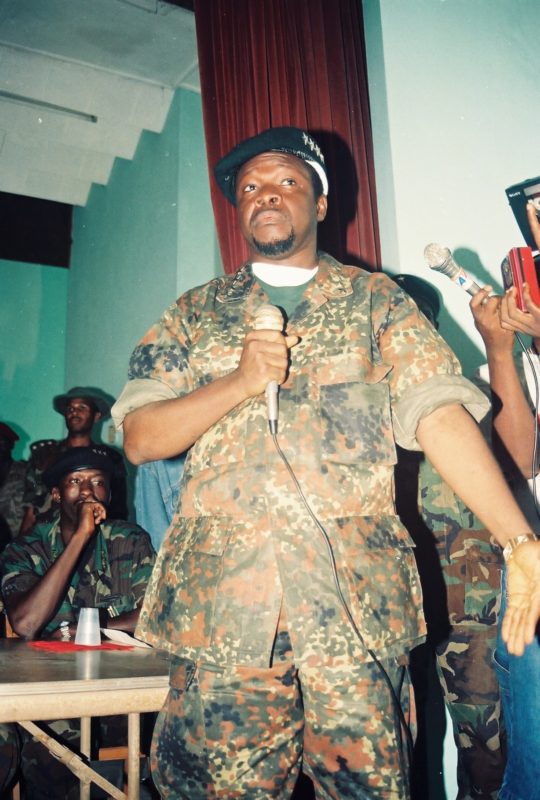
“General” Alhaji Kromah, leader of mainstream ULIMO. Photo: (c) The AfricaPaper/James Fasuekoi
Amid all this the real irony is that many of those accused of grossly violating human rights during the war are the ones holding power in Liberia today while still being celebrated as “heroes” by diehard “loyalists.” For instance, Liberia’s Pres. Johnson Sirleaf, whose role in the war has come under serious criticism from many, along with ex-Independent National Patriotic Front of Liberia (INPFL) leader, Prince Johnson, served as leaders in the present government accused of engaging in massive corruption. Some Liberians view this as another way via which key ex-war players are depriving war victims not of life, but preventing them from accessing a better livelihood because of the institutionalization of corruption.
By contrast, the story is different in the case with Sierra Leone, a neighboring state that also experienced a decade of an atrocious war which left adults and even children amputees. The AFRC military junta later merged with rebels of the Revolutionary United Front (RUF) during Sierra Leone’s war and the two are reported to have launched a brutal campaign of mass murder and amputation of civilians as means to install fear and forced the nation to give into their demand for power. Unlike Liberia, Sierra Leone masses never allowed those who brought “deaths” in Sierra Leone to serve in the government for peace’s sake.
But as Liberians appear undecided over whether or not to set up a war crime court, the US and its European allies like Switzerland and Belgium, have meanwhile vowed to prosecute people suspected of involvement in human rights violations, including war criminals from Liberia and elsewhere who enter their countries.
Attempt by The AfricaPaper to contact Mohammed Jabbateh’s legal representatives proved unsuccessful.
World Copyright
The AfricaPaper,USA, 2016. All rights reserved. Photos and text may not be published, broadcast, rewritten, redistributed or used in any form without the written permission of The AfricaPaper, and AIIR. We take legal action for any copyright infringement.
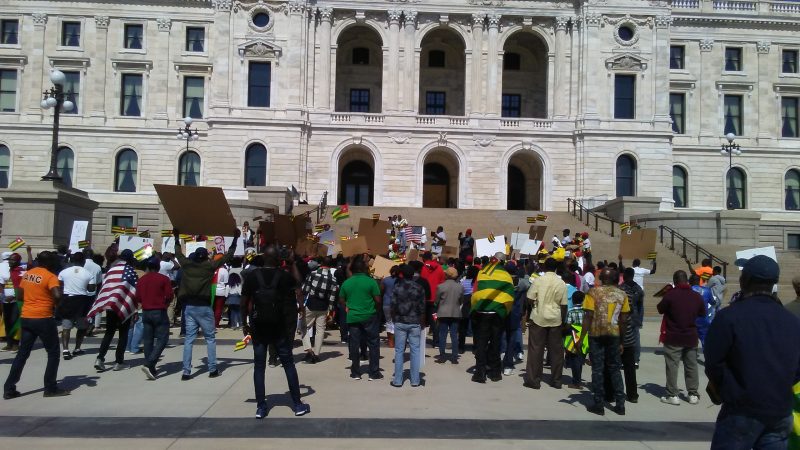
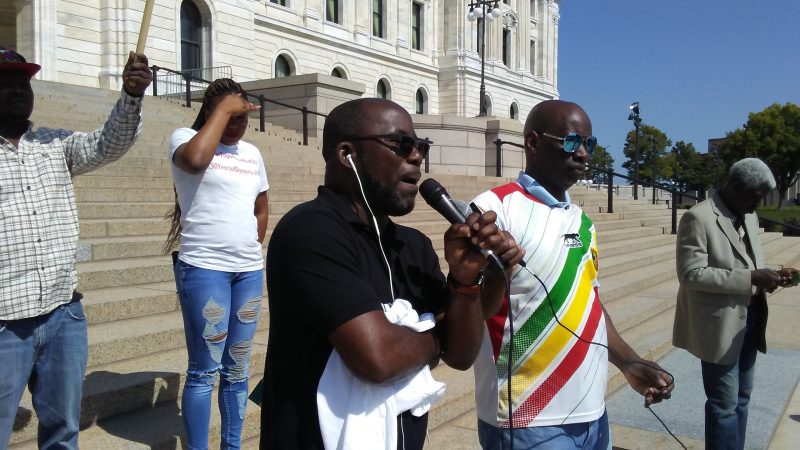
Saint Paul, Minnesota – At least more than 200 Togolese nationals residing in Minnesota, Saturday, Sept. 9, joined a growing chorus that has reverberated throughout Togo in the past days, with demands from Togolese at home and abroad that their country’s president, Faure Gnassingbe, resigns from power immediately due to his unwillingness to introduce political reforms and change in the governing system.
Togolese in Minnesota take to the Capitol. Photo: The AfricaPaper/James K. Fasuekoi
Political Turmoil
Saturday’s demonstration began near the Sears Store, off University Ave., and ended at the door steps of the Capitol, St. Paul, MN. It is in solidarity with the ongoing political demonstrations throughout Togo, which were sparked by the murder of two opposition party supporters last August by the military and the imprisonment of scores of opposition parties members.
The rallies in Togo itself according to observers, remain a challenge to the current government of Prez. Gnassingbe and are reported to be the first biggest ever in the sleepy tiny West African country since Faure’s father, Gnassingbe Eyadema seized power through a military coup in 1967. The rallies were organized by the opposition Pan-African National Party (PNP) and National Alliance for Change (ANC). News media reported a spike in Thursday’s turnout, putting the figures to over 100,000 people in the capital, Lome, alone.
Constitutional Reform
Besides calls for Prez. Faure Gnassingbe to step down, the Togolese masses also want a constitutional reform that could limit presidential terms to only two, which they believe could avoid nurturing another dynasty. The opposition parties are demanding the government to free all of their members who were arrested and jailed by the military and security forces during recent unrest in the capital and around the country.
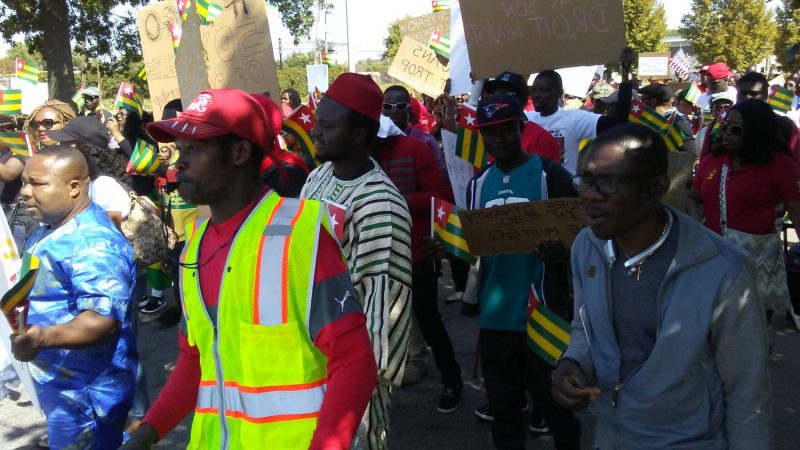
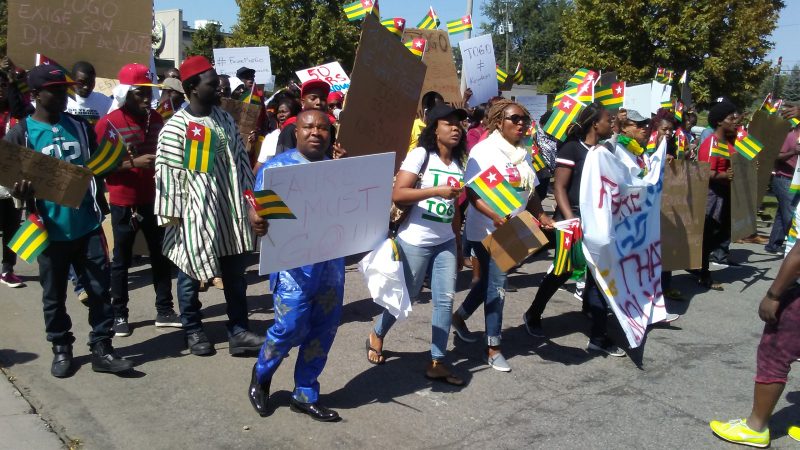
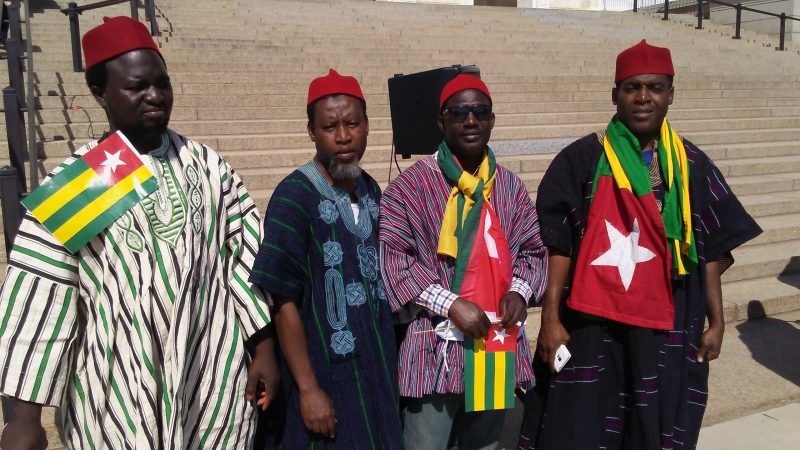
Togolese protest in St. Paul, Minnesota. Photo: (c) The AfricaPaper/James K. Fasuekoi, 2017
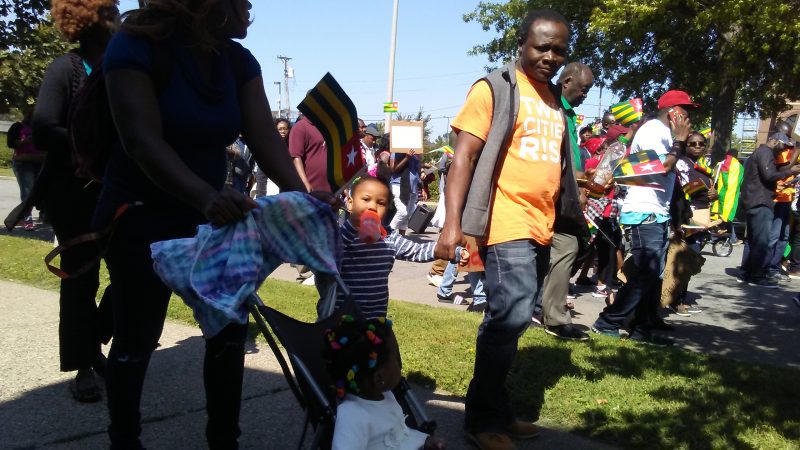
Clad in traditional Togolese garments such as the “Temtoko” from the Kotokoli Tribe, and Togo’s green, yellow and red national colors, some of the marchers carried minors in baby strollers, while others simply held the hands of their kids as they sang revolutionary songs, amid slogans, in their local dialects and in French, Togo’s national language, on their way to the Capitol.
Free Togo
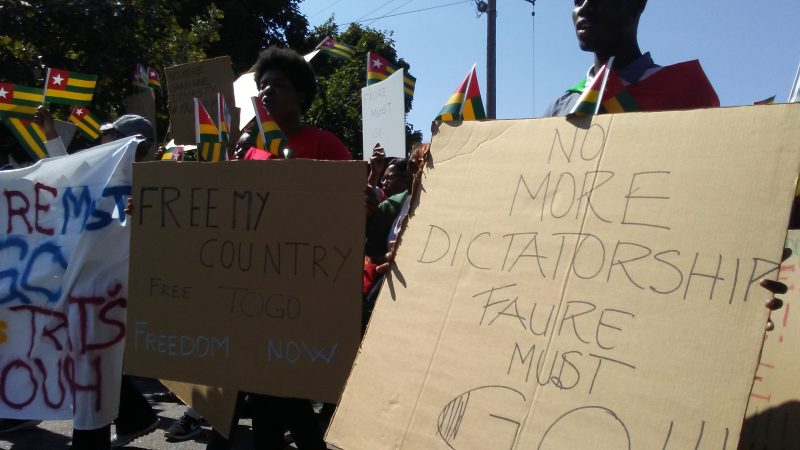
Marchers carried banners of all types and sizes. Some read: “Faure Must Go Enough Massacre” and “Free My Country, Free Togo, Freedom Now.” Yet, another read: “No More Dictatorship Faure Must Go!!!”
Togolese protest banners in St. Paul, Minnesota. Photo: The AfricaPaper/James K. Fasuekoi, 2017
The popular uprising in demand for Prez. Faure Gnassingbe to step down from power remains the call and talk among the Togolese people everywhere presently. As the crowd moved closer to the Capitol Saturday morning, the same call, “Faure Must Go,” to the astonishment of many, was re-echoed by a two-year old who waved a Togolese national flag as she walked with her dad.
Dictator’s Son
A statement from the Togolese Community in Minnesota, accused Togo’s military hierarchy of usurping (violating) the constitutional provision “by appointing the late dictator’s son, Faure Gnassingbe” as head of state after the father died. The constitution, it said, requires the speaker of Togo’s National Assembly to assume power in the event of a vacancy in the presidency caused by death, or where the president becomes disabled.
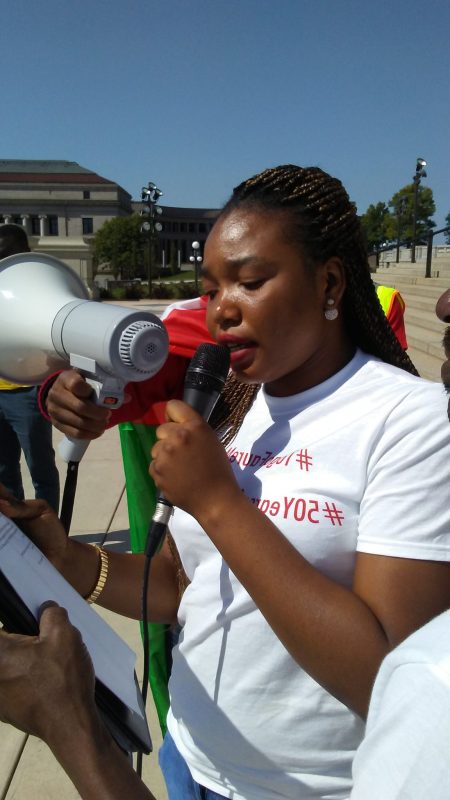
Statement, read by Edith Kowouto. Photo: The AfricaPaper/James K. Fasuekoi
The statement described Prez. Faure Gnassingbe a “tyranny of another century that controls all the institutions of the country.” Accordingly, during the 12 years Faure Gnassingbe has ruled Togo, he has failed to introduce reforms and political change despite persistent appeals from the Togolese people. And with such predicament, they maintained: “a popular uprising remains the only alternative.”
The statement, read by Edith Kowouto, further called on the United States government and international community “to stand in solidarity with the Togolese populations in their effort to rid themselves of the tyrant,” and urged them to closely monitor political events in Togo, while making sure the rights and dignity of of peaceful protestors are respected.
Concluding, the statement warned that “if the U.S. and the international community fail to stand with the Togolese people today, Faure Gnassingbe will be emboldened to use the military to systematically massacre the peaceful protestors, which may escalate to general unrest in the country and beyond its borders.”
Over 50 Years in Power
Faure Gnassingbe inherited power in the West African country of Togo, in 2005 following the death of his father, former dictator Gnassingbe Eyadema who ruled the former French Colony for 38 years uninterrupted. The Gnassingbes have ruled the country for over 50 years and opponents say, the newest “tyranny shows no signs of abating.”
Earlier, the crowd held a minute of silent prayer to the memories of those gunned down by the military during recent protests in Togo. Brief prayers were also offered in Islam.
Togolese take to the Capitol. Photo: The AfricaPaper/James K. Fasuekoi
So far, Lome, appeared tense and security situation remains grave, prompting the United States Embassy in Togo to warn US Citizens to take note of their surroundings and avoid certain areas in the capital and upcountry. “U.S. citizens should stay aware of their surroundings, monitor local media for security information, including possible demonstrations, and avoid crowds or stopped traffic,” noted the embassy’s website on Sept. 8, 2017.
No Internet
Internet users in Togo also reported a freeze placed on internet access by the government in an apparent attempt to censor information and photo materials being wired out of the country since demonstrations began Wednesday. The freeze was confirmed by the US Embassy website: “Interruptions in internet connectivity and telephone messaging services continue throughout the entire country.”
A Togolese government spokesperson, Gilbert Bawara, later confirmed this in an interview with reporters says, “The government had moved to limit internet access nationwide for “security’ purposes.” |TAP|Africa’s Newspaper of Record
DEMO ON CAMERA
In Protest. Photo: The AfricaPaper/James K. FasuekoiIn Protest. Photo: The AfricaPaper/James K. FasuekoiIn Protest. Photo: The AfricaPaper/James K. Fasuekoi
In Protest. Photo: The AfricaPaper/James K. Fasuekoi
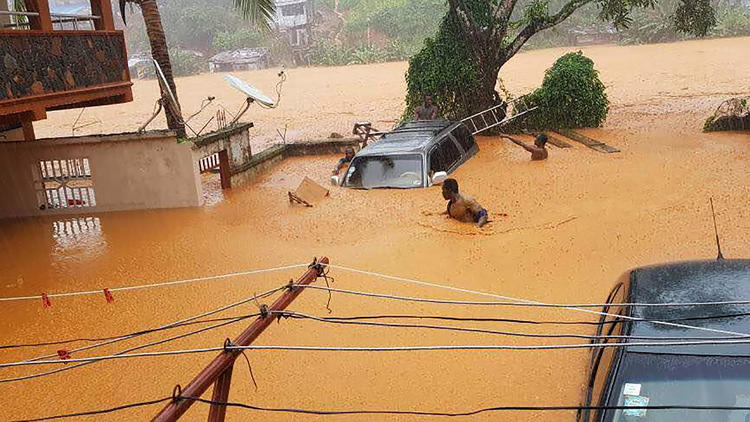
FREETOWN – Sierra Leone’s president has appealed for urgent help to support the thousands of people affected by a devastating mudslide on the outskirts of the country’s capital.
A national emergency has been declared after the city suffered heavy flooding, thought to be the worst in Africa over the past two decades. Freetown’s mayor, Sam Gibson, said 270 corpses had been recovered and were “being prepared for burial”, while the chief coroner told Reuters that nearly 400 bodies had been found. Estimates of the numbers missing vary: the Red Cross reported that 600 people have not been traced, while the country’s interior minister has said thousands are unaccounted for.
At least a hundred houses were hit when a hillside in Regent, a mountainous town 15 miles east of Freetown, collapsed in the early hours of Monday morning.
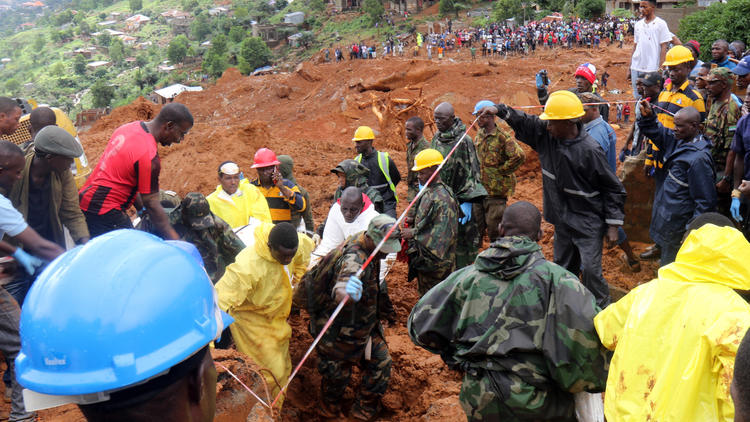
Search and rescue efforts have continued throughout Tuesday, hampered by the country’s dangerous terrain and the sheer scale of the tragedy. The mudslide, which trapped residents while they were sleeping, is thought to have travelled for two miles.
Addressing the media, president Ernest Bai Koroma said the devastation “was overwhelming us”. “Entire communities have been wiped out,” Koroma said. “We need urgent support now.”
0:28
Flash flooding hits the outskirts of Freetown on Monday
Linnea Van Wagenen, working for the UN in Sierra Leone, said: “We have the mountains and very steep hillsides. [It’s very hard to] access these areas, where it’s muddy, it’s slippery – there’s a risk of a second landslide. We’re not sure how this massive landslide has affected the ground around it.” She added that the chances of finding survivors on Tuesday was low.
The UN is using satellite data, radar imagery and drone mapping to assess which areas may be at risk of a second mudslide or further flooding. The country is not yet halfway through the rainy season, Van Wagenen said.
“Last year the heavy rains came in September, so we want to make sure we do analysis of communities that are at risk now and [see how we can] prevent the risk of something like this continuing to happen.”
Sierra Leone is prone to flooding, but it was not prepared for a disaster of this magnitude, said Daniel Byrne, monitoring and evaluation officer for Oxfam in Sierra Leone. “This particular emergency is unique because the total number of survivors is not that high compared with the people who have died. No one was expecting a situation like this. People are using their bare hands to remove bodies.”
Issatu Koroma, from Regent, is among the hundreds of people to have lost relatives and their homes in the mudslide. Both her son and nephew are missing, she said on Monday. “Everything is gone. We’ve lost everything – our house, everything. The mud came down with the water so fast and my son did not escape. We found him lying in the mud. He was just a boy. They took his body with the others to I don’t know where. God help Sierra Leone. Why are we cursed? What are we supposed to do now, with nothing?”
Abibatu Kamara, a mother of three who spent the night on her neighbours’ veranda, said so far any government response had been absent. “We have not received any food or blankets since the disaster occurred yesterday,” she told Agence France-Presse.
Kayode Akintola, Cafod’s country representative for Sierra Leone, said bodies are lining some of the capital’s streets: “Things are really bad on the ground. Just a few minutes’ walk from our office a bridge has been submerged. There are dead bodies in the water and littering some of the streets, and houses are still under water.
“We are working with our local partners to assess what support we can provide. The immediate need of people affected are water and food, meanwhile thousands of families who have lost their homes need shelter, and there are also serious health concerns.
Gaston Slanwa, Tearfund’s Country Representative for Sierra Leone, added that 60 people have died in one church community alone. “I drove around Freetown yesterday and saw several houses had disappeared, roads completely gone. On one bridge I saw two people who were already dead being pulled out of the water. In just one of the church communities we work with, 60 people have died and 300 have lost their homes. One of the churches was hit by the mudslide.”
Many of the 3,000 people left homeless spent last night in neighbouring homes that had survived the tragedy. Others were taken to a nearby police station for shelter
Ishmael Tarawali, head of the Office of National Security, said that burials of identified bodies will begin immediately. “The hospital mortuary is overwhelmed right now and it is really our only option,” he said. Body bags are being donated by charities and NGOs.
“We’re hoping to organise as well as we can to get every last person identified, but it’s a complicated process,” he said. In some cases entire families have been killed, and the condition of the bodies is also making it difficult to identify victims.
The Red Cross and the government have been moving bodies to a holding centre at Connaught hospital in Freetown.
Alex Carle, director of international programmes at the British Red Cross, said the death toll is likely to rise, adding: “The spread of diseases such as cholera, typhoid and diarrhoea following flooding is also a huge concern.” The city’s drainage system has been overloaded by the torrential rains, leaving stagnant water in some areas.
Sorie Bangura, whose family is safe, was among the residents helping the rescue operation on Monday. “We’ve been trying to dig people out all day but it’s no use – just not enough volunteers. Some houses are so buried it would take machinery to dig them up,” he said on Monday.
“There are dead everywhere and people don’t know where to go. There are only so many houses still standing, and we can’t take in everybody. What we need is help from the international community. People need shelter, clothes, anything. This is the rainy season and it might only get worse. There must be a way to stop this from happening but nobody seems to know how. I’m scared for my life because it could be my family next.”
Richard Miller, ActionAid’s humanitarian director, said he feared the situation could get worse.
“There are signs of continuing rainfall and hanging debris from the mudslide,” he said. “ActionAid is planning an immediate humanitarian response in the worst-hit areas. Thousands of people’s homes have been swept away and their businesses and crops destroyed.
“Our local aid workers in Sierra Leone are telling us that they are especially concerned for the welfare and safety of girls and women, who are the most vulnerable at this time. Many children have been made homeless and are in immediate need of shelter and protection,” he said.
According to Agence France-Presse, Sierra Leone’s meteorological department issued no warning ahead of the torrential rains, which might have allowed for swifter evacuations from the disaster zones.
Priti Patel, the international development secretary, said in a statement that the UK is ready to provide support. “We have pre-positioned vital aid supplies and helped prepare the country’s response to disasters. We are already working with the government of Sierra Leone to coordinate the rescue “Žefforts and are ready to provide further assistance to those in need.”
LILONGWE – “It is pathetic and more painful to see that we are still drinking together with wild animals in the contaminated rivers, and worse still, suffering from diarrhea – yet our government is just watching,” laments the people in the poverty stricken Mzimba District in northern Malawi .
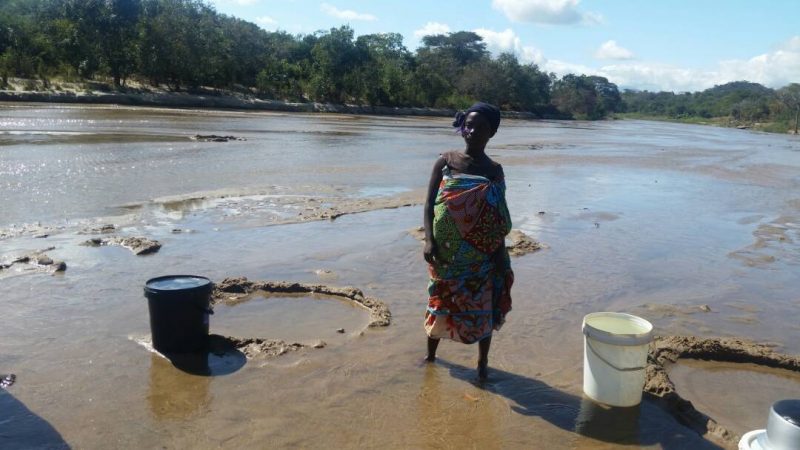
Since their birth, people in this remote area of Traditional Authority Chindi have been drinking together with cattle, goats and other animals in a contaminated Mzimba river due to lack of boreholes to supply them with safe water.
Acute Shortage
The acute shortage of safe drinking water and poor sanitation remains one of the biggest challenges to development for rural communities in Malawi.
For instance, about 80 percent of the population live in rural areas and more than 3.5 million people consume water from contaminated rivers, lakes, wells and streams.
The situation experienced by the Mzimba community highlights the magnitude of the problem in Malawi.
Grace Mkandawire of Yadesha village is among a group of women we found drawing water for drinking in the contaminated river.
“As usual, we leave our homes early in the morning for drawing water here. Sometimes we find it [River] it flooded. But we force ourselves to draw the water because our homes are completely out of water,” said Mkandawire.
“Despite putting our lives at risk, we have no choice but to continue with the ordinary life because water is life and we have nowhere to go apart from this river.”
Some Villagers walk for more than an hour to get water. Those with money hire bicycle taxis to fetch water but operators charge exorbitant fees.
Where fetch water from contaminated rivers: Photo. Henry Mhango/The AfricaPaper
Contaminated Rivers
Communities around Ngana in the far west of Songwe and Katili and Fulirwa in the south of Karonga district in the same northern region of the country, also depend on water from contaminated rivers, wells and streams for survival.
The Ngana residents drink from the Songwe River while those in Fulirwa drink from another crocodile infested river called Wovwe. Apart from drinking these rivers, they are also used by wild animals, and for domestic use such as irrigation water and washing clothes.
The country’s renowned social analyst Mr. Dan Nsowoya said a lack of political will from the government to improve infrastructure was a major factor contributing to the poor water supply in rural areas.
“This is not the Malawi we wanted when we were fighting for independence in 1964 and democracy in 1994,” said Nsowoya.
He also bemoaned the laziness of men who regard water issues as the remit of women, and the time the daily chore takes.
“Even in places where there are boreholes, some women leave their homes as early as 4 a.m. local time [2GMT] and return to their homes around 10 a.m. [8GMT]. They have to queue for so long due to the high demand of the commodity as each borehole serves many villages”, she explained, adding that, “this is not fair and must be treated as a matter of concern.”
Boreholes and Health Risk
Each borehole serves some 500 people but they frequently breakdown and once broken repairs can take a long time to because spare parts are expensive.
The implications for the population’s health are enormous.
Speaking on condition of anonymity, officials at Ngana and Fulirwa health centers told TAP that cases of diarrhea and bilharzia account for 60 per cent of patients visiting both facilities.
The officials attributed most of these health problems to the use of dirty water.
The situation remains grave in poverty stricken areas where uneducated people consume water from contaminated sources without boiling or applying chemicals such as chlorine to kill germs: the chemicals are simply are too expensive.
It is against this background that the government is being urged to provide civic education to people on the dangers of consuming untreated water. Government is also being pressurized to start distributing free water treating chemicals as a short term measure while the drilling of more boreholes takes place.
Government Excuse
In response, the government claims the provision of safe-water in rural areas is hampered by the frequent breakdown of water points due to reckless use by the population.
“[The] effects of climate change have also affected us as well,” said Aggrey Massi, Minister of Agriculture Irrigation and water Development.
“Most boreholes are functioning during rainy season but dry up during dry season due to the massive deforestation of our forests.”
The minister insisted the government was doing everything it could to improve the situation by drilling more boreholes.
“We are also encouraging the people to embark on afforestation especially in areas where water dries up during summer to avoid the problem,” Massi added.
But Massi’s comments provided no solace to people affected.
“You mean it [government] has realized today that we are drinking with animals? How do we trust them if they have never even visited us to say sorry for the problem or provide us chlorine for treating the water?” asked Bright Zgambo, a Fulirwa resident.
Patch Work – Where is the Money?
In 2008, the governments of Malawi and Tanzania, with financial assistance from the African Water Facility [AWF} and New Partnership for African Development, embarked on implementing a water project called the Songwe River water Development Programme. The two year multi-million project was aimed at improving the water supply for residents in both countries but nine years down the line, only a little or patch work has taken place.
Emily Mkamanga, a Women’s rights activist said the delay is due to lack of political will and she urged the government to investigate what has happened to the project’s funding. She claimed that the government officials are failing to pay attention to the problem because they stay in towns where access to safe water is not an issue.
Mkamanga says the poor water supply is greatly affecting development in the rural areas because people have no time to participate in the community’s development.
“How do they participate in development when their children are sick due to diarrhea or if they don’t have water?” said Mkamanga, urging government to make more efforts to ensure the problem is quickly addressed. |TAP| Africa’s Newspaper of Record.