Home Blog Page 19

Anxiety Pushes Kenyans to Rally for Peace Ahead of August Polls


By Henry Owino | The AfricaPaper

Nairobi, KENYA – Political temperatures in Kenya are currently getting higher with just a few days to the D-day. Due to this, anxiety has developed and many who fear for their lives are busy relocating to other residential areas where they feel safer.

The people are heading to settlement areas with same tribe dominance as opposed to minority. Others are traveling from urban centers to upcountry where they are at least sure of a peaceful environment.

Call for Peace

Kenyans are calling for peace to prevail before, during, and after general elections slated for August 8, just a few days to go. However, all these movements are as result of anxiety caused by politicians’ utterances in political rallies, and campaigns fueled by social media networks.

The electoral body has on several occasions assured Kenyans that elections would be transparent, free, fair and credible. Nevertheless, the political class from both government and opposition believe that an Independent Electoral and Boundaries Commission (IEBC) is taking sides.

Political Role

Wafula Chebukati, IEBC chairman challenged Kenyans that as much as the buck stops with the electoral body in conducting free, fair and transparent polls, political leaders and electorates must also play their roles of ensuring that much needed peace and harmony prevails.

“Nearly 45 million Kenyans’ lives depend on us (IEBC) as the main stakeholder in this elections process. It is therefore up to the commission to work day and night, burning the midnight oil to ensure all loopholes of rigging are sealed and deliver convincing results,” Chebukati IEBC chairman said.

In efforts to quell the jitters and political heat in the country, others sectors such as religious organizations, civil society, youths, women groups, business community, media, individuals, and many other groups have taken it up upon themselves to preach and disseminate peace messages across the country.

Insults and Hate Speech

Adams Oloo, political analysts, and Political Science lecturer at the University of Nairobi said the efforts by other sectors to promote peace might not achieve so much. In elections where stakes are extremely high with political class inciting their supporters, insults and hate speech dominate rallies.

He however admitted it could avert possible anarchy in a highly polarized environment not where some cards are kept under the carpet or everyone says, it is a do or die.

Oloo argued that considering public trust in the institutions such as Courts is absolutely low, any small aberration can easily explode into violence. He said IEBC is the mediator to rely on before and during but not after elections.

“In churches, mosques, temples and shrines among other places considered sacred for purposes of worshiping God, the message is the same, “peaceful election.” I remember religious groups were the first to feel the tension and began to sing and preach peace ahead of 8 August General Elections,” Oloo stated.

Peace is Good, War is Bad

Currently, several women groups have joined the bandwagon of peace initiatives not because everyone else is on it or for the sake of it, but peace is seriously needed in this country. Women and children suffer most compared to men.

“Peace is good, war is bad and anybody who witnessed the kind of bloodletting in the wake of the disputed 2007/08 presidential elections would agree on these simple precepts being done to avert chaos,” Oloo recalled.

According to Joy Breda Mdimo, a Nairobi lawyer, no person of right mind would contemplate Kenya again descending to such primordial depths simply because their preferred presidential candidate misses the top seat. The party or tribe of the leader should not be applicable here but individual who will unite citizens.

“The efforts being made by various organizations are to ensure each and every individual stand together as one to ensure that fellow Kenyans never again pick up arms against one another,” Mdimo explains. May we dwell in unity, peace and liberty so that plenty to be found in citizens’ hearts,” she pleads.

Mdimo suggested that it would be senseless and foolish to fight on behalf of two privileged individuals as their mindless with atavistic cruelty. She stated elections are not a matter of life and death as perpetrated by the selfish leaders out to get or keep power for personal gains rather than public service.

Platforms for Incitements

Political campaign rallies have become platforms for incitements, hate speech and propaganda not called for. The country is balkanised, with communities being pitted against one another.

“It is unfortunate that as the D-day draws closer, campaign s are getting nastier with political leaders busy unleashing insults, provocation utterances that may trigger acrimony among communities who have lived together for years,” Mdimo observes.

Recently, the European Union (EU) Election and Monitoring team issued a statement warning of possible violence after the elections. They cited the utterances by politicians, the skewed campaigning landscape and the involvement of State agencies in the campaigns.

“We are indeed, being forewarned and must take appropriate measures to avert any possible anarchy which may results as our failure to address them due to selfish interests,” Mdimo explained.

This is why the country is currently flooded with peace messages, preached and disseminated everywhere to avert any possible poll chaos,” Mdimo added.

Rosemary Masitsa, Women Group chair-lady in Nairobi County said when the country turns into chaos, women and children bare all the brunt. The privileged wealthy politicians and ruling elites would fly their wives and children to secure places abroad while they are protected.

The Voter, and The Poor

Masitsa claimed their cars, and other property are insured and if damaged gets compensation by the insurance firms. So it is the common mwananchi – the voter, and the poor whose life is endangered by going into the streets to light bonfires, barricade roads and loot property amid anti-riot police reactions.

“To help quell the brewing tensions and calm down current political temperatures in the country ahead of elections, we women groups from hot spot areas in Nairobi County are reaching out to various communities in peace match to restrain from any acts of violence,” Masitsa explained.

The women are reminding Kenyans that peace is paramount and without it, no developments can be sustained. Again when skirmishes unfold, majority of those who suffer most are women and children. They become targets of rape, defilement, sodomy among other inhuman activities.

“We first had peace match in Nairobi Central Business District (CBD) then have spread to estates prone to violence like Kibera, Mathare, Dandora, Kawangware, Embakasi and Mukuru estates among other informal settlements with different ethnic communities,” Masitsa pointed out.

Guarantee Free, Fair Election

Above is for IEBC to remain impartial to guarantee free, fair elections where process are credible, the players are treated equally and with a level playing ground.

Anything to the contrary is a recipe for chaos no matter how many times civil society organizations, women’s groups, religious bodies, the media, National Cohesion and Integrity Commission (NCIC) among others preach peace to calm the heated political temperatures.

“As a woman, mother and wife, I understand what clashes are and that is why we are creating awareness to Nairobi residents that peace is paramount for our lifestyle to continue. We want this peace message to reach out to men, our husbands, sons, brothers or any male outside there to disown being used by politicians as agents of wars,” Masitsa explained. |TAP| Africa’s Newspaper of Record

Suburban CAP Embraces Minneapolis


Expanded agency replaces defunct Community Action program

By Issa A. Mansaray | The AfricaPaper

Three years after the sudden demise of Community Action of Minneapolis, what promises to be a permanent replacement for the agency has been announced. The former Community Action Partnership of Suburban Hennepin County (CAPSH) has relaunched itself as Community Action Partnership of Hennepin County (CAP-HC), according to a May 1 press release, in order to provide comprehensive services to low-income residents of Minneapolis as well as other Hennepin County residents.

CAPSH, which served as a transition organization, was formerly recognized by Gov. Mark Dayton to serve as a Community Action agency providing services to Minneapolis residents after the Community Action of Minneapolis (CAM) collapsed in 2014. The newly formed Community Action Partnership of Hennepin County is to serve about 64,000 Hennepin County residents.

Background

In 2014, State authorities stormed the Community Action of Minneapolis (CAM) and confiscated its files, financial records, and computers. Authorities then closed the nonprofit organization’s downtown office, which had served the Minneapolis communities for years, sending its workers home unemployed. Low-income residents were left in limbo to seek help elsewhere for energy assistance and other services.

Leaders of the now defunct CAM misspent more than $800,000 on administrative costs and items unrelated to serving low-income residents, according to State officials. When residents were turned away without services in 2014, authorities scrambled to provide help during the transition. Most of the CAM’s functions were passed on to other Community Action agencies, including Community Action Partnership of Suburban Hennepin County.

New Challenge

Scott Zemke, executive director of CAP-HC, says in a press statement, “Regardless of this expanded footprint for our organization, we understand every community in the city and county has its own unique challenges, initiatives, needs and opportunities. It’s our job to work with individuals, local leaders and partner organizations to close gaps and increase the quality of life for all of our neighbors. We are ready and excited to meet these challenges to ensure that our neighbors can achieve stability and thrive.”

To understand how to meet these challenges, the needs of residents, and for CAP-HC to prepare services for Minneapolis, the organization engaged Wilder Research to assess the community’s need in Hennepin County. The research also addressed staff re-structuring and how to re-brand the agency.

Monitoring and evaluating CAP-HC’s activities was also addressed. Thus, the new agency expanded its board of directors to 21 members, including Minneapolis representation. CAP-HC’s board is now composed of three parts or layers of governance structure. One-thirds of its members are elected officials in Hennepin County, one-third are from the private sector, and another one-third is drawn from low-income communities and neighborhoods in Hennepin, according to the press release.

CAP-HC initiated what it described as a “one-time sub grant” aiming at building partnerships and addressing “basic and pressing community needs.” The grant committee, made up of volunteers from the CAP-HC board members, City of Minneapolis representatives, and community partners, reviewed and evaluated all applications. Through this process, CAP-HC granted more than $960,000 to Minneapolis nonprofit organizations to serve and meet the needs of low-income residents. The agency received about $4 million in grant requests.

“CAP-HC is committed to serving all of Hennepin County in a thoughtful and strategic manner, and to continue to develop our partnerships with existing Minneapolis organizations,” said Zemke.

To communicate directly with residents, CAP-HC hired an outreach coordinator to focus on the community, school events, jobs, and resource fairs in Minneapolis to help “identify ongoing resident needs.” CAP-HC is also hiring a community developer to help create partnerships focused on the city’s economic inequality, a problem that many think needs to be addressed.

In an interview with MSR, Zemke said his agency has learned about the service gaps in what residents need and how to work with many other community organizations to provide services in Hennepin County. CAP-HC also aims to provide programming that fills the gaps in services.

“Everybody who is doing this type of work wants to see that low-income communities thrive. Our goal is to ensure that the work we are doing is either filling a gap or is complementary to the work that is been done to meet the needs of low-income communities.”

As the Community Action Partnership of Hennepin County takes over the duties of the now defunct Community Action of Minneapolis to provide services, such as energy assistance, that affect every aspect of low-income residents’ lives, many don’t want to see a repetition of the failures of its predecessor. Zemke feels confident that his agency’s strong board membership and its commitment to transparency over the years will assure residents that its programs are sound and its funds are not being misspent. |TAP| Africa’s Newspaper of Record

First Somali-American Wins Seat on Minneapolis City Council


By Issa A. Mansaray | The AfricaPaper

Minneapolis, MINN – On Nov. 5, Abdi Warsame was declared winner in the municipal election to represent Ward 6 on the Minneapolis City Council. In his first run for political office, Warsame defeated incumbent Robert Lilligren in a landslide victory. Lilligren was the first and only Native American City Council member in Minneapolis for over a decade.

WINNER

Warsame won about 64 percent of first choice votes, followed by 40 percent of the second choice votes and an estimated 20 percent of the third choice votes, as reported on the Minnesota secretary of state’s website on Nov. 5.

The website also reported that incumbent Lilligren gained 32 percent of the first choice votes, an estimated 27 percent of the second choice and 13 percent of the third choice votes for Ward 6.

Seven years after his arrival in the U.S., Warsame has become the first Somali-American to be elected to the Minneapolis City Council.

“We did it through hard work. Actually, I am not just the first Somali-American. I am the first Africa-born American to win a council seat in the city of Minneapolis, the first East African and also the first Somali,” Warsame explained. “So there is a lot of firsts now. But before that, there was late Hussein Samatar, elected to the school board. But he didn’t have a competitive race. That is the difference.”

SUPPORTERS

In mid-April this year, the Minnesota Democratic-Farmer-Labor Party endorsed Warsame’s candidature. He staged a tireless campaign to get the East African community’s support, promising to represent a diverse and broader community if elected. The East Africa community turned out in recorded numbers to cast their votes after many years of complaining that they are underrepresented in the city’s politics.

More than 200 of Warsame’s volunteers gathered on Tuesday, Nov. 5 to transport supporters to the polling booths in Ward 6. Biniti Sufi Ali volunteered in Warsame’s campaign, encouraging other women on Cedar Avenue to vote.

“Many people wanted to help. Many people that live on Cedar Avenue voted for him: Koreans, East Africans and other Africans,” said Sufi Ali. “All of them worked together to make it possible for Abdi Warsame. It is not only the Somalis.”

When Warsame was declared winner, hundreds of his supporters and volunteers gathered to celebrate at the Mixed Blood Theatre, close to the heart of Cedar Riverside Plaza, where more than 6,000 Somalis and East Africans reside.

Abdi Ali Mohamed, 84, was the first to vote for Abdi Warsame when the polls opened on Nov. 5 in Ward 6. Mohamed said he was glad that he voted and his candidate won. Though he voted for President Barack Obama in 2008 and Rep. Keith Ellison and volunteered in both campaigns, Warsame’s election is special to him.

REALITY

Warsame was born in Somalia but moved to London with his parents at a young age. He earned a Bachelor of Science in business and a master’s degree in international business.

“I am mindful that I did not earn the support of all residents of Ward 6,” he said in a press statement. “But I will work tirelessly to represent and fight for the rights of all our neighbors so that we may all see prosperity.” He also thanked Lilligren for his 12 years of service as a councilman.

Warsame faces a long list of issues to address in his community, from unemployment, road constructions and mounting housing demands to youth in search of mentors. The Somali community has grown rapidly for the past 20 years. Now, many long for political representation.

The Somalis and East Africans on Cedar Riverside celebrated Warsame’s victory at the Mixed Blood Theatre on the evening of Nov. 5, a few hours after he was declared winner.

“Actually, we couldn’t believe it when he won,” said Osman Abdi, a recent graduate from the University of Minnesota. “He was against a veteran candidate that has been in the City Council for a decade and half. Finally, it came to reality.”

CHANGES

Abdi, a strong supporter of Warsame, added that they spent the weeks prior to the election knocking on doors for last-minute votes. For now, many Somalis and East Africans are happy that they have sent a message across the state. Eagerly, they look forward to Warsame’s days in office as a council member who can relate to them, understand their problems and help find solutions.

“We’re very excited. Some people want someone who can represent them and solve their problems,” said Abdi. “He opened doors for other youths like me. He proved that if you have the education, the confidence, you can have an office.”

For businessman Abdirahman Ali, Warsame’s victory is “a big deal” for Somali businesses.

“We expect a lot of changes in Ward 6 on the way we do business,” said Ali, owner of the Dar-el-Salam store at the African International Mall, commonly known as Kaa Mbo Market, on Cedar Riverside. “We will try to connect to the city of Minneapolis more than before. Our candidate is just elected. We’ll see how he is working and what he is doing.”

Ali believes many Somalis expected less from elected officials before, but now they understand that local elections are really powerful.

“Abdi Warsame is the one that opened that door. I hope everyone would vote next time,” said Ali. “Expectation is good. A lot of youths who came to this country want to step up like Warsame. I am sure they can make it.”

“We have a big community here. Abdi Warsame is not only elected for the Somali people. He is [elected] for Ward 6, and everyone is happy for him,” Ali added.

HISTORY

Business owners said Warsame, whose office is located at the mall, has helped their community for a long time. Somali leaders also indicated that if there are shootings in the area, such as the recent killings along Chicago Avenue, which is close to the Somali businesses, Warsame would be expected to help solve such problems by connecting the city of Minneapolis and the community.

“It would be easy for both sides,” Ali opined. “He is making history, as you can see.”

After winning the Minneapolis City Council seat, Warsame, who currently serves as executive director of the Riverside Plaza Tenants Association and board chair of the Cedar-Riverside Neighborhood Revitalization Program, was in his office on Friday afternoon as groups of Somali youths, women, elders and well-wishers flocked in and out to congratulate him.

Hugging people and shaking hands, Warsame said it “feels good” to win an election that he and his volunteers worked on for more than two years. In his first post election interview in his office, he said the position comes with huge responsibilities and expectations. He plans to prioritize his goals and manage people’s expectations because he did not make outlandish promises during his campaign.

“Every day it gets heavier, and the expectations are high,” said Warsame. “But I think with great responsibilities, there are opportunities as well.”

He is confident that he will play a key role in the city with members from different backgrounds. With a new mayor and young council members, he believes “it will be an exciting time” in the city of Minneapolis.

“I am happy that he won,” said Sufi Ali, a first-time campaign volunteer, adding that many Africans at home and abroad are following the Somali politics in Minneapolis.

|TAP| Africa’s Newspaper of Record

How South Africa’s Private Sector Left Out Its People

0


By Sana Butler | The AfricaPaper

South Africa – When the president of a country invites business leaders to a strategy meeting on the best ways to partner to strengthen the economy and create jobs, it seems like a no-brainer. Yes, especially if the collaboration is in a developing country where political instability can be linked to high unemployment rates and weaken economic growth.

Not if the invitation is sent to the private sector in South Africa.

“Companies would send a # 3 person, who clearly had no decision making authority,” echoed Lindiwe Zulu, Minister of Small Business Development, as he referenced series guest lists initiated by President Jacob Zuma, intended to lure businesses. “It was a clear sign to government that the private sector doesn’t need to work with us, ” Minister Zulu added.

And for the most part it didn’t.

End of Apartheid

And for the most part, it didn’t. Well, after apartheid ended, business leaders and the former apartheid elite encouraged the government to focus on peace, stability and security and they would take care of the country’s financial system. They did it so well sans international sanctions and isolation that fast forward 22 years and whites in South Africa joke that if they knew how much money they would make by ending apartheid they would have voted against it a long time ago.

Private Partnership

Public-private partnerships (PPPs) are suppose to be win-win situation as a means to tap the strengths of the private sector to build public services and infrastructure. Business benefits from payments from the government for its services and, in exchange, the public sector welcomes better value for money than it would through traditional procurement.

Since 1999, the South African government has entered into partnerships with the private sector and see the cooperation as a way to push beyond PPPs to help create five millions jobs by 2020 in a country where unemployment for blacks is 42 percent.

What should be a win-win situation has instead been a challenging long term relationship as the private sector has consistently and arguably with intention left out one thing, (The people).

Richest People

The two richest people in South Africa have the same wealth as 50 percent of the population. According to World Bank data, South Africa is the most unequal country on the planet. More than half of income goes to those in the top 10 percent, while those in the bottom 10 percent receive less than one percent of total income.

“The emancipation of black people was never the aim of the private sector,” says Minister Zulu, pointing out that Gautrain Rapid Rail Link, one of the largest infrastructure project in Africa delivered in a PPP valued at R25 billion, transferred significant construction skills only to white-owned small and medium size enterprises. “Where were the contracts with blacks?”

A t is shown in the water.

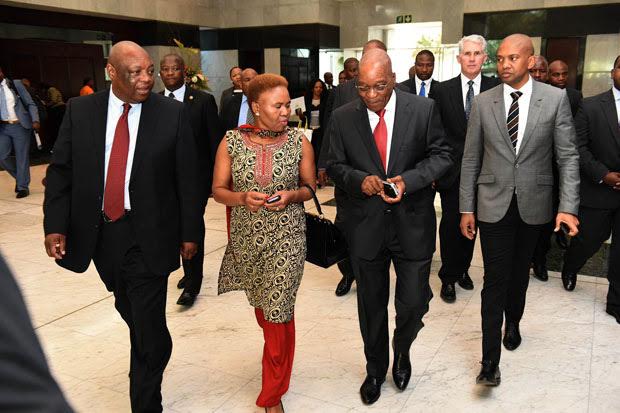
Minister Zulu (with green headscarf) meets with young entrepreneurs features in Forbes Africa, 7 Jun 2016. Photos courtesy of South African Government

Demanding Change

Minister Zulu has taken on the charge and challenge to start demanding change to bring those who have been excluded into the mainstream economy. “Whites can no longer develop just for themselves.”

If they won’t come to the meetings with the President, she will go to them. Last month she met with Mercedes Benz South Africa which launched its C-Class sedan production factory in 2014. The agenda focused on programs to include black-owned SMEs in the supply chain design. In June, she met with Pick-n-Pay to discuss building a local mall economy into townships. This summer she talked to cashew farmers in rural villages to introduce a new education program on how to export to the world markets.

Credit Record

Watch out big banks; she has plans. “The banks won’t lend without a credit record and have not put into place innovative programs to do business with the country’s majority who don’t have one,” says Zulu, adding that the solution is to create a competitive alternative by calling for black-owned banks. Goldman Sachs confirms that the South African economy could grow by five percent over the next five years if the government and private sector invest R12 billion into 300,000 black-owned small businesses.

“Blacks will never be able to compete for a loan when compared to an application from a white-owned business who has been enriched with generations of wealth.”

Restless Voters

Yes, most of this new heavy lifting with the private sector comes in light of recent elections where the opposition Democratic Alliance (DA) won big in three of the country’s main urban centers with the mantra jobs, job, jobs. A huge upset, though it can be argued that some restless voters admittedly had no clue that the co-founder of DA was part of the Apartheid regime and that the party has historically been supported by the majority of white South Africans.

Shared Prosperity

“The ANC is working towards shared prosperity and transformative inclusive growth,” says Zulu, acknowledging that if the ANC knew the private sector was not supportive of economic empowerment “for all” following the historic 1994 elections, it would have done things differently.

“The DA promises jobs but what kind of jobs are they?” Answer: Not the wealth enrichment ones whites want. “To improve our economy and prevent civil unrest, we must deliver real opportunity for blacks not just whites,” adding, “If this country will burn, it will be burning for everyone.”

|TAP | Africa’s Newspaper of Record

The AfricaPaper: Sana Butler is an award winning author and former Newsweek correspondent. She has written for Wall Street Journal and New York Times magazine.

$100 Million Play Smart. Play Safe Sham

0


The U.S. Football League’s $100 Million Play Smart. Play Safe Initiative a Sham, says Internationally recognized pathologist, Dr. Bennet Ifeakandu Omalu. Dr. Omalu, known as “the Concussion Doctor,” tells Westminster College symposium attendees the NFL has no credibility in medical research.

By The AfricaPaper | USA

FULTON, MO – The forensic pathologist who identified and named a brain disease directly related to high impact sports called the National Football League’s just-announced Play Smart. Play Safe initiative a sham during a lecture Thursday, Sept. 15, at Westminster College‘s two-day Hancock Symposium.

Window Dressing

“It’s just window dressing, a marketing gimmick,” Nigerian-born Dr. Bennet Ifeakandu Omalu told about 1,200 symposium attendees late Thursday afternoon. “The NFL is a corporation and its owners are out to make money. The NFL is not a medical or research organization.”

The NFL announced Wednesday that it would commit $100 million in a Play Smart. Play Safe initiative “to drive progress in the prevention, diagnosis and treatment of head injuries, enhance medical protocols, and further improve the way the game is taught and played.” The pledge included paying for independent medical research and engineering advancements, and “a commitment to look at anything and everything to protect our players and make the game safer.”

Damage Done

Dr. Bennet Ifeakandu Omalu. Photo: © Kristi Foster/The AfricaPaper

“But nothing will change,” said Omalu, who discovered and named Chronic Traumatic Encephalopathy (CTE), a progressive, irreversible, degenerative disease in people – mostly athletes – who have had a severe blow or repeated blows to the head. Its symptoms can appear as many as 40 years after the damage was done, he added. Omalu, who was portrayed by actor Will Smith in the 2015 movie Concussion, also told the audience how the NFL “professionally ostracized” him and tried to discredit him when he discovered and announced CTE.

“Furthermore, based on what we now know, children under the age of 18 should not be allowed to play football, hockey, box, wrestle or participate in other contact sports,” he said, because such body contact can literally rattle the youths’ brains “that are like floating balloons inside their skulls.”

Omalu, a member of the Igbo (or Ibo) tribe, is the Chief Medical Examiner of San Joaquin County, CA, and also serves as a Clinical Professor and Associate Physician Diplomate at the University of California-Davis Medical Center, Department of Medical Pathology and Laboratory Medicine.

Courageous Scholar

He said he has performed more than 8,000 autopsies during his career, and said “I have never performed an autopsy on an American football player and not found CTE.”

His comments during the Green Lecture, an annual Westminster Hancock Symposium highlight, were met with a standing ovation by the audience.

One near-front row symposium attendee, former Kansas City Chiefs football team quarterback Bill Kenney (1979-1988), of Kansas City, MO, told the audience during a question-and-answer session that he fully agreed with Omalu, and said he appreciated Omalu’s continued efforts to raise awareness about CTE

During his introduction, Omalu was described by fellow Nigerian and Westminster College President Dr. Benjamin Ola. Akande as “one of America’s finest minds, a tenacious researcher, a courageous scholar, a drum major for the truth, and one of the most amazing and inspiring individuals alive today.”

International Experts

A t is shown in the water.

Westminster College President Dr. Benjamin Ola. Akande

In addition to Omalu, the symposium – titled “Audacious Ingenuity: Pushing the Boundaries of Science” – included lectures by Dr. Mario Livio, a noted astrophysicist who worked behind the Hubble Telescope for 24 years; Dr. Francis Ali-Osman, a world leader in cancer research; Dr. Tyrone B. Hayes, whose research concludes pesticides and other chemicals cause adverse health issues; and, Dr. Norman Lederman, an internationally known expert with the Illinois Institute of Technology, who discussed teacher and student concepts of science and scientific inquiry.

Other lecturers were Dr. Sharon Deem, a wildlife veterinarian and epidemiologist at the St. Louis Zoo; Dr. Jim Carrington, president of the Donald Danforth Plant Science Center in St. Louis; and, Dr. Hakeem Oluseyi, who is working on the 100 Year Starship Project, laying the groundwork for the first human mission to a nearby star system.

Academic Experience

Presented by Westminster’s Churchill Institute of Global Engagement, the Hancock Symposium is one of the college’s signature academic experiences, bringing in national and international leaders and experts to educate, inspire and challenge students on a subject of global significance. All sessions are free and open to the public.

The AfricaPaper: This article is produced in collaboration with Westminster College‘s Hancock Symposium.