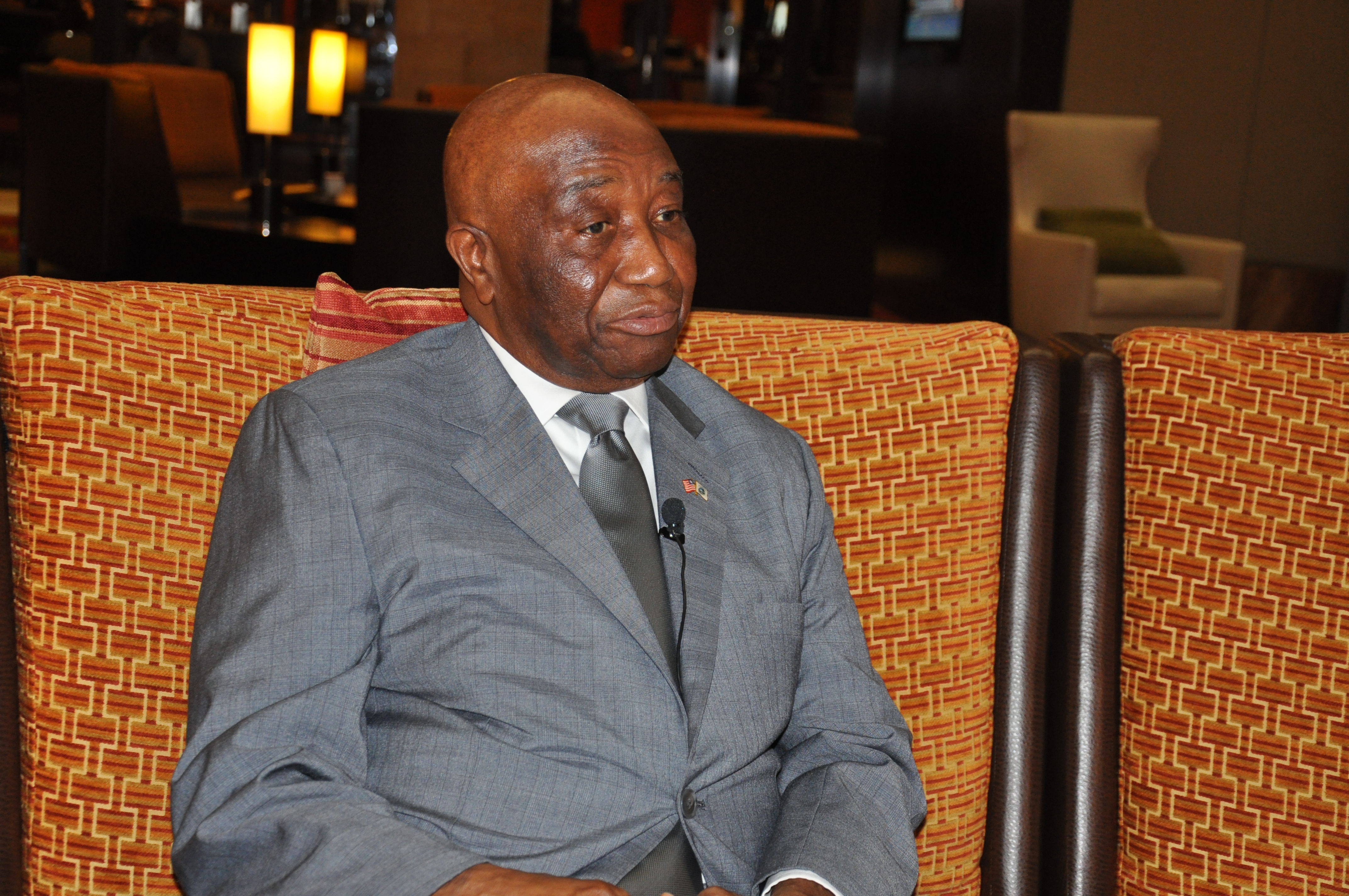
Brooklyn Park, Minn – Liberian Vice President, Joseph N. Boakai, has arrived in the Twin Cities, home to more than 30,000 people of Liberian descent in the US.
The Vice President, who arrived in the Twin Cities on Wednesday on a week-long visit, will among other things meet with a cross section of Liberians in a Town Hall meeting on Friday at the Brooklyn Park City Hall.
VISIT
Mr. Boakai is the highest ranking Liberia official to visit the Twin Cities since the Ebola crisis that ravaged the West African country. Accordingly, he will speak on the country’s post Ebola recovery and the current state of affairs in the Country.
In a brief interview with The AfricaPaper, Hon. Boakai expressed his government’s gratitude to Liberians in Minnesota as well as international partners in the Twin Cities for their various role in fighting Ebola in Liberia.
OUTBREAK
The Ebola outbreak in West Africa, which was first reported in March 2014, rapidly became the deadliest occurrence of the disease since its discovery in 1976. More than 11, 000 people died as a result of the outbreak. Liberia suffered the highest casualties with more than 4,800 fatalities in the country, according to the Centers for Disease Control and Prevention.
Liberia was declared free of the Ebola virus for the second time in early September by the World Health Organization and entered a 90-day period of heightened surveillance aimed at preventing a re-emergence of the disease.
DISCUSSION
While in the Twin Cities, the Vice President will hold discussions with State and local officials including Governor Mike Dayton and the Mayors of Brooklyn Park and Brooklyn Center; two cities with predominant Liberian population.
DINNER
Meanwhile, the Patriots for Liberia’s Transformation, an interest group comprising volunteers, Liberians and friends of Liberia are planning a private dinner in honor of Vice President Boakai. According to Mrs. Georgette Gray, Coordinator of the Minnesota Chapter of the Patriots, funds raised from the dinner, which will take place on Sunday, Oct. 25 at the Passion Events Center in Fridley, will be used to transport Medical and Emergency supplies to Liberia.
Among individuals and groups expected to attend the dinner are Governor Mark Dayton, state and local officials, Liberia’s Ambassador to the United States. Hon. Jeremiah Solunteh, Liberia’s Acting Consul General in Minnesota, Hon Jackson George, Executives of the Organization of Liberians in Minnesota, Liberians and friends of Liberia.|TAP|Africa’s Newspaper of Record.
Guinea, in West Africa, is one of the world’s poorest countries. The iron ore buried inside the Simandou range may be worth a hundred and forty billion dollars.
Untapped Iron
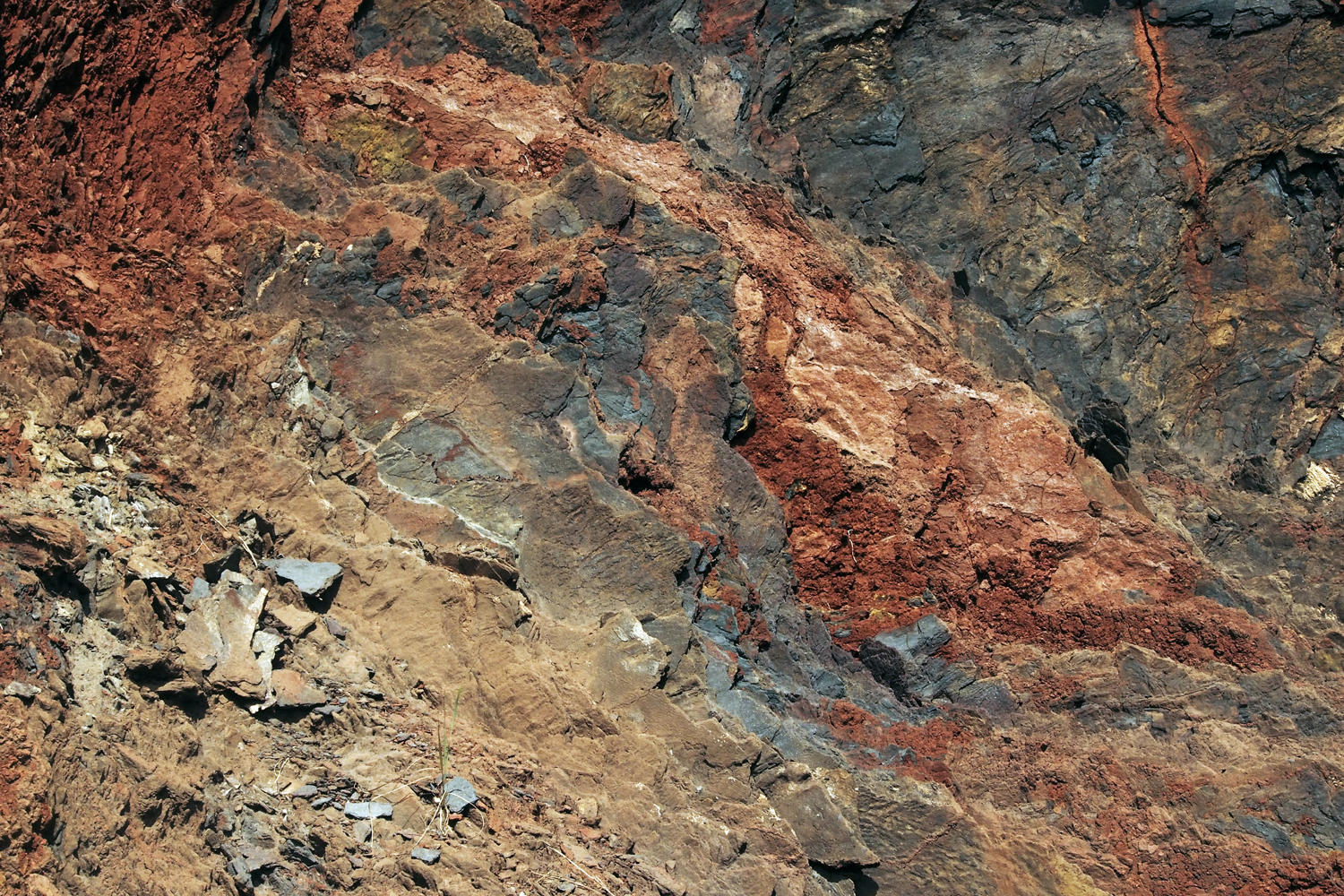
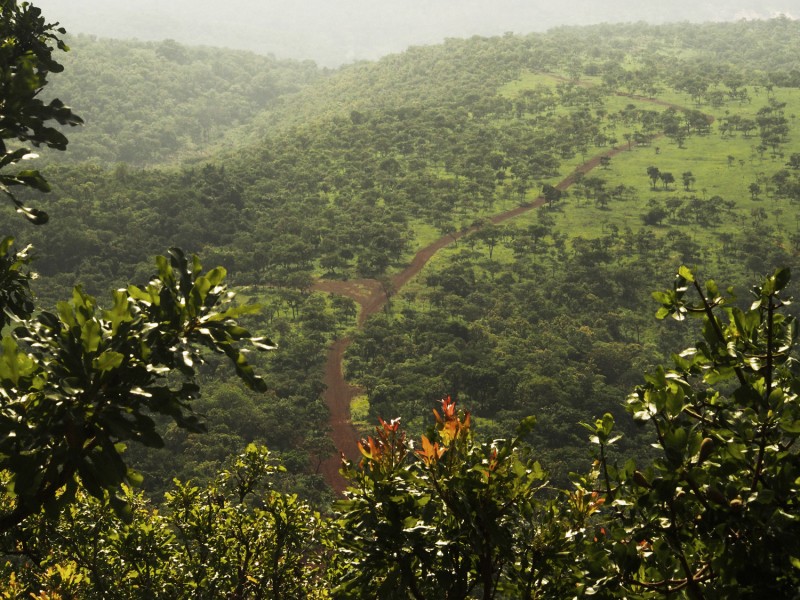
One of the world’s largest known deposits of untapped iron ore is buried inside a great, forested mountain range in the tiny West African republic of Guinea. In the country’s southeast highlands, far from any city or major roads, the Simandou Mountains stretch for seventy miles, looming over the jungle floor like a giant dinosaur spine. Some of the peaks have nicknames that were bestowed by geologists and miners who have worked in the area; one is Iron Maiden, another Metallica. Iron ore is the raw material that, once smelted, becomes steel, and the ore at Simandou is unusually rich, meaning that it can be fed into blast furnaces with minimal processing. During the past decade, as glittering mega-cities rose across China, the global price of iron soared, and investors began seeking new sources of ore. The red earth that dusts the lush vegetation around Simandou and marbles the mountain rock is worth a fortune.
Huge Amount of Capital
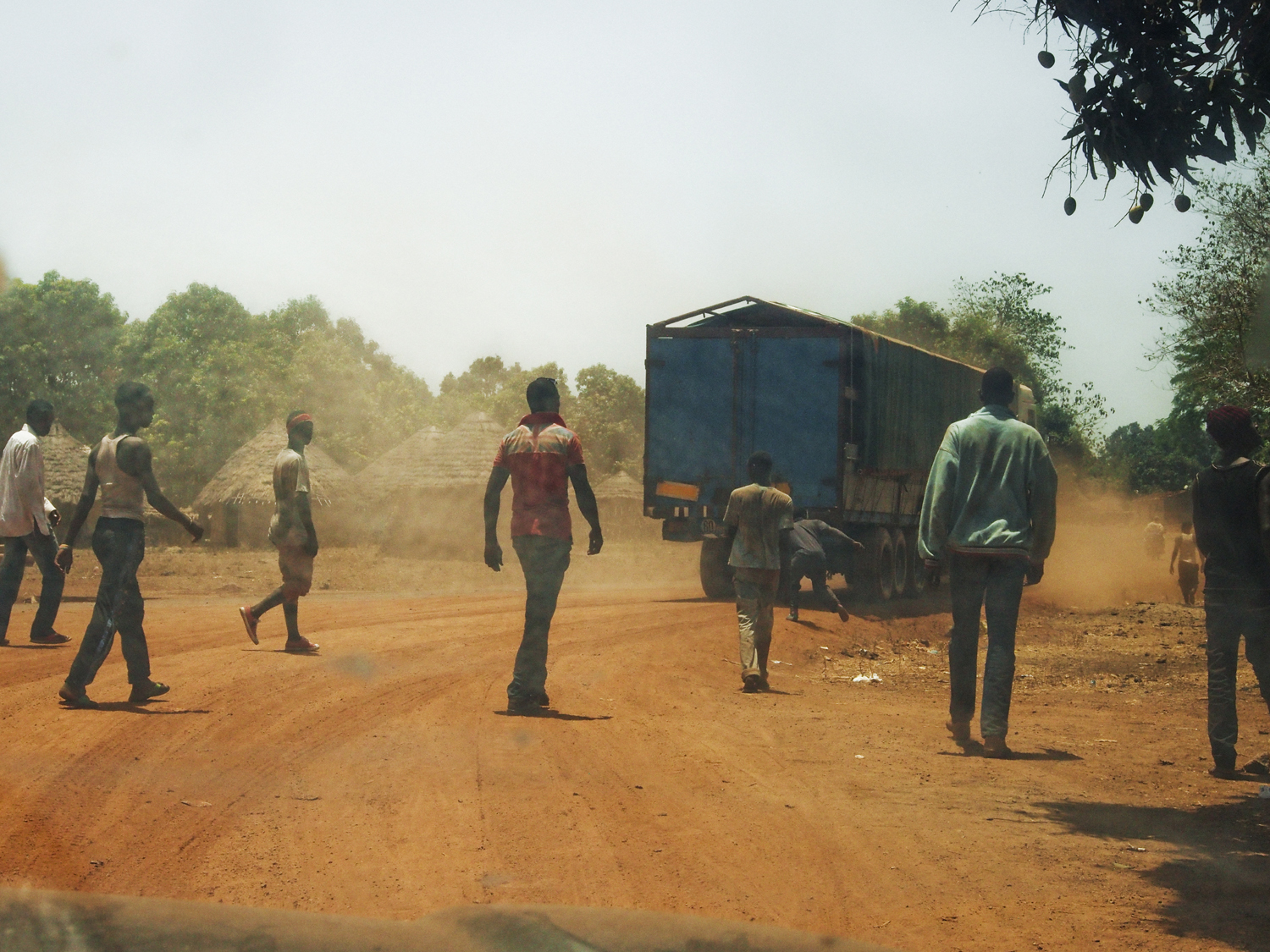
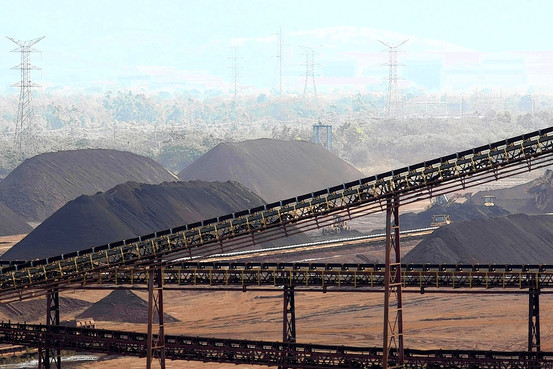
Mining iron ore is complicated and requires a huge amount of capital. Simandou lies four hundred miles from the coast, in jungle so impassable that the first drill rigs had to be transported to the mountaintops with helicopters. The site has barely been developed–no ore has been excavated. Shipping it to China and other markets will require not only the construction of a mine but the building of a railroad line sturdy enough to support freight cars laden with ore. It will also be necessary to have access to a deepwater port, which Guinea lacks.
Guinea is one of the poorest countries on the planet. There is little industry and scarce electricity, and there are few navigable roads. Public institutions hardly function. More than half the population can’t read. “The level of development is equivalent to Liberia or Sierra Leone,” a government adviser in Conakry, Guinea’s ramshackle seaside capital, told me recently. “But in Guinea we haven’t had a civil war.” This dire state of affairs was not inevitable, for the country has a bounty of natural resources. In addition to the iron ore in the Simandou range, Guinea has one of the world’s largest reserves of bauxite–the ore that, twice refined, makes aluminum–and significant quantities of diamonds, gold, uranium, and, off the coast, oil.
“A New Scramble for Africa”
As wealthy countries confront the prospect of rapidly depleting natural resources, they are turning, increasingly, to Africa, where oil and minerals worth trillions of dollars remain trapped in the ground. By one estimate, the continent holds thirty per cent of the world’s mineral reserves. Paul Collier, who runs the Center for the Study of African Economies, at Oxford, has suggested that “a new scramble for Africa” is under way. Bilateral trade between China and Africa, which in 2000 stood at ten billion dollars, is projected to top two hundred billion dollars this year. The U.S. now imports more oil from Africa than from the Persian Gulf.
The Western world has always thought of Africa as a continent to take things from, whether it was diamonds, rubber, or slaves. This outlook was inscribed into the very names of Guinea’s neighbor Côte d’Ivoire and of Ghana, which was known to its British masters as the Gold Coast. During the Victorian period, the exploitation of resources was especially brutal; King Leopold II, of Belgium, was so rapacious in his pursuit of rubber that ten million people in the Congo Free State died as a result. The new international stampede for African resources could become another grim story, or it could present an unprecedented opportunity for economic development. Collier, who several years ago wrote a best-seller about global poverty, “The Bottom Billion,” believes that, for countries like Guinea, the extraction of natural resources, rather than foreign aid, offers the greatest chance of economic progress. Simandou alone could potentially generate a hundred and forty billion dollars in revenue over the next quarter century, more than doubling Guinea’s gross domestic product. “The money involved will dwarf everything else,” Collier told me. Like the silver mine in Joseph Conrad’s novel “Nostromo,” the Simandou deposit holds the promise of supplying what Guinea needs most: “law, good faith, order, security.”
Enter Rio Tinto
As with deepwater oil drilling or with missions to the moon, the export of iron ore requires so much investment and expertise that the business is limited to a few major players. In 1997, the exclusive rights to explore and develop Simandou were given to the Anglo-Australian mining giant Rio Tinto, which is one of the world’s biggest iron-ore producers. In early 2008, Tom Albanese, the company’s chief executive, boasted to shareholders that Simandou was, “without doubt, the top undeveloped tier-one iron-ore asset in the world.” But shortly afterward the government of Guinea declared that Rio Tinto was developing the mine too slowly, citing progress benchmarks that had been missed, and implying that the company was simply hoarding the Simandou deposit–keeping it from competitors while focusing on mines elsewhere.
In July, 2008, Rio Tinto was stripped of its license. Guinean officials then granted exploration permits for half of the deposit to a much smaller company: Beny Steinmetz Group Resources, or B.S.G.R. Beny Steinmetz is, by some estimates, the richest man in Israel; according to Bloomberg, his personal fortune amounts to some nine billion dollars. Steinmetz, who made his name in the diamond trade, hardly ever speaks to the press, and the corporate structures of his various enterprises are so convoluted that it is difficult to assess the extent of his holdings. The Simandou contract was a surprising addition to Steinmetz’s portfolio, because B.S.G.R. had no experience exporting iron ore. A mining executive in Guinea told me, “Diamonds you can carry away from the mine in your pocket. With iron ore, you need infrastructure that can last decades.”
Rio Tinto angrily protested the decision. “We are surprised that a company that has never built an iron-ore-mining operation would have been awarded an area of our concession,” a spokesman said at the time. Company officials complained to the U.S. Embassy in Conakry; one of them suggested that Steinmetz had no intention of developing the mine himself, and planned instead to flip it–”to obtain the concession and then sell it for a big profit.” Rio Tinto viewed Steinmetz, who was rumored to have extensive contacts in Israeli intelligence, as a suspicious interloper. According to a diplomatic cable released by WikiLeaks, the general manager of Rio Tinto told the U.S. Embassy that he did not feel comfortable discussing the Simandou matter on an “unsecured” cell phone. Alan Davies, a senior executive at Rio Tinto, told me that the company had invested hundreds of millions of dollars at the site, and had been moving as expeditiously as possible on a project that would have required decades to complete. “This was quite a shocking event for the company,” he said.
In April, 2009, the Ministry of Mines in Conakry ratified the agreement with Steinmetz. A year later, he made a deal with the Brazilian mining company Vale–one of Rio Tinto’s chief competitors. Vale agreed to pay two and a half billion dollars in exchange for a fifty-one-per-cent stake in B.S.G.R.’s Simandou operations. This was an extraordinary windfall: B.S.G.R. had paid nothing up front, as is customary with exploration licenses, and at that point had invested only a hundred and sixty million dollars. In less than five years, B.S.G.R.’s investment in Simandou had become a five-billion-dollar asset. At that time, the annual budget of the government of Guinea amounted to just $1.2 billion. Mo Ibrahim, the Sudanese telecom billionaire, captured the reaction of many observers when he asked, at a forum in Dakar, “Are the Guineans who did that deal idiots, or criminals, or both?”
Steinmetz was proud of the transaction. “People don’t like success,” he told the Financial Times, in a rare interview, in 2012. “It’s disturbing to people that the small David can disturb the big Goliath.” He said that it was B.S.G.R.’s strategy to pursue “opportunities in an aggressive way,” adding, “You have to get your hands dirty.”
Concession Through Bribes
In Conakry, there were rumors that Steinmetz had acquired the concession through bribes. According to Transparency International, Guinea is one of the most corrupt countries on earth. A Human Rights Watch report suggested that, when Steinmetz acquired his parcel of Simandou, Guinea was effectively a kleptocracy, with its leaders presiding over “an increasing criminalization of the state.” A recent report by the Africa Progress Panel, which is chaired by Kofi Annan, suggests that well-connected foreigners often purchase lucrative assets in Africa at prices far below market value, by offering inducements to predatory local élites. “Africa’s resource wealth has bypassed the vast majority of African people and built vast fortunes for a privileged few,” it says. The report highlights the billions of dollars that Vale agreed to pay Steinmetz for Simandou, noting that “the people of Guinea, who appear to have lost out as a result of the undervaluation of the concession, will not share in that gain.”
In 2010, several months after the Vale deal was announced, Guinea held its first fully democratic elections since independence, ending half a century of authoritarian rule. The new President, Alpha Condé, had run on a platform of good governance and greater transparency in the mining sector. But as he took office he faced the possibility that Guinea’s most prized mineral asset may have been traded out from under the country. He could not simply void the contract. “There is continuity of the state,” he told me recently. “I couldn’t put things back where they had been–unless I had right on my side.” B.S.G.R. denied any wrongdoing: “These allegations are false, and are a smear campaign against B.S.G.R.,” a company spokesman told me. If the Simandou license had been secured through bribery, then the deal could potentially be undone. But Condé and his advisers would have to prove it.
Condé and his Advisers
“I inherited a country but not a state,” Condé told me when I first met him, in January. He had come to the Swiss Alps to attend the World Economic Forum, in Davos, and we met in a hotel suite that was bathed in sunlight reflecting off the snowbanks outside. Condé is a tall man with a high forehead, and he has small eyes that light up with wry amusement when he listens. He wore a brown suit and a red tie. Lowering himself into a wingback chair, he listed slightly to the right while we talked, in a posture of heavy-lies-the-crown fatigue. At times, his elbow appeared to be propping up his whole body, like a tent pole.
When he was elected President, Condé was seventy-two years old, and he had spent much of his life in exile. He left Guinea as a boy, when it was still ruled by France, and eventually settled in Paris, where he became a leader of the pan-African student movements of the nineteen-sixties. He studied law, lectured at the University of Paris, and emerged as perhaps the most famous member of the Guinean opposition. For this distinction, he was sentenced to death, in absentia, by the first despot to rule an independent Guinea, and jailed for more than two years by the second, after he returned, in 1991, to run, unsuccessfully, for President. The 2010 election was bitter–his challenger, Cellou Dalein Diallo, had been a government minister when Condé was thrown in jail. After Condé was finally inaugurated as President, he pledged to be the Nelson Mandela of Guinea.
“State of Anarchy.”
GUINEA – State of Anarchy
First, he told me, he had to confront the legacy of a decades-long “state of anarchy.” The government in Conakry had a Potemkin quality: a profusion of bureaucrats showed up for work at crumbling administrative buildings, but there was little genuine institutional capacity. “The central bank, they were printing counterfeit money,” Condé said. Yet he couldn’t fire every official; he’d have to make do with a civil service that had never known anything but graft. “Almost everybody who had any expertise was compromised,” one person who has advised Condé told me. “So he had to balance between people who were competent but compromised and people who were upstanding but inexperienced.”
Condé was defensive about the fact that he had spent so much of his life abroad; when I raised the subject, he snapped, “I know Guinea better than those who have never left.” But his outsider status meant that he was not implicated in the scandals of past administrations. And, having spent much of his life in France, he was strikingly at ease in places like Davos. The U.S. Ambassador in Conakry, Alex Laskaris, told me, “Condé has a much broader circle of contacts and advisers globally than any other African head of state I’ve dealt with.” Bernard Kouchner, the former foreign minister of France, went to high school with Condé, and is a good friend. Kouchner introduced him to George Soros, the billionaire financier, who became an informal adviser, and connected him with Paul Collier, the Oxford economist. Collier, in turn, introduced Condé to Tony Blair, who offered him assistance through an organization that he runs, the Africa Governance Initiative.
Opportunity to Save Guinea
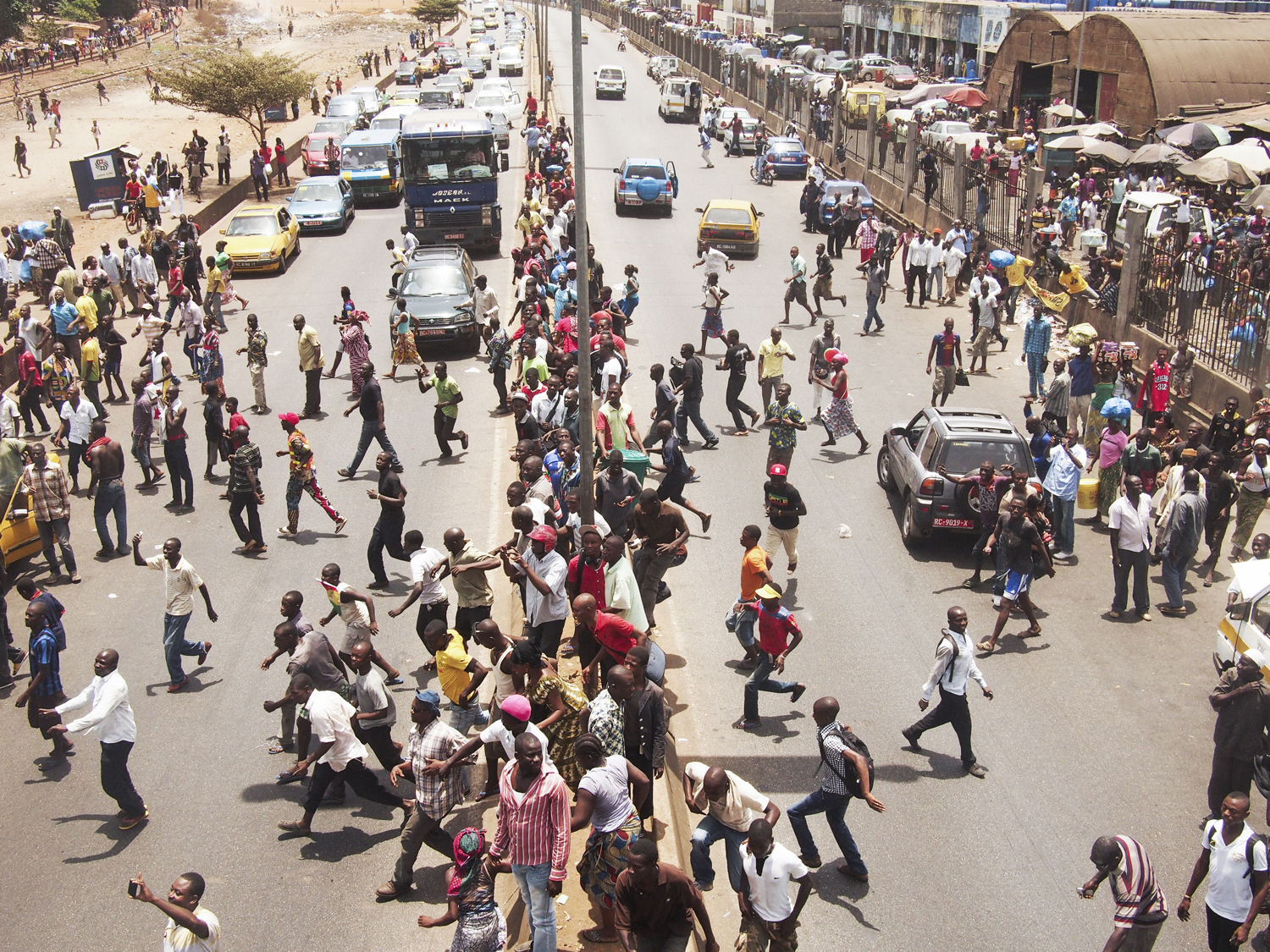
These Westerners saw in Condé an opportunity to save Guinea. Collier told me that what the country needed above all was “integrity at the top.” Condé could be ornery; he had a tendency to lecture his interlocutors as though they were students. And, after a life spent in perpetual opposition, it was not clear how well he would govern. From the start, he had difficulties. He came into office with a commitment to complete Guinea’s democratic transition by holding parliamentary elections, but he delayed them, ostensibly on procedural grounds, then delayed them again. Opposition riots broke out in Conakry, leading to a series of violent confrontations between demonstrators and government security forces.
For all the tumult, Condé’s foreign friends and advisers maintain faith in his ethics. “He is absolutely incorruptible,” Kouchner told me. “He’s not luxurious. He’s not travelling. He is having a cold potato at night!” Corinne Dufka, a senior researcher at Human Rights Watch, has not lost hope that Condé can succeed as a reformer. “There’s a lot of work to be done for Guinea to overcome its legacy of abusive rule,” she said. “Power remains too heavily concentrated in the executive, and, without a robust judiciary or a democratically elected parliament, there is next to no oversight, which they desperately need. But Condé has made real progress in confronting the disastrous governance and rights problems he inherited.”
Kind of Triage
It is no easy task to transform a country that is corrupt from top to bottom. During Condé’s first months in office, he performed a kind of triage. With the assistance of Revenue Watch–an organization, backed by Soros, that encourages transparency in extractive industries–Condé established a committee to inspect existing mining contracts and determine if any of them were problematic. He didn’t know Steinmetz–”I didn’t know any miners,” he said, with pride–but there were elements of the Simandou deal that appeared to warrant an investigation. “I found it a bit strange that they had invested a hundred and sixty million dollars and were going to earn billions,” Condé said. “It’s a little . . .” He smiled and gave a Gallic shrug.
“A One-man Show”
Beny Steinmetz
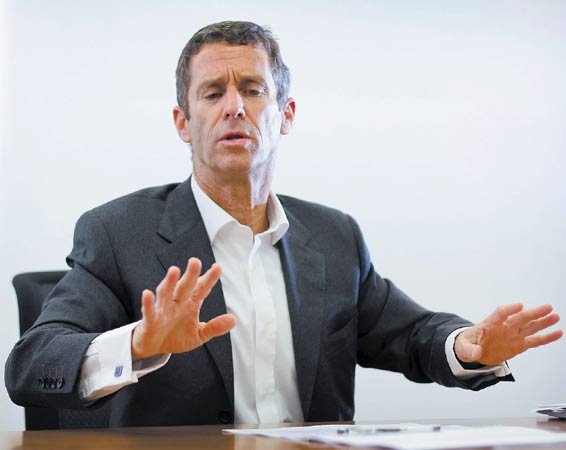
Beny Steinmetz, who is fifty-six, does not seem to live anywhere in particular. He shuttles, on his private jet, between Tel Aviv (where his family lives, in one of the most expensive houses in Israel), Geneva (where he technically resides, for tax purposes), London (where the main management office of B.S.G.R. is situated), and far-flung locations connected to his diamond and mineral interests, from Macedonia to Sierra Leone. He is technically not an executive of the conglomerate that bears his name, but merely the chief beneficiary of a foundation into which the profits flow. This is a legal fig leaf. Ehud Olmert, the former Prime Minister of Israel and a friend of his, described Steinmetz as “a one-man show.” Olmert continued, “I don’t quite understand the legal aspects–just know that he can work ceaselessly and will move from one side of the globe to the other if he identifies a promising deal.” Steinmetz is very fit and exercises every day, no matter where he is. With blue eyes, tousled sandy hair, a preference for casual dress, and a deep tan, he looks more like a movie agent than like a magnate.
“The Steinmetz Diamond Story”
“I grew up in a home where diamonds were the subject,” Steinmetz has said. His father, Rubin, was a Polish diamond cutter who learned the business in Antwerp before settling in Palestine, in 1936. A family photograph from 1977 captures Beny as a young man, sitting at a cluttered table with his two older brothers and his father, who looks sternly at the camera while Beny inspects a precious stone. That year, Beny finished his military service and struck out for Antwerp, with instructions to expand the company’s international business in polished stones. According to a privately published history of the family business, “The Steinmetz Diamond Story,” Beny branched into Africa, in search of new sources of rough stones. The plan wasn’t to establish mines but, rather, to make deals with the people doing the digging.
Approximately half the diamonds in the world originate in sub-Saharan Africa, and many ambitious Westerners have followed the lead of Cecil Rhodes–the founder of De Beers–and sought fortunes on the continent. “Unfortunately, there aren’t any diamond mines in Piccadilly,” Dag Cramer, who oversees Steinmetz’s business interests, told me. “That’s not where God put the assets.”
Underdevelopment and Corruption and War
Instead, diamonds tend to be found in countries that are plagued by underdevelopment and corruption and, often, by war. This is enough to scare off many investors, but not all; some entrepreneurs are drawn to the heady combination of political uncertainty, physical danger, and potentially astronomical rewards. Ambassador Laskaris, who has done tours in Liberia and Angola, likened the diamond trade in much of Africa to the seedy cantina in “Star Wars.” “It attracts all the rejects of the galaxy,” he said. “Low barriers to entry. It rewards corruption. It also rewards a little bit of brutality.”
“A Multi-faced Empire”
Steinmetz plunged into Africa’s treacherous political waters. In the nineteen-nineties, he was the largest purchaser of diamonds from Angola; later, he became the biggest private investor in Sierra Leone. Today, Steinmetz is the largest buyer of rough diamonds from De Beers, and one of the major suppliers of Tiffany & Company. And he has diversified his holdings into real estate, minerals, oil and gas, and other fields, with interests in more than twenty countries. A Web site that Steinmetz recently set up describes him as a “visionary” who used a “network of contacts on the African continent” to build “a multi-faced empire.”
Paul Collier, however, takes a dim view of businessmen like Steinmetz, who have secured the rights to natural resources that they may not actually have the expertise to develop. “Their technical competence is a social-network map,” Collier said. ” ‘Who has the power to make the decision? Who can I reach?’ They know how to get a contract–that is their skill.” (Cramer rejected this characterization, insisting that Steinmetz makes sustainable investments wherever he operates. “B.S.G.R. is not a company that has ever been in the business of obtaining rights and flipping them,” he told me.)
“His family is all he cares about–and his business”
Despite his great wealth, Steinmetz has maintained an exceptionally low profile. Last year, after “Hamakor,” a news program on Israeli television, devoted an episode to a battle that he was having with tax authorities in Tel Aviv, he threatened legal action and succeeded in blocking the program from being posted on the Internet. “He’s a very private guy,” Alon Pinkas, a friend of Steinmetz’s who once served as Israel’s consul-general in New York, told me. “His family is all he cares about–and his business.”
Steinmetz’s diamond business, however, has occasionally engaged in some creative publicity. The company sponsors Formula 1 events, sometimes furnishing drivers with diamond-encrusted helmets and steering wheels. At a 2004 race in Monaco, a large Steinmetz diamond was affixed to the nose of a Jaguar race car. As the vehicle tore around a hairpin curve, the driver lost control and the Jaguar slammed into a guardrail. The diamond, which was reportedly a hundred and eight carats and worth two hundred thousand dollars, was never recovered.
“Thieves”
General Lansana Conté, the dictator who ruled Guinea before Alpha Condé became President, was famously corrupt: he referred to his ministers, not without affection, as “thieves,” and once remarked, “If we had to shoot every Guinean who had stolen from Guinea there would be no one left to kill.” By 2008, after more than two decades in power, he had become ill, and had largely stopped appearing in public; when he did, he was propped up by bodyguards and orbited by adjutants who often made a show of stooping to whisper in his ear, even when it was obvious, to a close observer, that he was asleep.
During this period, Steinmetz flew to Conakry and met with Conté. At the General’s compound, they sat and talked beneath a mango tree. Conté was aware of B.S.G.R. because it had acquired the rights to explore two small parcels of land abutting the Simandou range–places where others in the mining industry had not thought to look. In 2006, one of Steinmetz’s employees called him from the top of a mountain, using a satellite phone, and said, “Beny, you cannot believe. I’m standing on so much iron here, you have no idea.” After this success, General Conté began to entertain the idea of reapportioning the Simandou deposit. It was not long after he met Steinmetz that he stripped Rio Tinto of its claim and gave B.S.G.R. a license to explore half the Simandou range. Two weeks after General Conté signed the deal, he died.
Erratic Young Army
Hours later, a military coup installed an erratic young Army captain, Moussa Dadis Camara. The junta was a nightmarish period for Guinea. In September, 2009, during an opposition rally at a stadium in Conakry, government soldiers massacred more than a hundred and fifty demonstrators. The U.S. evacuated most of its staff from the Embassy, and the International Criminal Court described the violence as a crime against humanity. But B.S.G.R. stayed put. On one occasion, Steinmetz flew in with two of his sons to meet Captain Dadis. They invited him to Israel to attend the wedding of Steinmetz’s daughter–a celebration with more than a thousand guests. (Dadis sent his regrets.)
To Steinmetz, this cultivation of the junta only proved his company’s unshakable commitment to Guinea. “We put money in the ground at a time when people thought we were crazy,” he told the Financial Times. B.S.G.R. and the junta eventually came to terms over how the company would export iron ore. It did not have to build a deepwater port or a railroad capable of carrying iron ore to Guinea’s coast. Instead, B.S.G.R. could pursue a cheaper option: exporting the ore through Liberia, which already had the necessary infrastructure. For years, the government of Guinea had resisted such a scenario when Rio Tinto had proposed it. As a concession, B.S.G.R. agreed to spend a billion dollars developing a passenger railway for Guinea.
Two-and-a-half-billion-dollar
In December, 2009, an aide shot Captain Dadis in the head. He survived, and fled the country; another interim government took over. Once again, Steinmetz weathered the chaos, and in April, 2010, he flew to Rio de Janeiro to finalize the two-and-a-half-billion-dollar deal with Vale. Afterward, he stopped at a shipyard in Chile, to check on the progress of a mega-yacht that he had commissioned to be built there.
When President Condé set out to clean up Guinea’s mining industry, he discovered a generous ally in George Soros. “I was aware of the magnitude of the problem in Guinea,” Soros told me. “I was eager to help.” He enlisted Revenue Watch to provide technical support in revising the mining code. He also suggested that Guinea hire Scott Horton, an attorney at the U.S. law firm D.L.A. Piper; Horton has conducted dozens of corruption investigations around the world.
“There was no way, going up against a guy like Steinmetz, that the Condé government could compete effectively without outside help,” Horton told me. Another difficulty was that so many government officials had held prominent roles in prior regimes. “I can’t task my gendarmerie to do the investigation,” Condé observed to his advisers. “They’ll come up with members of their own families.”
Investigating the Simandou Deal
In the spring of 2011, Horton began to investigate the Simandou deal. For assistance, he turned to a man named Steven Fox, who runs a risk-assessment company, in New York, called Veracity Worldwide. When corporations want to do business in countries that suffer from political instability and corruption, Veracity can help them assess if such an investment would be prudent–and viable without breaking the law.
Fox is in his forties, with the bearing of a man who feels most comfortable in a suit. He speaks softly, enunciating each syllable. At a recent meeting at his office, in midtown Manhattan, he told me that until 2005 he had worked for the State Department, and had spent time as a foreign-service officer in Africa. According to Eamon Javers’s “Broker, Trader, Lawyer, Spy,” a 2011 book about the private-intelligence industry, Fox actually worked for the C.I.A. As we sat down to talk, I noted a bookshelf that was heavy on le Carré and Furst.
Parcel of Simandou
Steinmetz’s Man in Guinea
When Guinean government officials began looking into the Simandou contract, Fox told me, they had no evidence of malfeasance. “They only heard the rumors on the street,” he said. Fox had met Steinmetz once, in London, and had found him quiet and unassuming, but his understanding was that Steinmetz enlisted employees to pave the way for him–”pointy-end-of-the-spear forward-reconnaissance people.” Fox decided that his first essential task was to identify Steinmetz’s man in Guinea.
He soon pinpointed a candidate: Frédéric Cilins, a tanned, gregarious Frenchman, with thinning hair, who lived on the Riviera, near Cannes, but spent a lot of time in Africa. He had served as a scout for B.S.G.R. in Guinea. When I asked Fox how he had learned of Cilins, his response was enigmatic: “We knew a circle of people who knew a circle of people.”
Fox said of Cilins, “He’s an operator–that’s the best way to describe him.” His role at B.S.G.R. was to accumulate relationships and identify relevant power structures. In that respect, Fox realized, Cilins was not so different from him: they both excelled at parachuting into foreign countries and figuring out what “makes them tick.” (Cilins declined to comment for this article.)
One day in the fall of 2011, Fox flew to Paris and met with Cilins. They had been introduced by a mutual acquaintance; as Cilins understood it, Fox was working on behalf of a client who wanted to know how B.S.G.R. had secured the Simandou deal. Fox told me that, unlike some corporate-espionage outfits (and spies), Veracity does not “pretext”–employ ruses to approach a potential source. Even so, he did not acknowledge that his client was the new government of Guinea.
Fox and Cilins met in a conference room, then went to a restaurant for lunch. Cilins was affable and surprisingly candid. While Fox took notes, Cilins explained that he first visited Guinea in 2005, after a B.S.G.R. executive in Johannesburg had informed him that the company wanted to “shoot for the moon”–a phrase that Cilins took to indicate Simandou. Cilins told Fox that he spent the next six months in Conakry, staying at the Novotel, a seaside property that is popular with mining executives. He became friendly with the staff in the business center, and persuaded them to hand him copies of all incoming and outgoing faxes. In this manner, he learned details about the Conté regime’s frustration with Rio Tinto.
Gifts–MP3 Players, Cell phones, Perfumes
Each time that Cilins flew from France to Guinea, he brought gifts–MP3 players, cell phones, perfumes–which he disbursed among his contacts. They came to think of him as “Father Christmas,” he told Fox. One minister informed him that the only person who mattered in the country was General Conté–and that the way to Conté was through his four wives. (Plural marriage is tolerated in Guinea, a predominantly Muslim country.)
After further inquiries, Cilins focused on the fourth and youngest wife, Mamadie Touré–a stout, almond-eyed woman who was still in her twenties. “She was young, and she was considered very beautiful,” Fox told me. “She’s not a rocket scientist, but she had a certain dynamism. Most important, she had the ear of the President.”
Cilins hired Touré’s brother to help promote the company’s interests in Guinea, then secured an introduction to her. Not long afterward, Cilins and several associates from the company obtained an audience with the President. At this meeting, Cilins told Fox, they gave General Conté a watch that was inlaid with Steinmetz diamonds. At another meeting, they presented the Minister of Mines with a model of a Formula 1 race car that was similarly encrusted with Steinmetz bling. Soon afterward, Touré’s brother was named the head of public relations for B.S.G.R.-Guinea.
Fox shrugged when asked why Cilins had confided in him. “There’s an element of arrogance,” he said. “Or of complete naïveté. Of believing they did what they did and there was no big deal.” Cilins seemed proud of his work in Conakry. He told Fox that, in his view, the history of Guinea would henceforth be thought of as dividing into two periods–”before and after B.S.G.R.”
Bribes as Deductible Business Expense
To Cilins, giving gifts may have seemed simply like the cost of doing business in places like Guinea. Many countries aggressively prosecute domestic corruption but are much more permissive when it comes to bribes paid abroad. Until fairly recently, French firms that gave bribes in order to secure business in foreign countries could declare them as deductible business expenses.
In recent years, however, international norms have begun changing. The U.S. Justice Department has dramatically increased its enforcement of the Foreign Corrupt Practices Act; the U.K. has passed its own stringent Bribery Act; and the Organization for Economic Coöperation and Development has instituted a convention against bribery, and several dozen countries–including Israel–have signed it. Major companies, like Siemens and K.B.R., have settled corruption investigations by paying hundreds of millions of dollars in fines. (Rio Tinto, too, has contended with corruption; in 2010, four representatives of the company were convicted of accepting bribes in China.) Many multinational corporations have responded to the increased vigilance about graft by establishing robust internal-compliance departments that monitor employee behavior. B.S.G.R. says that it conducts itself ethically wherever it operates, and a company representative pointed out to me that neither Steinmetz nor his organization has ever been implicated in bribery. But B.S.G.R. does not have a compliance department, and it does not have a single employee whose chief responsibility is to monitor company behavior abroad.
Private Wealth in Africa is Held Outside the Continent
Shortly after General Conté died, Mamadie Touré fled Guinea. Fox and his colleagues discovered that she was living in Jacksonville, Florida. The World Bank estimates that forty per cent of the private wealth in Africa is held outside the continent. In a recent civil-forfeiture proceeding against the son of the dictator of Equatorial Guinea, the Justice Department documented some of his possessions: a twelve-acre estate in Malibu, a Gulfstream jet, seven Rolls-Royces, eight Ferraris, and a white glove once worn by Michael Jackson.
Jacksonville isn’t Malibu. But, when Fox and his team investigated, they discovered that Touré had purchased a McMansion on a canal there, along with a series of smaller properties in the vicinity.
Concessions are Snatched up by Foreigners
When you disembark from a plane in Conakry, the corruption hits you almost as quickly as the heat. At the airport, a uniformed officer will stop you, raising no specific objections but making it clear, with his body, that your exit from the situation will be transactional. Out on the rubble-strewn streets, which are perfumed by the garbage that clogs the city’s open sewers, the military presence is less conspicuous than in the past–security-sector reform has been a priority for Condé–but at night insouciant young soldiers position themselves at intersections, holding submachine guns; they lean into passing cars and come away with cash. In 1961, Frantz Fanon wrote of post-colonial West Africa, “Concessions are snatched up by foreigners; scandals are numerous, ministers grow rich, their wives doll themselves up, the members of parliament feather their nests and there is not a soul down to the simple policeman or the customs officer who does not join in the great procession of corruption.” This description no longer applies to the region as a whole–Ghana, for example, is a prospering democracy–but in Guinea little has changed.
“It was outsourced”
One afternoon, I went to a whitewashed building in Conakry’s administrative quarter to meet Nava Touré, a former professor of engineering whom Condé had entrusted with running the technical committee on mines. Touré (no relation to Mamadie Touré, the General’s fourth wife) has a round face, a melodious voice, and a decorous, almost ethereal, manner. During the months that I spent reporting this story, Nava Touré was one of the few officials in the government about whom I never heard even a rumor of corruption. He had been charged with establishing a new mining code that would create a more equitable balance between the interests of the mining companies and the people of Guinea. In addition, he had been asked to review all existing mining contracts and recommend whether any of them should be renegotiated or rescinded. But when he turned his focus on Simandou he had no staff of trained inspectors, so he relied on D.L.A. Piper, the law firm, and Steven Fox, the investigator. “It was outsourced,” Touré told me.
“Possible Irregularities”
Last October, he sent an incendiary letter to representatives of the joint venture between Vale and B.S.G.R., identifying “possible irregularities” in the Simandou concession. It called Frédéric Cilins “a secret proxy” for Steinmetz, raised suspicions about Cilins’s alliance with Mamadie Touré, and itemized gifts such as the diamond watch and the bejewelled model race car. The letter accused B.S.G.R. of planning all along to flip the rights to Simandou, in order “to extract immediate and substantial profits.”
Nava Touré’s accusations also implicated a man he knew: Mahmoud Thiam, who had served as the Minister of Mines under the junta that ruled Guinea after General Conté’s death. Touré had been one of Thiam’s advisers at the time. Thiam came to the job, in early 2009, with stellar credentials. After obtaining an economics degree from Cornell, he had worked as a banker at Merrill Lynch and U.B.S. Thiam was handsome, very polished, and a champion of Beny Steinmetz. In 2010, in an interview on “Closing Bell with Maria Bartiromo,” on CNBC, Thiam praised the “very aggressive junior company, B.S.G.R., that came and developed that permit to the point where it made it attractive to a big player like Vale.” Simandou, Thiam said, would “catapult the country into the No. 3 iron-ore exporter in the world.” He had attended the lavish wedding of Steinmetz’s daughter in Israel, as a representative of the junta.
“You Can’t Serve as Mining Minister Without being Accused of Corruption”
Simandou
According to Nava Touré’s letter, Thiam not only took payoffs from B.S.G.R.; he effectively worked as the company’s paymaster, meeting a corporate jet at Conakry airport, unloading suitcases full of cash, and then distributing bribes to the junta’s leaders. Steven Fox, the American investigator, had discovered that while Thiam was minister he took to driving around Conakry in a Lamborghini. Before he left office, in 2011, he bought an apartment on the Upper East Side of Manhattan, for $1.5 million, and an estate in Dutchess County, for $3.75 million. He paid for both properties with cash.
Thiam currently lives in the U.S., running an investment-advisory firm. This spring, I visited him at his elegant office, on Madison Avenue. He denied any wrongdoing. The Manhattan apartment, he explained, was paid for with money that he had made in banking. And he had bought the country estate on behalf of a Mozambican friend who was looking to invest in the U.S. (Thiam refused to name the friend.) The Lamborghini was not a sports car but a four-wheel-drive vehicle. “You can’t serve as mining minister without being accused of corruption,” he told me. He regards the review of the B.S.G.R. contract as little more than a witch hunt, but added that he still maintains the highest respect for Nava Touré.
“The Feeling of Shame”
During our meeting in the whitewashed building, I asked Touré how it made him feel to learn of such allegations about former colleagues. He paused. “The feeling of shame,” he said at last. “Because, finally, what they have got personally–let’s say ten million U.S. dollars, twelve million U.S. dollars–what does that amount to? Compared with the lives of the whole country?” The lights in the room suddenly shut off, and the air-conditioner powered down. He didn’t seem to notice. “I don’t think that it is tolerable or acceptable from the investors,” he continued. “But I’m more shocked by the attitude and the behavior of the national decision-makers.”
When B.S.G.R. received Touré’s letter, it responded aggressively, dismissing the investigation as an effort by President Condé to expropriate its asset. The company insisted that it had never given a watch to General Conté; though the story about the miniature Formula 1 car was true, the model had a value of only a thousand dollars, and B.S.G.R. routinely gave such “gifts to companies around the world.” Frédéric Cilins had worked for the company, but “B.S.G.R. never told Mr. Cilins that it ‘asked for the moon.’ ” Cilins may have distributed gifts among his contacts in Conakry, but the company denied any knowledge of them. Oddly, B.S.G.R.’s written response insisted, more than once, that Mamadie Touré had not actually been the wife of General Conté.
B.S.G.R. faulted the Condé administration for failing to name the sources of the allegations, and noted that any payments made to public officials “would be easily identified by bank transfers, payment orders, copies of checks, etc.” Again and again, B.S.G.R. returned to “the absence of the smallest amount of supporting proof.”
U.S. Easiest Country to Establish an Untraceable Shell Company
But how do you prove corruption? By its nature, corruption is covert; payoffs are designed to be difficult to detect. The international financial system has evolved to accommodate a wide array of illicit activities, and shell companies and banking havens make it easy to camouflage transfers, payment orders, and copies of checks. Paul Collier argues that there are often three parties to a corrupt deal: the briber, the bribed, and the lawyers and financial facilitators who enable the secret transaction. The result, he says, is “a web of corporate opacity” that is spun largely by wealthy professionals in financial capitals like London and New York. A recent study found that the easiest country in which to establish an untraceable shell company is not a tropical banking haven but the United States.
A Series of Legal Contracts
Richest Mountain
In the spring of 2012, one of President Condé’s ministers took a trip to Paris. At the Hilton Arc de Triomphe, he was approached by a Gabonese businessman. According to an affidavit by the minister, the Gabonese man said that he had been in contact with Mamadie Touré, and that she had provided him with documents that would be interesting to President Condé. “Madame Touré was angry with Mr. Beny Steinmetz,” the Gabonese man said. She believed that “she had been taken advantage of.”
The minister was astonished by the documents. They appeared to be a series of legal contracts, complete with signatures and official seals, between officers of B.S.G.R. and Mamadie Touré. The documents contained the signature of Asher Avidan, the head of the company’s Guinea operations. Avidan was a former member of Israel’s internal security service, Shin Bet. The contracts had been signed in Conakry in February, 2008–five months before General Conté took the Simandou concession away from Rio Tinto, and ten months before the northern half of that concession was given to Beny Steinmetz. The agreements stipulated that Touré would be granted a five-per-cent stake in the northern “blocks” of Simandou, in addition to “two (2) million” dollars, which would be paid through a shell company. In exchange, she committed “to do all that is necessary” to help B.S.G.R. “obtain from the authorities the signature for the obtaining of said blocks.”
A Contract for Bribery
An American lawyer involved in the case told me, “I’ve been involved in corporate corruption work for thirty years, and I’ve never seen anything like this. A contract for bribery that’s actually signed by a senior executive? Corporate seals?” The Gabonese man intimated that the documents were potentially worth millions of dollars. He was not going to part with such a valuable commodity for free. He was associated with an investment company, Palladino, which had loaned the Condé government twenty-five million dollars to set up a mining project. Now, in return for the documents, the Gabonese man wanted his own stake in Simandou. (Palladino acknowledges that the Paris meeting took place, but denies that the Gabonese businessman made any such demands.)
President Condé refused to make a quid-pro-quo deal for the documents, but at least the Guinean government knew of their existence. If they were genuine, they could be that rare thing: proof of corruption.
When I asked Steven Fox, the investigator, why any company would sign such a contract, he suggested that Touré may have insisted upon it. “There’s a whole Francophone-African culture of these very legalistic documents that formalize certain arrangements,” he explained. And Touré would have been concerned about securing her position. “Her sole value was that she was the wife of the President,” he said. When the contract was signed, the General’s health was in rapid decline, and “she knew that the minute he closed his eyes she would have absolutely nothing.” At first glance, it seemed odd that she had entrusted copies of the documents to the Gabonese man. But several people who have spoken to Touré suggested to me that she had grown to fear Steinmetz. The contracts–which, if exposed, could potentially imperil his position in Guinea–amounted to a form of insurance policy.
Narrowly Survived an Assassination Attempt
By this time, President Condé had come to fear for his safety as well. In 2011, he had narrowly survived an assassination attempt, in which soldiers bombarded his residence in Conakry with machine-gun fire and rockets. He pressed on with his efforts to reform Guinea, but his situation grew more precarious. His Treasury chief, whom Condé had charged with investigating embezzlement by government officials, was driving home from work one night when her car was cut off by another vehicle; she was shot and killed. Bernard Kouchner said of Condé, “He is really isolated.” After the attack on his residence, Condé moved into the Presidential palace, a cavernous fortress, constructed by Chinese contractors, which one diplomat referred to as “the Dim Sum Palace.” Condé is married, but at night he often ate alone, occasionally watching a soccer game to distract him from his worries. He did not discuss the matter with me, but several people who have spoken with Condé about it told me that he believes that Steinmetz is eavesdropping on his communications. (B.S.G.R. denies this.)
Sad Pattern of Many Post-colonial African Leaders
Rich Mountains, Poor Masses
Condé was also contending with an unstable capital. The violence that erupted after he delayed parliamentary elections did not abate. Rival factions fought one another in the street, and protesters threw rocks at police. In several instances, Condé’s security forces fired on protesters. More than two dozen people died. To some, it looked as if Condé might replicate the sad pattern of many post-colonial African leaders who have started as reformers and then drifted into tyranny. In September, 2011, Amnesty International declared that “President Alpha Condé is resorting to exactly the same brutal methods as his predecessors.”
Ehud Olmert told me that Steinmetz “is the last guy you want as an enemy.” B.S.G.R.–sensing, perhaps, that Condé was politically vulnerable–went on the attack, labelling his government a “discredited regime” that was trying to “illegally seize” the Simandou deposit. The company also pointed out that Rio Tinto had reacquired the rights to the southern half of Simandou, eventually paying the Condé government seven hundred million dollars to secure the deal.
Huge Sign of Progress
But was this corruption at work? Rio Tinto’s payment was, in part, a reflection of a new mining code, which levied higher taxes on international companies exporting Guinean resources. The company also granted the government up to a thirty-five-per-cent stake in the mine. In this respect, the Condé administration was trying to bring mining into line with the more equitable deals made by the oil-and-gas industry. (Dag Cramer, the executive who oversees Steinmetz’s business interests, told me, “There’s a reason Arab families own half of London today. The bulk of the profits from oil are being extracted by the host countries. This hasn’t happened yet in mining.”) The Rio Tinto deal was also transparent: the contract was published, in its entirety, on the Internet. “This is something that no other Guinean government would have done, at any point in the country’s history,” Patrick Heller, who works at Revenue Watch, told me. “It’s a huge sign of progress.” Moreover, the funds went not into numbered bank accounts but directly into the Guinean treasury.
“In the diamond business, a handshake is more important than a contract”
Nevertheless, several B.S.G.R. employees suggested to me that the seven hundred million dollars amounted to a colossal bribe. They further speculated that Condé had “stolen” the election in 2010, by collaborating with wealthy South African backers to rig the results. In conversations with me, friends of Steinmetz’s likened Condé to Robert Mugabe and to Mahmoud Ahmadinejad. (Both the Carter Center and the European Union, which monitored the election, found that, despite some procedural irregularities, Condé’s victory was “credible” and “fair.”)
In September, 2011, Condé invited Steinmetz to Conakry, to clear the air. Steinmetz arrived at the palace, and they sat in Condé’s office, speaking in French. (Steinmetz is fluent.) “Why are you against us?” Steinmetz asked. “What have we done wrong?”
“I have no personal problem with you,” Condé replied. “But I have to defend the interests of Guinea.”
Steinmetz was not placated. Cramer told me that the company had to counter the allegations as forcefully as possible, because, for Steinmetz, “the perception of him being an honest person” was crucial. “In the diamond business, a handshake is more important than a contract,” Cramer explained.
Several Ostensibly Dubious Transactions
B.S.G.R. expanded its campaign against Condé, and turned to a company called F.T.I., which is based in Palm Beach but has operations throughout the world. F.T.I. practices an aggressive form of public relations, seeking not only to suppress negative media coverage about a client but also to plant unfavorable stories about the client’s adversaries. An F.T.I. spokesman blasted the Guinean government’s review process, calling it a “crude smear campaign.” The firm encouraged journalists to run negative stories about Condé; the President soon began to receive bad press about the delay in setting parliamentary elections and about several ostensibly dubious transactions made by people close to him, including his son, Alpha Mohamed Condé. It is not hard to imagine that at least some of Condé’s associates have made side deals. “I practice the watch theory of politics,” a Western diplomat in Conakry told me. “When a minister is wearing a watch that costs more than my car, I start to worry.” During my interviews with officials in Conakry, I spotted more than one conspicuously expensive watch; in the Guinean fashion, the watches hung loose on the wrist, like bracelets.
Inside F.T.I., the decision to work on behalf of Steinmetz caused discord. In 2012, the company hired a new executive to oversee some of its accounts in Africa, and when he discovered that the firm represented Steinmetz and Dan Gertler–another Israeli diamond mogul, who has been involved in controversial deals in the Democratic Republic of Congo–the executive protested, then resigned. Mark Malloch-Brown, the former Deputy Secretary-General of the United Nations, is now F.T.I.’s chairman for the Middle East and Europe. He grew concerned that the company’s reputation might be damaged by its association with Steinmetz, and earlier this year he terminated the relationship. The leadership at B.S.G.R. was incensed.
“Clear” B.S.G.R. of Any Wrongdoing in Africa
As the company’s troubles accumulated, Steinmetz and his colleagues began to direct their feelings of grievance at George Soros, who had financed Condé’s initial investigation and provided seed money to D.L.A. Piper. Soros also bankrolled Revenue Watch, the organization that had been assisting Nava Touré in revising Guinea’s mining code, and supported Global Witness, an anti-corruption watchdog group that had been looking into Steinmetz’s activities in Guinea. B.S.G.R. executives became convinced that Malloch-Brown had terminated the F.T.I. contract at the behest of an old friend of his: Soros. Cramer showed me an internal document, titled “The Spider,” which depicted Soros and Condé at the center of a web of influence, and which identified Soros as “a hater of Israel.” The firm sent Soros an angry letter, saying, “We can no longer remain silent letting you ceaselessly maul our company and maliciously attempt wrecking the investment.”
Earlier this year, lawyers for Steinmetz sent a letter to Malloch-Brown, demanding that he acknowledge his “personal vendetta” against Steinmetz, sign a formal apology that they had scripted, and “clear” B.S.G.R. of any wrongdoing in Africa. When Malloch-Brown refused, B.S.G.R. sued him, along with F.T.I. The lawsuit claimed that Soros nurtured a “personal obsession” with Steinmetz; it also alleged that Soros had perpetuated a shocking rumor–that Steinmetz tried to have President Condé killed, by backing the mortar attack on his residence in 2011. (B.S.G.R. maintains that this rumor is entirely unfounded; the lawsuit was recently settled out of court, with no admission of wrongdoing by Malloch-Brown or F.T.I.)
Promoting Transparency
When I asked Soros about Steinmetz, he insisted that he holds no grudge against him. A major philanthropist, Soros has long been committed to promoting transparency and curtailing corruption, and he funds numerous organizations in these fields. It is true that some of these groups have converged, lately, on the activities of Steinmetz. This may mean that Soros is obsessed with Steinmetz; or it may mean that Steinmetz is corrupt.
Soros told me that he had never met Steinmetz. When I asked Cramer about this, he said, “That’s a lie.” In 2005, the two men had attended a dinner at Davos, and spoke to each other. Presented with this account, Soros said that he has gone to many dinners at Davos over the years. If he did meet Steinmetz, he had no memory of it.
One day in April, Frédéric Cilins–the Frenchman who allegedly orchestrated the bribes in Guinea–flew to Jacksonville for an urgent rendezvous. Mamadie Touré met him at the airport. They sat in a bar-and-grill in the departures area, and she ordered a chicken-salad sandwich. Cilins was not as composed as he usually is; he suffers from high blood pressure, and as they spoke, in hushed tones, he was extremely anxious. He had come to Florida on a mission. He told Mamadie Touré that she must destroy the documents–and that he was willing to pay her to do it.
Approached by the F.B.I.
She informed him that it might already be too late: she had recently been approached by the F.B.I. “They’re going to give me a subpoena,” she said. A grand jury had been convened, and the authorities would expect her to testify and turn over “all the documents.”
“Everything must be destroyed!” Cilins said. It was “very, very urgent.”
Cilins did not realize that he had fallen into a trap. Touré was wearing a wire. She had indeed been approached by the authorities and, aware of her own legal predicament, had agreed to coöperate with the F.B.I. As she subsequently explained in an interview with Guinean authorities, Cilins and his colleagues had “one single concern,” which was “to get these documents back at any price.”
As federal agents observed from around the restaurant and the wire recorded every word, she asked Cilins what she should do if she was summoned before the grand jury. “Of course, you have to lie!” he said, according to a court filing that quotes the exchange. Cilins then suggested that she should deny that she had ever been married to General Conté.
Touré and Cilins had spoken on the phone before meeting in Jacksonville, and at one point she had asked him if the plan to buy her silence had been authorized by an individual who is identified in court documents only as “CC-1,” for “co-conspirator.” Two sources close to the investigation told me that CC-1 is Beny Steinmetz.
“Of course,” Cilins had replied. That call, too, was recorded by the F.B.I.
Documents in a Vault
At the airport, Cilins said that he had seen CC-1–Steinmetz–the previous week. “I went specially to see him,” he explained. He lowered his voice to a whisper and said he had assured Steinmetz that Touré would “never betray” him, and would “never give away any documents whatsoever.”
Steinmetz’s response, according to Cilins, was “That’s good. . . . But I want you to destroy these documents.”
Touré told Cilins that the documents were in a vault, and assured him that she would destroy them. But he wasn’t satisfied, explaining that he had been instructed to watch the papers burn.
If she agreed to this plan, Cilins told her, she would be paid a million dollars. He had brought along an attestation–a legal document, in French–for her to sign. (Cilins’s comfort with formal legal agreements appears to have extended even into the realm of the coverup.) “I have never signed a single contract with B.S.G.R.,” the attestation read. “I have never received any money from B.S.G.R.” The arrangement included a possible bonus, Cilins said. If she signed the attestation, destroyed the documents, and lied to the grand jury, and if B.S.G.R. succeeded in holding on to its asset at Simandou–”if they’re still part of the project”–she would receive five million dollars.
Before Cilins could leave Jacksonville, he was arrested. This put B.S.G.R. in an awkward position. The transcript of the airport conversation looked very much like confirmation of bribery. Mamadie Touré’s documents were now in the possession of the Department of Justice. The government of Guinea had also obtained a videotape, shot during the opening of B.S.G.R.’s office in Conakry, in 2006, that seemed to further illustrate Touré’s close relationship with the company. It shows Cilins sitting next to Asher Avidan, who is addressing a crowd of Guineans. Touré then makes an entrance, resplendent in a white headdress and flowing robes, and flanked by members of the Presidential guard–implicitly conferring, by virtue of her presence, the approval of her dying husband.
“I Don’t Give Interviews”
When news of the arrest in Jacksonville broke, Vale released a statement saying that it was “deeply concerned about these allegations,” and committed to working with the relevant authorities. By this time, it seems safe to assume, the Brazilian company may have developed some buyer’s remorse over its iron-ore project in Guinea. When I visited the Conakry office of V.B.G.–the joint venture of Vale and the Beny Steinmetz Group–it was operating with a skeleton staff, and the project was clearly on hold, though the executives there would say nothing for the record.
“The question for Vale is: What were you thinking?” a diplomat in Conakry told me. “Did you really think you would be able to start a fifty-year project exporting iron ore in the remotest part of Guinea on the basis of a clearly dubious deal?” Having paid only half a billion dollars to B.S.G.R. so far, Vale has refused, for the moment, to make any further payments on the two billion dollars it still owes.
In mid-June, I flew to Nice, on the French Riviera, and proceeded in a taxi to Cap d’Antibes, a resort town favored by billionaires. I had spent several months trying to meet with Steinmetz, without success. I had visited the B.S.G.R. offices in London, and been told when I arrived that Steinmetz would meet me in Paris. By the time I reached Paris, he had left on his private plane for Israel. I volunteered to fly to Israel, but was told that he wouldn’t necessarily meet with me when I got there. After weeks of negotiation, I finally managed to speak to him by telephone, and after a brief conversation–in which he announced, flatly, “I don’t give interviews”–he agreed to see me.
Parcel of Simandou Moutains
Controversy Over Simandou
We met at a hotel that was perched above the Mediterranean. Steinmetz was staying on one of his yachts–an Italian model. A sleek white multistory vessel, it floated regally in the distance. As I entered the lobby, I brushed past a slim, deeply tanned man wearing a blue linen shirt that was unbuttoned halfway to his navel. It was Steinmetz.
“Thank you for making the trip,” he said when I introduced myself. He seized my hand with the formidable grip of someone who puts a lot of stock in a handshake. We left the hotel and made our way up a steep hill, toward a suite of offices. Steinmetz moved almost at a trot; I had to scramble to keep up.
“I’m totally open–totally transparent,” Steinmetz told me when we sat down. “I never lie, as a principle.” He resents the idea that he is secretive, and believes that he simply protects his right to privacy. “I don’t consider myself a public person,” he said.
We talked for nearly three hours, until Steinmetz grew hoarse. He said that he felt blindsided by the controversy over Simandou. People who think that it is inherently outlandish to make billions of dollars on an investment of a hundred and sixty million simply don’t understand that the natural-resources business is a game of chance. “It’s roulette,” Steinmetz said; if you work hard, and take risks, you sometimes “get lucky.” As a small company that was comfortable with risk, B.S.G.R. made investments that the major mining companies wouldn’t. His company lost money in Tanzania. It lost money in Zambia. But in Guinea it won.
Steinmetz argued that the deal with Vale was not an effort by B.S.G.R. to sell off its asset but, rather, a partnership of the sort that is often necessary with ambitious, resource-intensive mining projects. “How did we flip?” he asked. “Why is bringing a partner in a flip?”
“A Very African Story”
In our telephone call, Steinmetz had described the saga of Simandou as “a very African story,” and when we met I asked him how his company has dealt with the pervasiveness of corruption in Africa. “Very strict instructions and guidelines to people on the ground,” he said, insisting that, even in jurisdictions that are notorious for graft, the company does not pay bribes. “We manage our business like the most transparent public company,” he said.
To hear Steinmetz tell it, the former leaders of Guinea were undeserving of the widespread censure they had received. General Conté was “more honest” than President Condé. Captain Dadis, the junta leader who presided over the stadium massacre, was “an honest guy” who simply “wanted the best for his country.”
President Condé was the real villain in this story, Steinmetz said. His loathing for Condé was so palpable that, whenever he mentioned him, the tendons in his neck stood out.
Steinmetz claimed that the accusations against him were the product of a concerted smear campaign, initiated by Condé and financed by George Soros. “According to the Jewish religion, if you say somebody is guilty of something without proof, this is a very bad thing to do,” Steinmetz said. And the documents that were discussed in Jacksonville did not prove anything, he said–they were forgeries.
After failing to meet Steinmetz in Paris, I had met Asher Avidan, the head of B.S.G.R.’s Guinea operations, for a drink. When I presented him with a photograph of a signature that appeared on one of the contracts, he had acknowledged that it was identical to his own but dismissed it as “a simple Photoshop.” In Cap d’Antibes, Steinmetz elaborated on this theme, claiming that Mamadie Touré’s documents were fake, and that long before the F.B.I. investigation began she had tried to blackmail B.S.G.R., using the fraudulent contracts as leverage. “We never paid her,” Steinmetz insisted. “We never promised her anything.”
Five Million Dollars to Destroy Documents
He pulled out color photocopies of the documents, and pointed at sequential notations that had supposedly been made on each contract by the notary public in Conakry. These notations, he said, ran in descending rather than ascending order–proof that they were inauthentic. I told him that I could imagine a scenario in which the documents were forgeries, and conceded that Touré was not exactly an unimpeachable witness. But the transcript of the Jacksonville conversation did not look good for Steinmetz, and I told him that there was another factor that inclined me to consider the documents real: if they were fake, why would Frédéric Cilins fly across the Atlantic and offer Touré five million dollars to destroy them? I posed the question to Steinmetz multiple times, in multiple ways, but he replied only that he would not “speculate” about Cilins while his case was before the courts.
I pressed the matter. “Cilins told Mamadie Touré, ‘I’ve spoken to Beny. He told me to do this.’ Did you?”
“I didn’t ask him to destroy these fake documents or any other documents,” Steinmetz said.
Was Cilins lying about Steinmetz’s directive, then? Or was he somehow mistaken?
Steinmetz, growing impatient, reiterated that he did not want to speculate about Cilins. He did want to talk, however, about Condé’s responsibility for the deaths of protesters in Guinea. “The guy has blood on his hands,” Steinmetz said.
“Captain Dadis had blood on his hands, too,” I observed. “And you invited him to your daughter’s wedding.”
Steinmetz stared at me for a second, then said, “I’m not going to argue or go into depth about the politics of Guinea.”
Nonrenewable Opportunity
Even as we were meeting in France, the leaders of the Group of Eight had assembled in Northern Ireland. A major goal was to assess the rules governing how executives from wealthy nations conduct themselves when they venture into the developing world. Before the summit, Prime Minister David Cameron, of the U.K., published an op-ed in the Wall Street Journal: “We must lift the veil of secrecy that too often lets corrupt corporations and officials in some countries run rings around the law. The G-8 must move toward a global common standard for resource-extracting companies to report all payments to governments, and in turn for governments to report those revenues.”
In developing this ambitious agenda, Cameron had been closely advised by Paul Collier. “This is Africa’s big opportunity,” Collier told me. “But it’s a nonrenewable opportunity.” If companies are allowed to acquire natural resources without full transparency, the result will be plunder–or, as Collier puts it, “a tragedy of awesome proportions.” At Cameron’s invitation, President Condé travelled to London before the meeting. “If we are to fight against exploitation and bring about transparency, we are going to need the help of the G-8,” Condé said, in a speech at Chatham House, the foreign-policy think tank. “Mining companies are mostly in the West.”
“They are Pretending to be Honest”
Steinmetz was appalled by the lionization of Guinea’s leader. The current government, he said, is a “sophisticated” version of a corrupt regime, because “they are pretending to be honest.” He repeated a claim that some of his colleagues had made–that Condé had stolen the 2010 election by promising to strip B.S.G.R. of its Simandou license and transfer the rights to his backers. “He sold our assets to South African interests who provided him with financial support to manipulate the election,” he said. Even before Condé entered office, he had decided “that he was going to take Simandou from us.” In Steinmetz’s telling, Condé is like the title character in “Nostromo”–the “perfectly incorruptible” man who, through his own vanity and the spell of the mine, finally succumbs to corruption.
“We are the victims,” Steinmetz said. “We have done only good things for Guinea, and what we’re getting is spit in the face.” With that, he wished me well. Dusk was falling, and I descended the hill while Steinmetz headed back to his yacht for dinner.
Funding the Opposition Movement
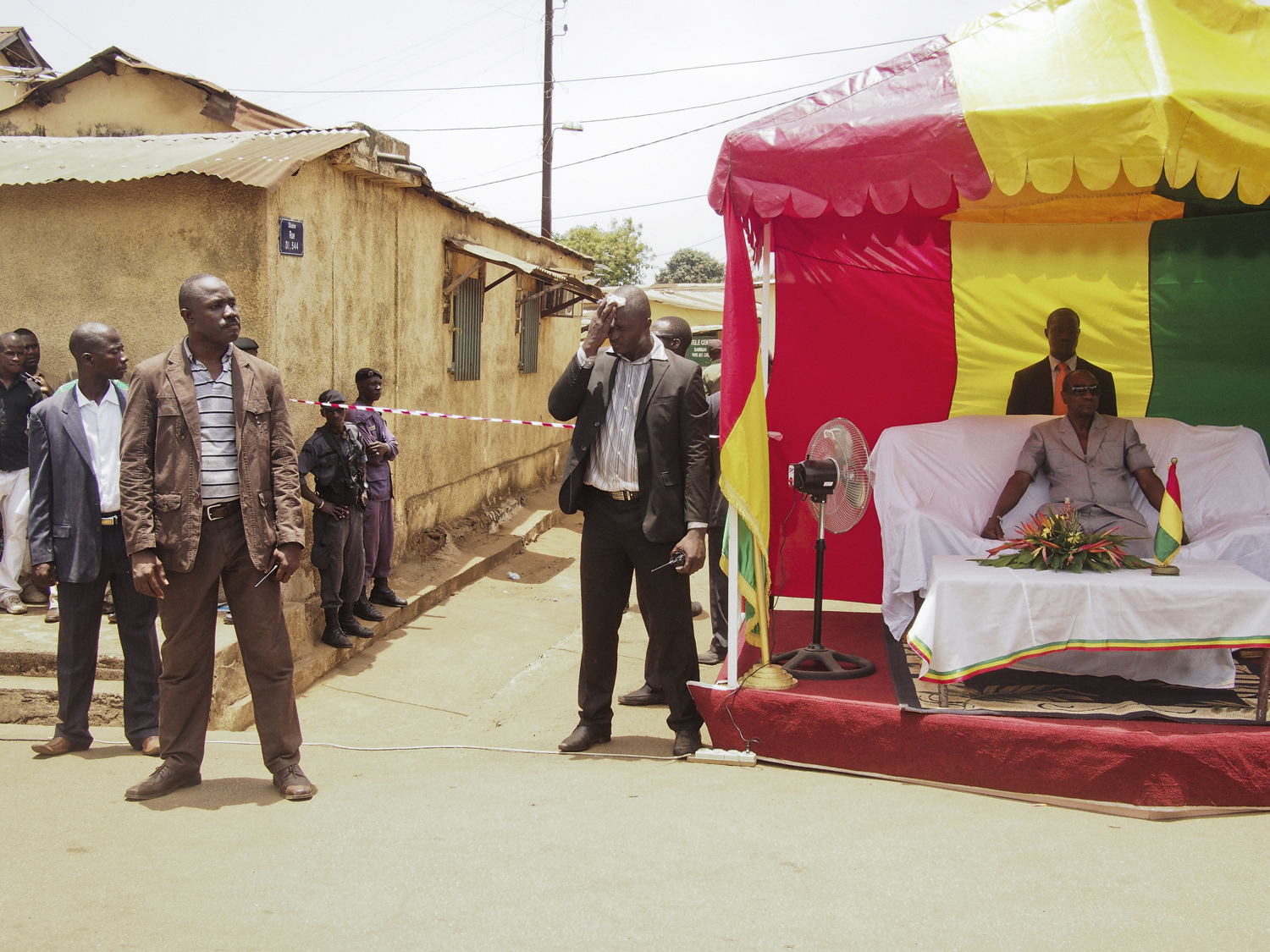
Shortly after Frédéric Cilins was arrested in Florida, I went to Conakry and visited President Condé at the Dim Sum Palace. He wore a white suit with short sleeves–a common style in Guinea–and looked tired. The violent opposition rallies showed no sign of stopping, and it was not entirely clear that Condé would hold on to power long enough to fulfill his reform agenda. Having failed to hold parliamentary elections, he was also at risk of losing his credibility as a genuinely democratic leader. Alexis Arieff, a Guinea expert at the Congressional Research Service, told me, “He came in with a real sense of having fought for the Presidency, and deserving a free hand in how he runs the country–’This is mine, I went to prison for this, I suffered for this.’ ” A European Union report recently blamed “Condé’s governing style” for the escalating tension in the country. Condé, for his part, felt that Steinmetz had played a role in the unrest; at Chatham House, he intimated that B.S.G.R. is funding the opposition movement. (Steinmetz told me that this was false.)
He Refused to Take the Bait
When I asked Condé if he felt vindicated when the U.S. Justice Department began investigating the Simandou deal, he refused to take the bait. It is ultimately up to him to decide–on the basis of counsel from the mining ministry–whether or not to strip B.S.G.R. and Vale of the Simandou license, and he did not want to say anything that might prejudice this process. Instead, he smiled and said, “The actions of the United States can help me advance in the struggle against corruption in Guinea.”
Cilins’s bail was set at fifteen million dollars, because of the danger that he might flee the U.S. In May, he pleaded not guilty to obstruction-of-justice charges, and it’s possible that he will decide to coöperate with authorities; in his court filings, he has not denied offering Mamadie Touré money to destroy the documents, or doing so at the behest of Steinmetz. B.S.G.R. continues to maintain that it never paid any money to Touré or signed any contracts with her. But Asher Avidan said something interesting in our conversation at the Paris bar. He repeated B.S.G.R.’s claim that Touré had not been married to General Conté when he signed over the rights to Simandou. “She was not his wife,” Avidan said. “Not even sleeping with him.” Then he added, “She is a lobbyist. Like a thousand others.”
A Lobbyist
It suddenly occurred to me why B.S.G.R. officials might be so committed to the notion that Touré had not been married to the old General. If she was not related to him, then she was merely another local influence peddler–a lobbyist. And it might be argued that, as a legal matter, paying a lobbyist is different from paying a bribe. If B.S.G.R. was ever forced to admit that it had paid Mamadie Touré, here, in embryo, was a defense.
Although the U.S. Justice Department will not comment on the case, Cilins is likely not the ultimate target of its investigation. When the grand jury in Manhattan began issuing subpoenas, earlier this year, it requested information not just on “the Simandou concession” but on Steinmetz himself. The F.B.I. recently dispatched two teams of investigators to Conakry. According to the Wall Street Journal, the Serious Fraud Office, in London, has also opened an investigation into B.S.G.R.’s activities. Because both Israel and France have been reluctant to extradite their citizens in the past, Steinmetz might never see trial in the U.S., even in the event that he was indicted. Still, Scott Horton told me, “Steinmetz’s future travel options may be limited.”
When we spoke in Cap d’Antibes, Steinmetz did not seem worried. “We have zero to hide,” he said.
Think Creatively and Move Fast
Steven Fox, the investigator, told me that Steinmetz and his colleagues were “very improvisational,” adding, “They can think creatively and move fast in an uncertain situation. That’s what accounted for their success, in a lot of ways. But it will probably also account for their downfall.”
For the moment, the iron ore remains locked inside the Simandou Mountains, and the site is still cut off from the rest of Guinea. “Everyone wants Simandou,” Condé told me as we sat in the palace. “It became the obsession, literally, of everybody.”
He continued to talk, in his professorial way, but a note of bewilderment crept into his voice. “Looking at the iron ore, the grade is world-class. The quality is world-class. Yet, in so many years, we haven’t been able to benefit from any of these tremendous resources.” President Condé paused. Then he murmured something, almost to himself: “How can we be so rich and yet so poor?” | TAP | Africa’s Newspaper of Record
The AfricaPaper: Our sincere thanks to Patrick Radden Keefe and The New Yorker for this special report.
Patrick Radden Keefe has contributed to The New Yorker since 2006 and joined the magazine as a staff writer in 2012. He has written about an alleged master counterfeiter of fine wine; a decades-long environmental lawsuit against Chevron over contamination of the Amazon rain forest; and the flamboyant Syrian arms trafficker Monzer al-Kassar. His book “The Snakehead: An Epic Tale of the Chinatown Underworld and the American Dream” grew out of an article in the magazine and was named one of the best books of 2009 by the Washington Post, the Christian Science Monitor, and the San Francisco Chronicle. He is also the author of “Chatter: Uncovering the Echelon Surveillance Network and the Secret World of Global Eavesdropping” (2005). His articles have appeared in the Times Magazine, The New York Review of Books, New York, Slate, and other publications, and he has been the recipient of a Guggenheim Fellowship and fellowships at the Cullman Center for Scholars and Writers, at the New York Public Library, and at the Woodrow Wilson International Center for Scholars. He is currently a senior fellow at the Century Foundation, and lives with his family in Washington, D.C.
Many oppose the transfer of a bridge-building MPD officer
By Issa A. Mansaray | The AfricaPaper
Meeting at the Zion Baptist Church on Sunday, March 26, community members sent a public message to the Office of Janee Harteau, Minneapolis Chief of Police, that Inspector Michael Friestleben, 53, should remain in North Minneapolis.
RESPECT
Friestleben with Lynn Crockett. Photo: (c) Issa Mansaray/The AfricaPaper, 2017
“I have so much respect for this man… I just can’t understand why someone who is making a positive difference in police and community relations in our community (of all communities) is being sent away,” said Lynne Crockett, a community member and one of the organizers of the meeting, in response to Friestleben’s reassignment.
Friestleben’s reassignment is now a source of concern to many in North Minneapolis, as highlighted in a March 22 community press release that reads in part: “As citizens of Minneapolis, particularly on the Northside, we found that we are on the sad side of positive relations. Lt. Friestleben made the most impact on the FourthPrecinct we’ve seen in years.”
People interviewed at the gathering told MSR that they want Friestleben to remain in North Minneapolis in a role accessible to the community. Many described him as “hard on criminals, soft on community, and a genuine person.”
PETITION
Organizers plan to present a community petition to elected officials registering their concerns. The petition on Change.org has about 430 signatures of the 500 required. At the Sunday gathering, community members bitterly complained that City officials treated them unfairly and that a “good officer” should not be removed from their community without a public explanation.
Manu Lewis moderated the event. Photo: (c) Issa Mansaray/The AfricaPaper, 2017
“As a community, we must stand strong for the good officers. Lt. Friestleben is one of our good ones,” reads a statement of purpose for the meeting. “There are more than enough officers who don’t protect and serve, so when we’re lucky enough to have one who does support us, we must respond.” Crockett and others present asked for more community support and solidarity for Lt. Friestleben.
POPULAR
The popular inspector was suspended earlier this month for an unexplained “personal matter.” Friestleben has been praised for his efforts in building community trust in the Fourth Precinct, as many in the meeting testified.
The event also addressed the gaps in building relationships and trust between the police and North Minneapolis over the years. It is these relationships and trust that Crockett and others think would be lost if Friestleben leaves the North Side police precinct.
“Those who don’t live here, sleep here, or die here should not be making choices for us,” said Crockett. “It is our community. If we don’t get involved and take it back, I don’t know when we will, if we don’t do it now.”
“SHOW UP”
Also sending a message to leaders and politicians who only “show up” in North Minneapolis to make promises during campaign season, speakers agreed that Friestleben has contributed much in curtailing the crime wave in the precinct. He has worked tirelessly to build confidence and trust especially among young people and community leaders.
“As I tried to keep my emotions, my hurt, my pain, and tried to turn [away from] anger because I’m not getting the correct answers that I need, he [Friestleben] was taken from me and the North Side,” said Kay G. Wilson. Wilson recalled how he met Friestleben at a time when he (Wilson) was seeking public help to keep peace on the North Side, and how Friestleben’s efforts built trust in the community.
“When you talk about solutions, it starts with relations,” Wilson said. “There is a trust that is not here in the Northside community with the police. We have to build community relations with the police.”
Kay G. Wilson. Photo: (c) Issa Mansaray/The AfricaPaper, 2017
“WE NEED HIM”
Wilson added that people sometimes know those committing crimes but can’t come forward if there is no relation or trust with the police. Attendees saw no reason why authorities should interfere with a solution that is already in place.
“I have not asked for anything in 14 years, no money, no funding… never asked for any of that,” Wilson said, “but I’m asking you, Chief [Harteau], to give us…back our brother, actively working in our community. We love him. We need him!” He added it is not about race, but about supporting their community’s relationship with law enforcement.
Manu Lewis, a community member who moderated the event, noted that though there is always an imbalance in police and community relations, Lt. Friestleben had bridged the divide. |TAP|Africa’s Newspaper of Record.
A workshop titled “What is Your Vision for Police in Schools?” was hosted by Students for Education Reform (SFER Minnesota) on April 17. The approximately 70 participants included students, parents, Minnesota Commissioner of Human Rights Kevin M. Lindsey, and representatives of Minneapolis Public Schools (MSP).
They gathered at the MPS Davis Center to voice both concerns and support for police in public schools, share their views about whether or not such policing is necessary, and question if it is solving or creating problems in the schools. Some of the participants said police presence wasn’t solving anything. Others pointed out the need to improve understanding between police and students, a concern which had prompted SFER to create the workshop.
Students shared firsthand experiences of interactions with police officers in their schools. Following general discussion, the workshop broke into small groups to generate ideas on how to resolve concerns about policing in schools.
SFER is partnering with Saint Paul Youth Services, Voices for Racial Justice, and the Dignity in Schools Campaign.Kenneth Eban, SFER MN program director, asked, “What [are the] things about police in schools we need to change for students to feel welcome, safe and achieving?”
Staff
He added that SFER wanted the community to help create concrete recommendations about how the state can improve relationships between students, the school districts, and local police departments. Participants questioned the need to collect data about students, questioning what type of data police should collect and why.
The question if police should be in schools in the first place sparked much discussion with a variety of answers. If police officers are allowed in schools, many felt this should be based on their qualifications just as schools regularly ask for teachers’ qualifications to meet students’ needs.
Eban said his agency wanted to listen and learn from the people, especially students most affected by the issues involving police presence in schools and why they are needed in an educational environment. The agency wanted recommendations not only from Minneapolis and St. Paul, but the entire state.
Students
Halimah Abdullah, a student from St. Paul High School for Recording Arts, said she never had any problems with the presence of police officers in her school, but she was concerned with the way police treat other students, as well as for her safety concerning police officers with guns. She complained that sometimes police take student bags to search as if “such things are normal to anyone else.” She added, however, “They are there to protect us.”
Some haven’t experienced any police brutality. Brandonisha Frazier said she sees police officers everywhere and doesn’t have a problem with them. She noted that sometimes police treat students differently after school, based on a student’s negative behavior.
Frazier said the police in her school don’t carry Tasers or guns, but for many students that doesn’t matter. According to Frazier, police want students to be involved in what matters to their future – their education.
In an interview with MSR, Eban noted that they haven’t heard from the police, but SFER would like to have a conversation with the police departments considering recommendations gathered from students and the community.
He said the issue of police in schools is gaining public support. “School districts across Minnesota spend significant resources on police without any state standards, accountability, or oversight,” said Eban. “In many cases, students say a police presence escalates situations and creates a climate of fear. If our goal is student safety and achievement, we need to listen to our students and respond to a more positive approach that’s focused on them.”
Collin Robinson, a Southwest High student, said it was “despicable” for police officers to visit his school to interview students three days after a killing incident that involved police officers.
Speaking at the event, Commissioner Lindsey said he wants his department to ensure that everyone’s human rights are respected. “…People mistakenly believe that all actions happen at the legislature or state council… That is not actually where the action happens,” said Lindsey. “It happens in rooms like this, where you galvanize neighbor to neighbor, citizen to citizen, and student to student…to make change.”
According to SFER, law enforcement officers work in about 28 percent of Minnesota schools, “Yet there are no statewide standards for training, certification, protocol, or monitoring to guide how they work with students.”
Student Tavell D. Williams said he had a “terrible experience with a police officer.” Because Williams was asking so many questions, he was accused of being “disrespectful to a police officer.” Many are concerned that Student Resource Officers (SROs) or police in schools too often arrest students for conduct that could be simply solved by school administrators.
Eban noted, “Arrests interfere with education. A student who goes to court is more likely to drop out of school. Both the National Association of School Resource Officers and Minnesota Department of Public Safety agree that officers should not be involved in classroom management or school discipline, but there’s no state policy to that effect.”
A statewide survey of School Resource Officers concluded that 22 percent of Minnesota SROs say they spend too much time enforcing school rules. |TAP|Africa’s Newspaper of Record.
Louise Karluah at her late son’s memorial service. Photo: The AfricaPaper/James Fasuekoi
Slain Liberian teen’s mother tells audience at memorial
By James Kokulo Fasuekoi | The AfricaPaper
Brooklyn Center, Minn – Louise Karluah, the mother of slain Liberian teen Barway Collins has spoken openly for the first time since the tragedy about her unending pains, frustrations, and how she has reacted. Barway’s father, Pierre Collins confessed to murdering him and dumping his body in the Mississippi River in Minneapolis a year ago.
Karluah’s Grief and Anger
A view of the audience. Sitting second roll in left corner is Yamah Collins, stepmother of Barway Collins. Photo: The AfricaPaper/James Fasuekoi
Karluah told a group of sympathizers here on Saturday, March 21, that her son’s brutal murder has left her angry at “God.” She said she can’t still comprehend why God didn’t act quickly that fateful moment to stop her son’s killer.
“I have told God, I will never serve Him…because why [is it that] Pierre Collins was killing that boy and You [God] didn’t exposed him….You let the boy died like that?” the angry young mother said during a memorial held at Brooklyn United Methodist Church in Brooklyn Center, marking a year since Barway’s murder.
“Lack of Transportation”
News crew follows Louise Karluah a day after she first arrived in Minnesota for her son’s funeral in 2015. Photo: The AfricaPaper/James Fasuekoi
Karluah explained she lives very close to a church and transportation wouldn’t be a factor if she wanted to visit another church but openly declared she often lied to avoid going to church. She said she intentionally uses “lack of transportation” as an excuse to avoid going to worship services whenever Rev. Alex Collins or someone encourages her to go.
She narrated how she endured hardship as a refugee in the West African state of Ghana during the period she became pregnant with Barway till she brought forth the child. She said whenever she reflects on that period, it brings severe frustration and pains to her heart, saying: “Barway didn’t deserve a death like this.”
Precious Child
She maintained Barway was her precious child and, even if she were to bear another child, that child would never reach late Barway’s age by now nor take his place.
If Pierre Collins felt tired keeping him, she continued, all merely needed to turn the child over to his mother and not harm him.
“I don’t care how much money people give me…they can give me the whole world; I will never be in peace,” she cried.
“What so much Pierre Collins wanted in life that he had to kill his own son? What benefit did he get by killing him?” Karluah openly wondered, adding that her life has been turned upside down since the killing of her son last year.
“What else can I say?”
Karluah said people often push her to talk whenever there is an event in Barway’s memory. “People always ask me why you don’t want to talk?”
Every mother, according to Karluah, dreams to witness her son’s school graduation and wedding and for her, those hopes were even higher when little Barway reached US soil. But with such tragedy that struck her she wondered, “What else can I say?”
Looking for Peace
Pastor Alex Collins, family pastor. No relation to Pierre Collins. Photo: The AfricaPaper/James Fasuekoi
Karluah indicated that people think funny of her whenever she goes on Facebook. Though she didn’t elaborate, but apparently some think she ought to avoid Facebook and other social activities and grieve continuously for her loss.
“Not that I’m happy to be there. When I go on Facebook, I make friends that will get me happy. I’m only looking for peace,” Karluah said.
Explaining further, she said Pastor Alex Collins spoke about the need for people, particularly Christians to “forgive and forget” whatever wrong others may have done to them in the past. But according to Karluah, she challenged such thought and asked Rev. Collins how possible is it that you will “forgive and forget” when someone causes you such a deep pain?
“I can forgive but I will never forget!” she maintained.
Justice Prevailed
The grieving mother thanked God that justice prevailed in Barway’s murdered case and told the gathering that she will pray to God so that “all those” who one way or the other that were involved in Barway’s murder (this includes anyone withholding information), must never rest in peace until he or she confesses.
On March 18, 2015, 10-year-old Barway Collins was reported missing by his father, Pierre Collins hours after a school bus dropped Barway off at their Crystal apartment. Minneapolis police sent out an Amber alert across the state. The incident prompted hundreds of volunteers to join the search for the missing boy in Crystal, MN.
Mississippi River
On April 11, Barway’s body was found in the Mississippi River with duct-tape wrapped around his feet and torso. Prior to his confession, Collins initially denied having anything to do with his son’s death, but was later sentenced to a 40-year jail term.
Though Collins refused to state the motive for “killing” his biological son, law enforcement officers investigating the homicide here suspect it might have been connected to insurance fraud. According to police reports obtained by The AfricaPaper, in a short period before Barway’s death, Collins had increased Barway’s life insurance from its initial $30,000 to $50,000.
“He[Barway] is gone. None of us can explain or comprehend, how a father could kill his son,” said Hennepin County Attorney Mike Freeman, after Collins was sentenced. “We don’t know what exactly happened… We don’t absolutely know. The only person that knows is Pierre Collins, and he is not sharing.”
Tragedy and Limelight
Since the tragedy, Karluah, barely known within her community back in Liberia, found herself in the limelight and, for much of her stay in the US, local newsmen have followed her almost at every turn. But through it all, Karluah has often remained mute whenever persuaded by friends and relatives to speak about the tragedy.
At Collins’ sentencing in August, Karluah was overcome by grief, unable to speak when Judge Bransford asked her to make a statement. Victoria Peabody, a friend, had to speak on her behalf. Karluah wept profusely during her son’s funeral and couldn’t stand to say a word.
Before opening up Saturday, she had similarly rejected a request to address a group of people who attended a night vigil staged in Barway’s memory Friday, March 18.
Celebration of Barway’s Life
Saturday’s event was a celebration of Barway’s life and it was interspersed with soul touching hymns such as – Pass Me Not O Gentle Savior, and Blessed Assurance.
Victoria Zulu speaks on behalf of Nimba Community in US. Photo: The AfricaPaper/James Fasuekoi
Present, was an array of speakers at the ceremony; among them, Imam Mohamed Dukuly, Pastor Alex Collins and also Pastor-Mother Marie Vah, all providing the bereaved family with prayers and comforting words.
“She [Karluah] was too young to go through what she went through…maybe she needs special prayer,” said Mother Vah, reasoning from a spiritual viewpoint.
She pleaded with pastors and family friends close to Barway’s mother to help provide special prayer for Karluah, stating, “Only God can comfort her.”
Others included Karluah’s relatives and community organization leaders; Barlee Sam, Karluah’s uncle; Victoria Zulu, representative for Nimba Community; James Yafondo, head of LIBAKO, and Erasmus Williams of OLM. Political activist Seyon Nyanwleh helped organized the event and also served as master of ceremony. |TAP| Africa’s Newspaper of Record
The AfricaPaper:James K. Fasuekoi is Associate Editor for The AfricaPaper
BANNED
The Daily Observer newspaper of Liberia is banned from lifting, republishing or rewriting any content(s) and using any photo(s) from The AfricaPaper and its sister publications.
World Copyright
The AfricaPaper, USA, 2016. All rights reserved. Photos and text may not be published, broadcast, rewritten, redistributed or used in any form without the written permission of The AfricaPaper, and AIIR. We take legal action for any copyright infringement.