Home Blog Page 24

Guinea on Knife-edge on Eve of Presidential Poll after Clashes

0


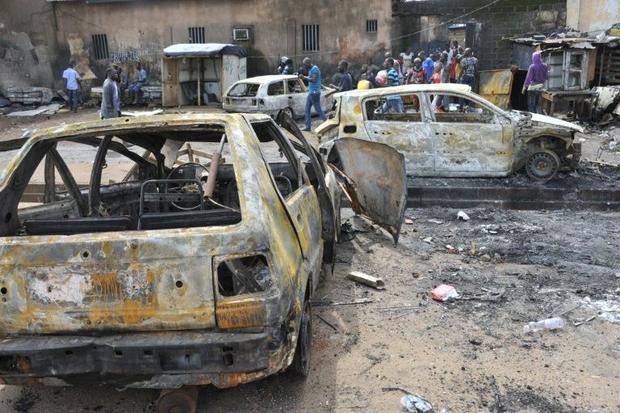
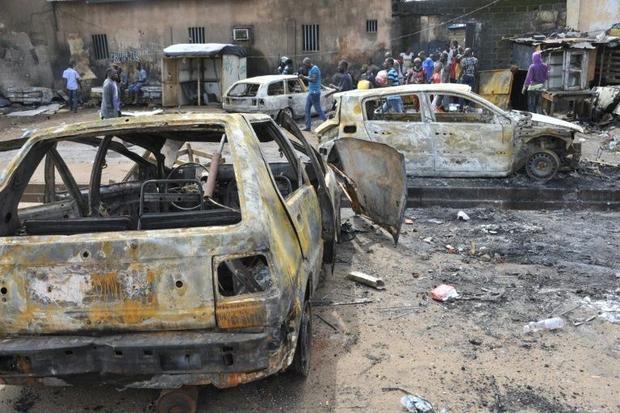
 People walk past destroyed cars in Conakry on October 9, 2015, after at least two people were killed and scores hurt in clashes between rival political parties ahead of Guinea's presidential election Cellou Binani, AFP  Read more: http://www.digitaljournal.com/news/world/tension-flares-in-guinea-ahead-of-presidential-poll
People walk past destroyed cars in Conakry on October 9, 2015, after at least two people were killed and scores hurt in clashes between rival political parties ahead of Guinea’s presidential election Cellou Binani, AFP

By Selim Saheb Ettaba & Mouctar Bah | The AfricaPaper

Conakry, Guinea – Guinea was on a knife-edge Saturday, on the eve of a presidential election, after clashes between supporters of incumbent leader Alpha Conde and his main rival left seven people dead, according to security sources and local authorities.

“We have seen since yesterday a deterioration in the security situation,” UN special representative for West Africa Mohamed Ibn Chambas told a press conference Friday, issuing a call for calm a day after deadly clashes in the capital Conakry and in the east.

Killed

In Conakry, two people were killed in confrontations between Conde supporters and backers of opposition leader Cellou Dalein Diallo after Conde rejected opposition calls for Sunday’s vote — the second since Guinea’s first democratic election in 2010 — to be delayed over alleged irregularities in the voter registration process.

A further five people were killed Thursday evening in the southeastern Banankoro district after their house was torched and dozens of people were injured by gunshots, Banankoro’s mayor told AFP.

After a largely peaceful campaign, tensions rose sharply this week after Diallo called for the poll to be delayed on the grounds that the electoral roll has been stacked in favour of Conde, who is favored to win a second term.
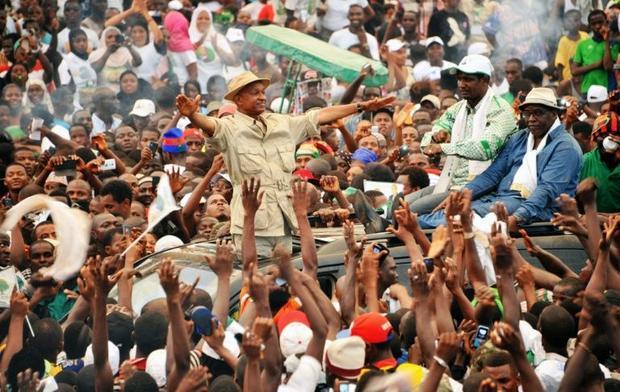
 Guinean opposition presidential candidate Cellou Dalein Diallo (C) waves to supporters on October 8, 2015 during a presidential election campaign in Conakry Cellou Binani, AFP  Read more: http://www.digitaljournal.com/news/world/tension-flares-in-guinea-ahead-of-presidential-poll/article/446088#ixzz3onfrjXkT

Guinean opposition presidential candidate Cellou Dalein Diallo (C) waves to supporters on October 8, 2015 during a presidential election campaign in Conakry
Cellou Binani, AFP

Sham

“We won’t take part in an electoral sham,” Diallo said at his last campaign rally.

“Otherwise we shan’t accept the results and I shall mobilise the population with all the other (opposition) candidates to reject them,” he warned, accusing the Independent National Electoral Commission (CENI) of being “incompetent and biased”.

Six of Conde’s seven opponents — who include three former prime ministers — have called for the vote to be postponed, citing the unreliability of the electoral lists and problems with distributing electoral cards.

But Conde told journalists that the commission was “perfectly entitled to organise the election on October 11.”
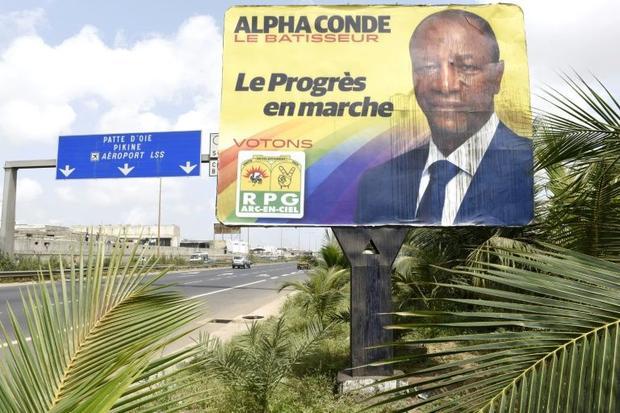
 A vandalized billboard showing Alpha at the side of a highway in Dakar, on October 9, 2015 Seyllou Diallo, AFP  Read more: http://www.digitaljournal.com/news/world/tension-flares-in-guinea-ahead-of-presidential-poll/article/446088#ixzz3ongOMPiV

A vandalized billboard showing Alpha at the side of a highway in Dakar, on October 9, 2015
Seyllou Diallo, AFP

Traffic

In Conakry on Friday, traffic was disrupted on the motorway leading to the airport as Conde supporters stopped cars and pedestrians suspected of backing the opposition.

Conde on Friday visited the city’s sprawling Madina market, where traders from his Malinke people had their wares torched Thursday by supporters of Diallo’s Fulani-dominated UFDG party.

“I call on my supporters not to attack anybody, irrespective of their political and ethnic affiliation,” Diallo told the private Espace FM radio station, while adding they should “defend themselves if attacked”.

Some 19,000 police and security personnel have been deployed to keep the peace.

Nevertheless, at one stage the motorcade of Prime Minister Mohamed Said Fofana was forced to make a detour to avoid a shower of rocks being hurled by rival groups, a police source said.

Police

“I’ve visited several districts since this morning and I can say that what I have seen is very serious,” Human Rights Minister Kalifa Gassama Diaby told AFP Friday, adding that he would be calling for police reinforcements.

A 72-member European Union observer mission is in Guinea to monitor the ballot.

“We’re ready for an election that should take place on Sunday,” mission chief Frank Engel said, before visiting the southeastern town of N’Zerekore, where one person died and dozens were injured last week in clashes between supporters of Conde and Diallo.

Diallo accuses the electoral commission of including minors on the electoral roll to boost Conde’s chances of re-election.

Conde insists that the panel is independent.

CENI spokesman Amadou Salifou Kebe said the election could go ahead Sunday as planned but acknowledged problems in the distribution of voting cards.

“Ask the people of Guinea”

Conde, whose election in 2010 marked an end to two years of bloody military rule, aims to be returned to office in the first round of the poll.

His election in 2010 was the first free vote in the west African country of 12 million people, with a reputation for trouble at election time.

He points out that during his five years at the helm, the army and judiciary have been reformed, a hydroelectric dam has been completed and mining contracts have been made more transparent, while a severe outbreak of Ebola was also brought under control.

“Ask the people of Guinea if what we have done in five years, the others did in 50. Ask that on the streets,” he said in an interview.

Guineans in neighboring Sierra Leone who have not received voters’ cards ransacked their embassy in protests this week, ambassador Fode Camara said Thursday.

Sierra Leonean police said they had arrested 29 Guineans.

The AfricaPaper: Many thanks to Selim Saheb Ettaba and Mouctar Bah for reporting from Guinea.

Guinean Community Says Goodbye to Slain Driver


By Daniela Castro | The AfricaPaper

An immigrant taxi driver was shot and killed following an argument about the fare

Bronx, New York, – Unnerved by the murder of one of their own in late September, Bronx taxi drivers are demanding prompt implementation of more effective safety measures.

Mamadou Barry, 39, was shot and killed in his car shortly before 1:30 a.m. on Sept. 21, near the intersection of East 189th Street and Beaumont Ave. in the borough’s Belmont section. Barry picked up a passenger near E. 138th Street and Brook Avenue, in Mott Haven, according to NYPD. Police say the the gunman shot Barry in the head after a dispute over the fare and fled the scene. His body was found in his green Lincoln Town Car.

Arrest

Nicolas Sanchez, 24, was arrested two days later and charged with murder. The following Friday, the Guinean community congregated at the Morrisania mosque where Barry regularly prayed, to say goodbye to their friend. The congregants at the Futa Islamic Center on 166th Street were both saddened for the loss of their friend and worried about their own safety and livelihoods. Barry, who had lived in the US for about 15 years, was a resident of the neighborhood.

“Stop-and-frisk: this has to come back,” said Mamadou Bah, who prays at Futa. “Because we know so many people have guns on the street. So I think the NYPD have to have more right to stop every suspect.”

Fear

The Futa Islamic Center on 166th Street and Third Ave. where friends said goodbye to Mamadou Barry on Sept.25.

Some fear that the killing will discourage taxi drivers from working at night, when most drivers pick up most of their fares.

However, Justin Bonet, head dispatcher for Barry’s former employer, American Base No.1 Inc., said service would continue as usual. Some drivers still prefer to work at night so they can be with their families during the day, he said, and added that many are willing to brave the safety risk of driving at night to avoid contending with morning traffic.

Shift

So far, the company says, drivers have not refused to take the night shift. Though Bonet said that there is little the company can do to push for legislation, they are anxiously standing by in hopes that the city will take notice and implement tougher safety standards. For that to happen, the Taxi and Limousine Commission will have to take the lead, he said. Partitions between drivers and passengers should be mandatory, he said, and every livery car should be equipped with a camera.

Burial

Barry’s body was sent back to his native Guinea for burial. He left three children and his wife is pregnant with their fourth.

The AfricaPaper: Many thanks to reporter Daniela Castro, and Joe Hirsch, Editor, Mott Haven Herald for providing this report.


FILM: Psycho, One of the Best Thrillers of All Time


By Lucas Jallah-Acosta | The AfricaPaper

Robbinsdale, Minn – Alfred Hitchcock’s 1960 thriller Psycho, one of the greatest suspense horror films of all time, focuses particularly on its main character Norman Bates (Anthony Perkins), a haunted young man with particularly psychological troubles. A seemingly ordinary, meek man, Norman shows throughout the film his propensity for violence, often through the lens of his mother, whose personality inhabits him in moments of great frustration and mania. Hitchcock uses very many psychological lashings-out, putting the audience in Norman’s state of mind while also exposing the terror of his victims.

Killer or Victim

Psycho Poster
Psycho Poster

The literary, dramatic and cinematic aspects of Psycho help to explore Norman’s psyche, and make us question whether or not he is a killer or a victim of his own childhood abuse. In the beginning, the scene starts out with an unmarried couple in Phoenix, Arizona, portraying Marion Crane (Janet Leigh) and Sam Loomis (John Gavin) spending lunchtime together.

They both have a sense of pleasure, both having this inclination for each other. She is very frustrated with how things are playing out in her life, irritated with her romance with Sam Loomis. Later, we begin to notice Marion’s discontent for her occupation at a real estate office. One after, Marion is given $40,000 in cash by her boss to directly deposit – on impulse, instead of Marion depositing the cash, she hastens quick, running away with it leaving Phoenix to another destination, hoping to start a new life.

“Bates Motel”

As she hits the road, later in the night she stops in the middle of nowhere and stops to sleep in at this unfamiliar motel called, “Bates Motel”. As she unpacks her baggage to move in, she meets the Motel owner named Norman Bates. Norman starts out as a seemingly nice character, but surprisingly acts as a complex character later in the film.

All throughout the film, we are led to believe that Norman Bates’ insane mother is the one killing all of the victims – Marion, the private investigator, and so on due to Norman’s own fear of her, his arguments with her that we hear, and the glimpses of dresses that we see. However, it is only in the latter act of the movie that we are shown that Norman is the killer, impersonating his mother’s body language in a fit of schizophrenia. Throughout the movie we gradually see Norman unearth his mystery and that he was the person we should have been afraid of all this time, for reasons we cannot fathom.

Real Danger

Psycho-(1960)
Psycho-(1960)

Hitchcock plays around with our expectations of Norman by revealing he is the real danger. The narrative structure of the film is unconventional, at the very least for introducing a protagonist (Marion Crane) who is killed off by the half-hour mark. This shocks the audience and throws them off, as they have already chosen to invest in them only to see them cut down so quickly; for the rest of the film, they must then worry about who will be killed next.

When it comes to Norman, the way they use him narratively, both as victim and villain, is fascinating; it is clear he is henpecked and humiliated by his mother, constantly seeking out female validation and satisfaction from Marion and other women who frequent the motel.

Visual Medium

Much of the subtle story of Norman is told cinematically – Hitchcock uses film as a visual medium to great success, giving the viewer an inside look at the mind of a psychotic man. Norman is usually filmed at low angles, giving him a sinister yet innocent look. During the infamous shower scene, the camera stays voyeuristically drawn to Marion, just as Norman would be in that situation.

Norman himself, is obscured by the curtain, lending a further air of mystery. Even when the attack happens, all we see is a stabbing hand and quick cuts of Marion’s body and the shower, adding a visceral feel to the murder. The fast-editing style of this scene also gives insight into the fractured nature of Norman’s mind during these attacks.

Unsettled Nature

Another cinematic scene that sells Norman’s unsettled nature is the murder of the private detective, Arbogast. When Arbogast goes up to the Bates’ house to investigate it, the house is empty – the audience feels almost as if he is entering Norman’s mind. In the dialogue of this scene, Arbogast hears what could possibly be a human sound coming from upstairs.

Upon going up the staircase, the door upstairs cracks open, Hitchcock only showing a sliver of light coming through. This is followed immediately by a wide, God’s eye view of the top floor as Norman (in a wig and dress) runs at Arbogast and brutally cuts him with the knife. Hitchcock does not show us the knife meeting flesh, but the camera immediately creates a straight cut to Arbogast with a red gash over his face, his own terrified expression, and still staring at the camera (aka Norman) in disbelief and fear as he falls down the stairs to his death.

Zooming Movement

In the final scene, where Norman has finally been caught, Hitchcock keeps the tension at a zooming movement as we finally really get inside his head. As the psychologist goes on about Norman’s history and trauma, the audience hears the voice over of Norman’s mother inside his head, creating an internaldiegetic sound as we pan over to Anthony Perkins’ vacant, yet sly expression.

Psycho-(1960)
Psycho-(1960)

The camera slowly pushes and pushes in on his face, creating a dolly movement and brings the audience closer to its subject until it can no longer get closer. Ending the film on this note finally sees Norman reflecting on himself, dissolving into his mother’s face of a skull and inviting the audience to join his psychosis.

Subverted Narrative

In conclusion, the literary, narrative and cinematic aspects of Psycho allow the audience to get inside Norman’s head. The subverted narrative, the plot twists and the film-making techniques all serve to create a story in which Norman is shown to be an unpredictable, psychotic yet a deeply troubled man, who seems to no longer be in control of his body. This terrifying presentation of someone with multiple personalities and how it was used as Hitchcock’s type of cinematic, literary, and dramatic aspects that makes this one of the best thrillers of all time. |TAP| Africa’s Newspaper of Record.

The AfricaPaper: Lucas Jallah-Acosta, covers film, music, and entertainment for The AfricaPaper.

Opinion: Why Every Diaspora Family Needs “Legacy Planning”

0


Legal Pix

By Henry M. Ongeri & Steven E. Antolak*

Henry M. Ongeri
Henry M. Ongeri

Right upfront, let’s face it: we all like to put off unpleasant or uncomfortable thoughts or conversations. It is not easy to confront the reality of our own disability, weakness or mortality. So we put it on the back burner. However, the reality remains that burying our heads in the sand hardly makes the unpleasant or uncomfortable issues go away.

Circumstances

Immigrant and first-generation immigrant families have unique circumstances that underscore the importance of advance planning and deliberative decision-making. Many first-generation immigrants (especially from African countries) still have and maintain a strong bond with their homelands. Whether it is keeping in touch with family, owning property or businesses, such immigrants have a “dual existence.” On the other hand, many do not have immediate family members in the West where they live and raise families. This actuality tends to rear its head at the most unlikely and unexpected times: disputes, disability, illness or sudden death.

To illustrate, one can imagine these purely hypothetical scenarios. First, a young immigrant family is rendered desolate by the sudden disability of a father, the main breadwinner. A rare and debilitating illness leaves him unable to speak or walk, cutting short a promising career in healthcare. He had not imagined (let alone made plans for) the day he would no longer work. He was only in his early thirties. In yet another, a graduate student at a state university is involved in a tragic road accident. He is airlifted to a local hospital where he lies in a coma for months. Having no immediate family members in the country, the student’s classmates and friends are forced into the distressing situation of speculating what the student’s end-of-life choices would have been. Well-crafted healthcare directives would have saved the day.

Questions

Steven Antolak
Steven Antolak

Another situation one can think of is burial for those who pass on in the diaspora. For decades, particularly among the African immigrant communities in the United States, this was seldom an issue. In the unfortunate event of a death amongst them, relatives and friends gathered, raised the necessary resources and transported the remains to their respective homelands. But as immigrant families’ numbers swell and prosper and possibly become more entrenched in their local communities, shipping remains back to Africa has come under increasing scrutiny. A growing number of children (born and raised in the diaspora with only a tenuous connection to their parents’ ancestral home lands) have started to question the practicality of this practice. As one teenage boy once asked me: why bury my parents in some distant land where we cannot visit them? I had no answer.

Legal Battles

Finally, in a more positive scenario, an immigrant family has built considerable wealth through an import-export business. They have acquired assets and made investments spanning continents, as most diaspora want to. The issue of allocation and ownership of such assets should be clarified, preferably in enforceable legal documents. This is more critical for families from cultures where communal ownership of property is the norm. Otherwise, the risk of confrontation and endless legal battles looms large.

Some basic documents that every diaspora family should have include (but are not limited to): living wills and living trusts; power of attorney (The legal authority to make decisions or act for another person); estate plan (you, rather than operation of State law, gets to determine inheritance of your assets; you decide who will manage your estate; you, not the court, select a guardian for your children and you can provide for the orderly continuance or sale of a family business.)

Personal Matter

At the risk of oversimplifying an otherwise very complex subject, it bears repeating that a failure to plan is an open invitation to the courts and lawyers to direct what is an otherwise intensely personal matter. Why would anyone want that? The unique experiences and circumstances of many diaspora families make “Legacy Planning”even more pertinent.

The AfricaPaper: *Attorneys at law and hosts of the “Life and Law Seminar Series” at ANTOLAK & ONGERI, The Transatlantic Law Firm, PLLC

Disclaimer: The information presented here is for informational purposes only. It is neither, nor is it intended to, constitute legal advice. No attorney-client relationship is created with ANTOLAK & ONGERI. If you have a specific question regarding the matters herein, you are advised to seek professional advice.

For children born of war, what future?

0


By Virginie Ladisch and Lindsay McClain Opiyo | The AfricaPaper

Gulu, Uganda – In recent weeks, more than 700 women and children have been rescued from Boko Haram by the Nigerian Army. Reports suggest that at least 214 of them are visibly pregnant. While agencies like the United Nations Population Fund (UNFPA) provide much-needed emergency medical and psychosocial support, little effective analysis exists on the long-term needs and challenges of these children born of war and their mothers.

Unfortunately, the experience of women and children abducted by Boko Haram is not unique to the emergent situation in northern Nigeria. Nearly 2,000 miles away from Boko Haram’s stronghold in the Sambisa Forest in northern Nigeria, the Lord’s Resistance Army (LRA) traverses the jungles of central Africa with hundreds of captive men, women and children. Known for using similar tactics of abduction and forced marriage as Boko Haram, the rebel group has survived for more than two decades despite numerous political and military attempts to expel it.

While mothers undoubtedly have a need for such support, the needs of their children may differ and it cannot be assumed that programs designed for the women will trickle down to the children.

Meanwhile, communities in neighboring northern Uganda, the original theater of the LRA, have experienced relative peace and security for nearly a decade, yet a multitude of economic and social consequences of the conflict still remain. One such issue has risen to prominence as of late, with some leaders going so far as to call it a ‘time bomb’: what will become of all of these children born of war? Thousands of such children exist on the margins, fathered through sexual violence by not only the LRA, but also government forces and a multitude of other state and non-state armed actors. As these children enter into early adulthood, with many now in their teens and twenties, increasing questions (and conflicts) of identity and belonging have emerged, prompting calls for targeted programs and policies to address their plight.

While the prevalence of sexual violence in conflict has received increasingly greater recognition in public, policy and academic circles around the world, the majority of the resultant reports and responses focus on short-term needs and largely ignore children born of sexual violence.

Last month, the International Center for Transitional Justice (ICTJ) conducted an assessment in northern Uganda to understand the needs and challenges of incorporating children born of war into reparations and development policies. Our findings, which will be produced in a report later this year, reveal long-term needs and challenges of children born of war that (re)integration programs and policies have largely ignored and overlooked. When the initial rush of attention and humanitarian aid wanes, it is important to keep in mind the longer term consequences of conflict on the children born of war and plan interventions accordingly.

Prioritizing the Unique Needs of Children

There is a need for special programs for children born of war. Often times, programs focus exclusively on their mothers, as the immediate survivors of conflict sexual violence. While mothers undoubtedly have a need for such support, the needs of their children may differ and it cannot be assumed that programs designed for the women will trickle down to the children. In societies where one’s identity derives from paternal lineage, children with unknown or untraceable fathers can face considerable hardship living with maternal relatives. Increasingly, peer-support groups have been a popular strategy in northern Uganda to provide psychosocial support to female survivors of conflict sexual violence. No such groups exist for the children, in part because of a lack of prioritization by non-governmental organizations and donors, and because of the challenges and sensitivities involved in identifying and mobilizing them.

Further, the programs for women survivors who bore children need additional support to recognize their status as mothers. For example, in northern Uganda, where persons returning from the rebels were awarded reinsertion packages of basic household items by the government, there were no additional allowances for those with children born in captivity. This trend continues today, with many governmental and non-governmental programs recognizing formerly-abducted persons as a special category for assistance, but not children born of war.

Reintegration at the Community Level

Generally, (re)integration programs often overlook the communities within which children born of war live and focus on preparing the mother and child, while overlooking the needs of the community. The families and communities within which these children will live must be adequately prepared for their return.

As much as the children deserve special programs for the violations they suffered, their communities do too. In conflicts like those in northern Nigeria and Uganda, war has affected nearly everyone. Trauma and scarcity of resources, for instance, can contribute to the exacerbated stigmatization and rejection of children born of war. Formerly-abducted women and their children may only initially be welcomed into homes and communities due to the appeal of the resources from reintegration programs that they return with. Tensions and conflicts often emerge over time, however, especially as the resources dry up and children reach school-going age and require additional support for fees and school requirements. Other times, as experienced by some mothers in northern Uganda, their relatives initially welcomed the women but refused to accept their children, forcing the women to leave home and rent in urban centers where they experience relative anonymity.

Any programs or policies that support these children or their mothers must consider the social circumstances in which they live. Failing to view other relatives and community members as key stakeholders in any support they receive is likely to undermine any efforts. More than a one-off sensitization campaign, it is necessary to take the time to understand how the community perceives the returning mothers and their children born of war as well as the specific obstacles the children are likely to face (such as land access, stigma, and resentment) and together with the community devise strategies to overcome those obstacles. In northern Uganda many young mothers felt that receiving support to become productive and self-sufficient was the key to gaining respect in their community and overcoming stigma, rather than just psychosocial support.

The Differentiated Impacts of Gender

Anticipating the nuances and gender differences among children born of war is a critical part of devising appropriate and responsive programs and policies. Even amongst children born of war under the same circumstances or within the same group of fathers, individual needs and circumstances may greatly differ. For instance, female and male children will face different challenges in societies in which females’ families receive dowry when their daughter marries while males are expected to inherit land and other resources when they come of age. In northern Uganda, some families and clans have rejected male children born of war to a higher extent than females because they do not want to allocate land to them on which to settle when they come of age.

Ethnicity can also affect levels of acceptance and acknowledgement, as can the identity of the father. In Uganda, children born of rape by government forces are largely invisible, due in part to the fact that the same government under which these atrocities were committed is still in power. Further, children whose parents are from different regions or ethnicities reportedly face greater stigma than children born of war to parents of the same ethnicity. This is especially severe if the father is believed to be from a group for which the conflict is blamed. Any interventions or responses to meet their needs must recognize these nuances and respond accordingly.

Focusing on the Future

The ICTJ’s assessment underscored the reality that the needs of children born of war shift over time and require long-term visioning and planning. The needs of children born of war are not the same when they are infants as when they are young adults. Their identity and needs constantly evolve over time as conflicts and circumstances shift over time. The interventions of UNFPA and other organizations providing support in northern Nigeria must evolve accordingly.

Whereas the pressing need today may be counseling for the mother and medical support for a safe delivery of the child, in the future, the need may be access to education, land, livelihoods, justice and redress. Not every organization may have a mandate to provide support this far into a post-conflict period, but the needs of children born of war shall remain.

Organizations involved in programming and policymaking must maintain a panoramic view of the reparative justice needs of children born of war while the lens is still fixed on the young women rescued from Boko Haram. Within this view, taking the time to extend any work involving children must also incorporate the receiving communities to ensure that the cycle of violence is not repeated through the next generation. It is important to recognize and plan for children born of war so that they can outgrow the negative consequences of the circumstances of their birth, and have the hope of a brighter future where they are treated with dignity and their rights are respected.


The AfricaPaper: Virginie Ladisch, head of ICTJ’s Children & Youth Program and Lindsay McClain Opiyo, ICTJ consultant & Gender Justice Team Leader at the Justice and Reconciliation Project in Gulu, Uganda.

PHOTO: Lawrence, a boy staying at Omoana House, a child rehabilitation center in Jinja, Uganda, plays outside on Saturday, May 21, 2012. (Bread for the World/Flickr).