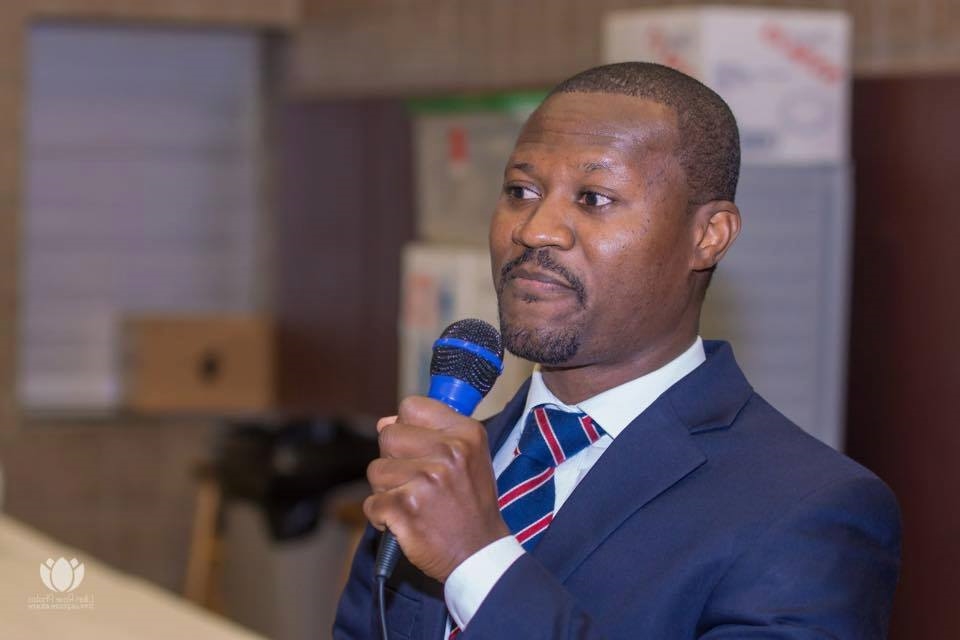
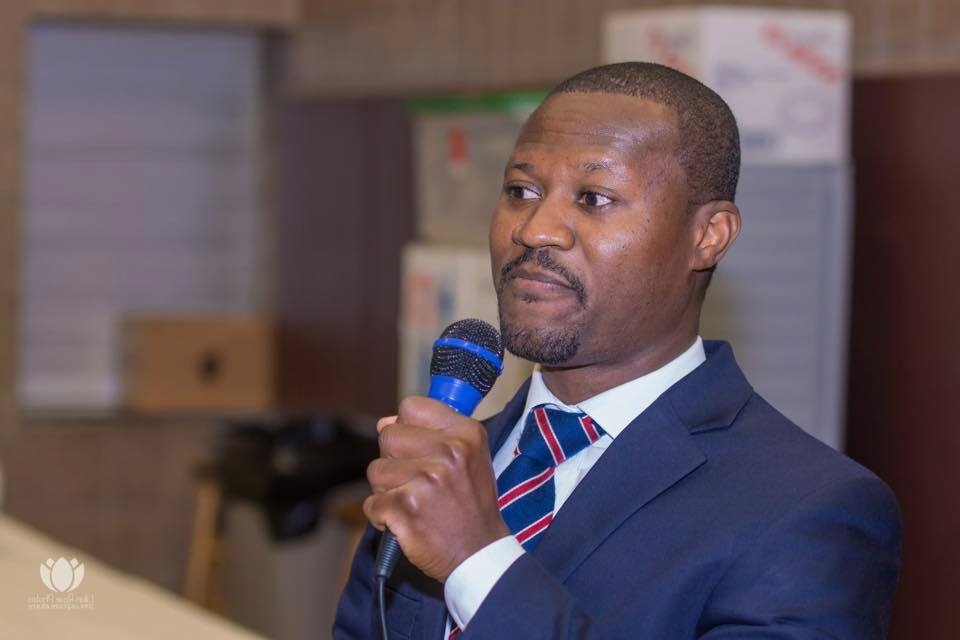
Henry Tobee McCabe went missing since Sept. 7, and found dead on Nov. 2, 2015
By Alie B. Sheriff | The AfricaPaper
New Brighton, Minn – The cause and manner of death for a 32-year-old Mounds View resident whose body was recovered Monday is pending toxicology report, according to Mound Views Police Chief Tom Kinney.
Missing
Gayle Nelson (left) and David Singleton (right) talk about area where McCabe’s body was found. Photo: The AfricaPaper/Issa A. Mansaray
Henry McCabe was reported missing on Labor Day, but this week family members got the news they dreaded hearing.
The Ramsey County Medical Examiner’s office confirmed McCabe’s body after it was found by a kayaker in Rush Lake about 4:20 p.m., police said.
Chief Kinney said McCabe’s death “does not appear to be suspicious, but the cause of death is still undetermined pending toxicology results.”
The matter remains under investigation by the Mounds View Police Department, the New Brighton Police Department, and the Ramsey County Medical Examiner’s Office, police said.
A search team member close to the tower near Silver Lake Road and Mississippi Street in New Brighton where McCabe’s cell phone last pinged off before his disappearance on Sept. 7, 2015. Photo: The AfricaPaper/Issa A. Mansaray
Call
A call made on McCabe’s cellphone moments before his disappearance was pinged off a tower near Silver Lake Road and Mississippi Street in New Brighton, some five miles from a gas station, where he was dropped off in the early morning hours of Sept. 7. An audio recording of his last phone interaction obtained by The AfricaPaper, is inaudible.
McCabe, who survived a 14-year civil war in his native Liberia, was an auditor with the Minnesota Department of Revenue. He is survived by his wife, Karen, and two daughters, 10 and 2.
Descent
More than 30,000 people of Liberia descent reside in Minnesota and the majority live within the Twin Cities. Nearly six months prior to McCabe’s disappearance, Liberians dealt with another tragedy involving 10-year-old Barway Collins, who went missing in Crystal. His father Pierre Collins is serving 40 years prison sentence after admitting to killing him.
Newly reelected Ivorian President Ouattara could consolidate peace and economic prosperity during his second term by addressing past violence in Cote d’Ivoire. This month’s piece on Worldviews, calls on the Ivorian President to make firm steps to deliver justice and reparations to victims and engage more fully on efforts to acknowledge the truth about Cote d’Ivoire’s past. It points out that as previous polls in Cote d’Ivoire and experiences elsewhere have shown, peaceful elections alone cannot guarantee a stable peace nor close the book on past grievances.
By David Tolbert | The AfricaPaper
Last month’s presidential election capped four years of relative peace in Cote d’Ivoire. To make the West African country of 23 million an example of how to address a legacy of violent civil strife, newly reelected President Alassane Ouattara can now do more to acknowledge and account for past violence.
Post-election Violence
On the heels of a decade of north-south division and brutal post-election violence in 2010-2011 that left 3,000 people dead, Ouattara prioritized security and economic recovery during his first term. Thousands of former fighters were demobilized with United Nations support, while annual economic growth in the country, the world’s leading cocoa producer, topped eight percent.
The legacy of violent political and inter-ethnic turmoil hangs heavy in Cote d’Ivoire. Politics in the country have long been characterized by hate speech, manipulation of youth groups to commit violence, and marginalization of whole sections of society. However, divisive rhetoric was thankfully in short supply during this year’s campaigns. Still, many Ivorians were quietly apprehensive ahead of the polls, and sporadic violence during a few demonstrations in September and October led to at least three deaths.
Consolidating Peace
The October 25 presidential election – deemed credible and transparent by both Ivorian civil society and international observers – marked an important milestone in consolidating peace. Of course, as previous polls in Cote d’Ivoire and experiences elsewhere have shown, peaceful elections alone cannot guarantee a stable peace nor close the book on past grievances.
During a campaign centered on the economy and social issues, Ouattara also condemned impunity and committed not to interfere with the justice system’s efforts to prosecute those most responsible, on all sides, for the massacres, rapes, community destruction, and other abuses that were committed during the 2010-2011 post-election violence. In 2015, two newly created or revamped governmental bodies –National Commission for the Reconciliation and Compensation of Victims (CONARIV) and the National Program for Social Cohesion – launched processes to identify victims of past violence and begin providing reparations.
Justice and Reparations
Given this progress and Ouattara’s previously stated commitments to justice and victims’ rights, Ivorians have come to expect concrete results during Ouattara’s second term. In particular, the next administration should aim to speedily deliver on justice and reparations and promote fuller engagement on efforts to acknowledge the truth about Cote d’Ivoire’s past violence.
On justice, Ouattara must go beyond his commitment not to interfere with the judicial system, and take specific action to strengthen its impartiality and capacity to prosecute individuals for serious violations committed during the post-election violence. Those named to key Justice Ministry posts must also act impartially.
Ouattara should also ensure that the Justice Ministry’s special unit for post-election violence, known as the CSEI, has sufficient resources for the task. In addition, the Ouattara administration should give its full support for a draft law on witness protection now working its way through the National Assembly, which would enable more victims to testify and thereby bolster the credibility of the prosecutions and trials.
National Prosecutions
There is no doubt that serious progress on fair and balanced national prosecutions would help deliver justice for Ivorian victims of conflict-related abuses. The International Criminal Court (ICC) is due to begin its trial against former President Laurent Gbagbo and his co-defendant, Charles Blé Goudé, in January; while playing a very important role, the ICC alone cannot respond to the need for justice in conflict-related cases. Indeed, effective national prosecutions Cote d’Ivoire would be a critical way to show victims and society that the state is committed to guaranteeing human rights and the rule of law.
A far-reaching reparations process for victims, which had a solid start in 2015, must continue to make progress. The relevant governmental bodies should expand their outreach to victims’ groups and civil society to inform their policies and actions.
Lack of Communication
A newly created commission, CONARIV, made progress this year to finalize a victims’ list while making a solid effort to listen to victims and integrate their views. And the National Program on Social Cohesion began implementing financial compensations to victims in August, drawn from a $16.7 million fund. But the work of these institutions has at times suffered from blurred roles and responsibilities and a lack of communication between the two, which President Ouattara should seek to improve by naming a coordinator for reparations among his senior staff.
During his swearing-in ceremony on November 3, Ouattara proposed “new consultations with CONARIV” as part of further reconciliation efforts. While this is a positive step, the Ouattara administration must clarify as soon as possible how such consultations will be managed, and how they will complement previous and existing efforts to determine the truth about past conflicts and provide reparations to victims.
Dialogue, Truth, and Reconciliation
Last, Ouattara should use his office to promote further acknowledgement among all Ivorians about the country’s violent past. Official efforts to seek the truth about past conflicts stalled in the previous term. The work of the Dialogue, Truth, and Reconciliation Commission culminated in a report in December 2014, which has yet to be made public.
Several Ivorian youth groups have made strides in acknowledging a painful past by apologizing for their role in the post-election violence of 2010-2011. Their brave and honest admissions should be followed by acknowledgement from the president and other political leaders, past and present, for the roles they themselves and their supporters played in the violence.
Account for Grave Abuses
Serious, careful, and effective efforts to acknowledge Cote d’Ivoire’s past and account for grave abuses can strengthen the country’s economic and social progress. Ouattara’s campaign promised that, with him, Ivorians would “succeed together.” Pursuing truth and justice can help him make good on that promise.
The AfricaPaper: The piece is written by ICTJ President David Tolbert. International Center for Transitional Justice has been working on justice issues in Cote d’Ivoire since2012.
Kaduna, Nigeria – The slow pace of the criminal justice system in Nigeria is responsible for the congestion of prisons across the country, says to prison experts.
Threat
Authorities revealed that over 34,000 out of the estimated 48,000 prisoners in custody in the country are awaiting trial, describing the situation as a serious threat to the reformation process in the country’s Prisons.
Even though, prisons worldwide are established to reform citizens who may have in one way or another break the laws of the land, the aim is sometimes defeated in Nigeria when awaiting trial inmates suffer unnecessarily before conviction.
Criminals
Nigerian prisons are overpopulated or rather congested with hardened criminals ending up with those who are awaiting trial in same cells.
Investigations have repeatedly revealed how bad the situation is with reports from convicts describing their lives in prisons as miserable.
“There is no life here in prison because life is simply miserable. No freedom and the condition is bad,” said Oyewale Ajibola, an inmate serving life in imprisonment.
He was jailed for Armed Robbery in 2003 and already spent five years in the prison. “I was brought here after the court found me guilty of an armed robbery offense. But I know I’m not guilty.”
Cell
It was also gathered that up to 50 inmates most times share a single cell in some of the prisons and their condition of living is so bad that they end up contacting various skin and other communicable diseases while in jail.
Human rights activists and Lawyers without Borders often speak on the need to decongest the prisons since majority of the inmates are people awaiting trials, and those who committed minor offenses such as stealing yam tubers, mobile phones, and goats among others.
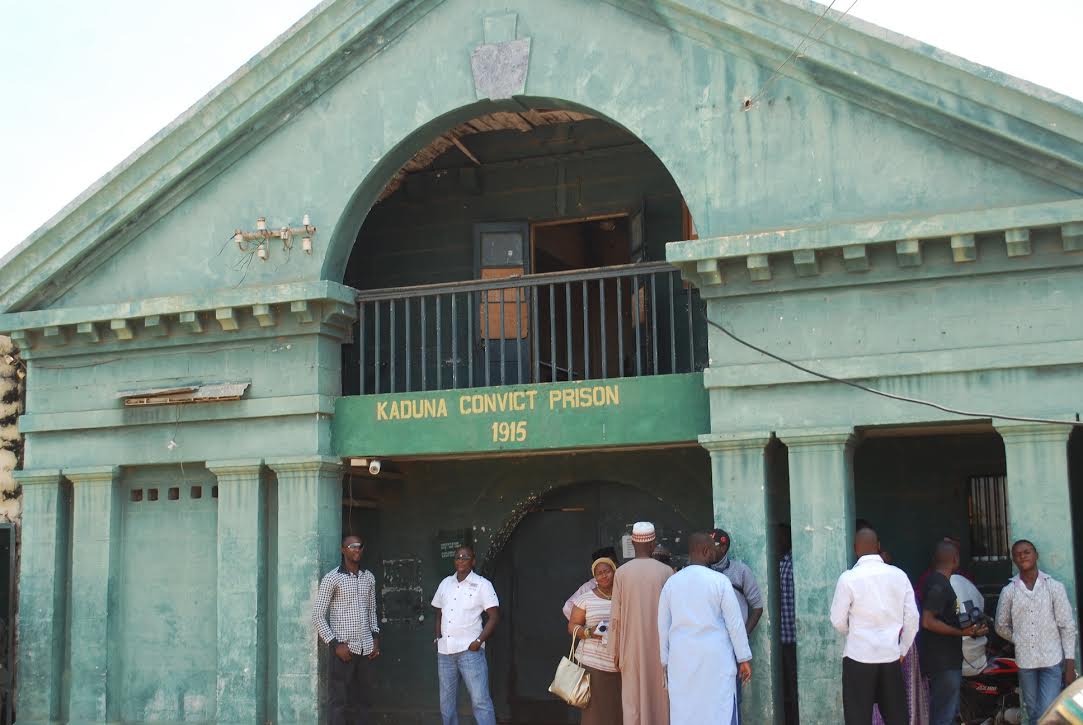
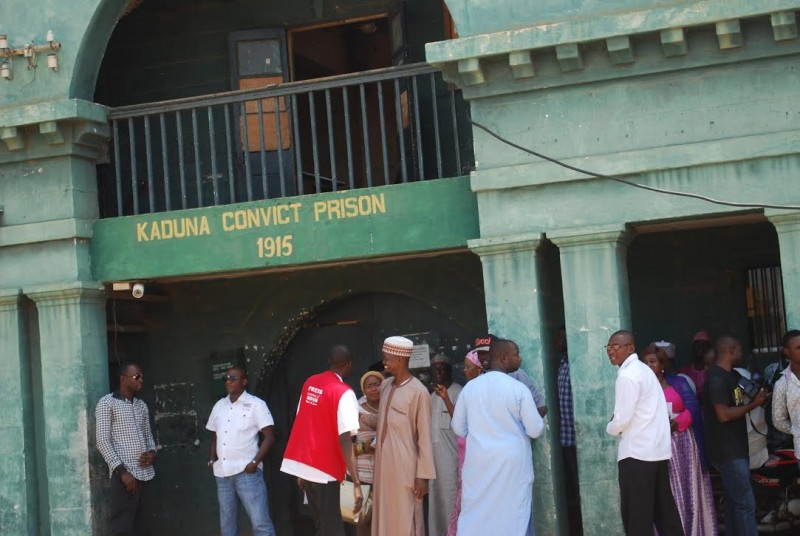
Kaduna Covict Prison. Photo: Mohammad Ibrahim /The AfricaPaper
There are also those inmates facing capital punishment who were kept in the prison for many years without been executed, and the government continue to feed them.
Colonial
In fact, the painful aspect of it all is the fact that some of these prisons were built during colonial era and are still in use in the 21 century. Some of tHe structures, are falling apart.
Kaduna Convict Prison for instance, built in 1915, is now 100 years old, and in the last 50 years the prison has suffered a lot of neglect. The capacity of the prison was 530, but presently it has over 1,000 inmates with majority awaiting their trial at the court of law.
The controller of Prisons in Kaduna, Abubakar Garba said the prisoners awaiting trial in all 14 prisons in the state outnumber the convicted inmates.
“We have cases of awaiting trial inmates with capital offenses that have been in the prisons for close to 10 years. Some are not even supposed to be brought to jail in the first because their offenses are minor,” said Garba.
Amnesty
Record showed that the Kaduna state government granted amnesty to 594 prisoners from 14 prisons across the states between January-December 2014.
Garba welcomed the development, and added that if government will continue the amnesty, challenges facing the prisons will drastically reduced. He said Kaduna have 14 prisons and most of the prisons have skills acquisition centers.
“We still have materials, but with the number of prisoners that are being brought on a daily basis,and with the increase of the crime waves and the issue of insecurity in the country, we have challenges ahead of us,” said Garba.
Transfer
Some of the problems associated to trial of inmates have been attributed to unnecessary transfer of prosecutors that are supposed to handle their cases.
Member of Lawyers without Borders in Nigeria, Barrister Meshach Ajeokwu also described prison condition in the country as below international standard.
“We have been fighting on their behalf by representing some of them in court because they are in pitiable conditions,” said Ajeokwu.
“People need to sympathized with them because the environment they are in is not habitable and things need to change. Government needs to look at the issue by decongestion of the prisons seriously.”
Nigerians are hoping that prisons congestion will soon become a thing of the past in all prison facilities across the country, based on President Muhammadu Buhari’s directive to all 36 states governors to decongest prisons in their respective states. |TAP| Africa’s Newspaper of Record.
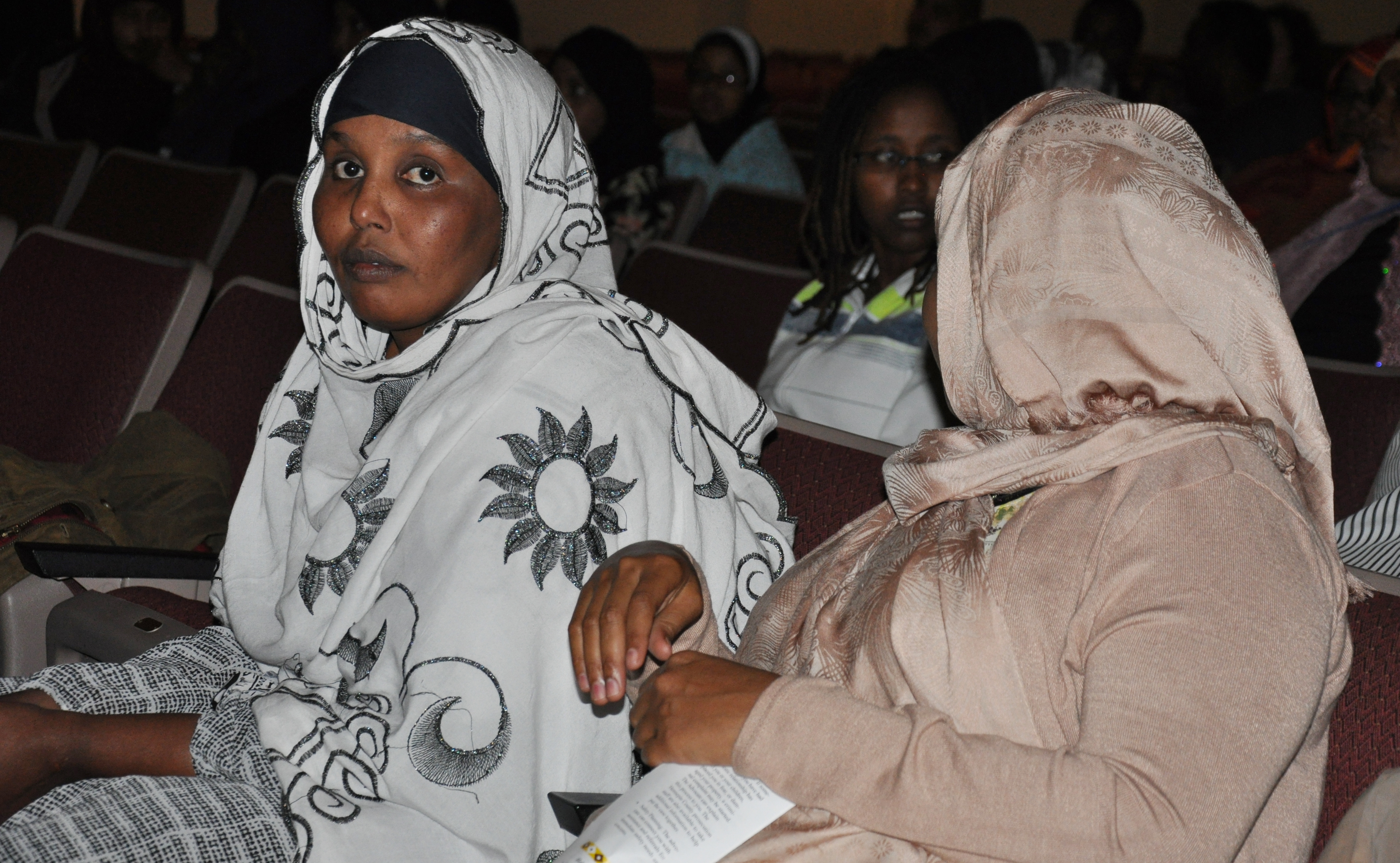
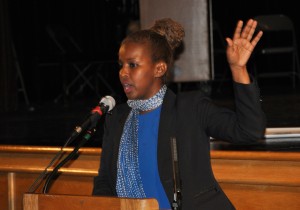
An attendee listens to one of the speakers. Photo: Issa A. Mansaray/The AfricaPaper
By Issa A. Mansaray | The AfricaPaper
Minneapolis, Minn – As terrorist groups continue to lure young Somalis from the Twin Cities to join them in the Middle East, Voice of East African Women (VEAW), based in Minneapolis, has started a series – Mothers Against Youth Recruitment – to address the growing problem affecting Somali women losing their children to terrorist recruiters.
Gathering
On October 15, at a local Somali community gathering at the Sabathani Community Center, Somali parents and community leaders were joined by Andrew Luger, U.S. Attorney for Minnesota, State Sen. Jim Carlson, Rep. Karen Clark, and Richard Thornton, FBI Special Agent in Charge, to talk about the continued trips of youths from Minnesota to join jihadist groups in Somalia, Syria, Iran, Iraq and other countries.
The organizer and participants hope the meeting will mend the tense relationship between the Somali community and law officials over the past few years. For now, the Somali women’s group and law enforcement want to find lasting solutions to cut down the rapid recruitment of young men and women from Minnesota for terror battlefields abroad.
Problem
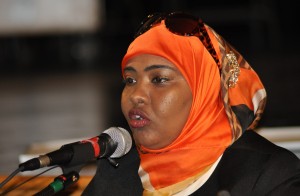
Farhio Khalif, founder and executive director of VEAW. Photo: Issa A. Mansaray/The AfricaPaper
Federal investigators say more than 20 Somali youths have left the Twin Cities to join the Islamic State of Iraq and Levant (ISIL), Al-Shabab and other groups in the past two years. Yet, many in the Somali community distance themselves from the problem.
“We want to open questions to the public with the media present,” said Farhio Khalif, founder and executive director of VEAW. “We see this [recruitment news] on TV every day. It is behind closed doors that we always talk about this. We invited the world to have mothers to put their voices out to talk about it. That something is happening. The recruitment is going on and who is really doing it?”
Khalif noted that this is the fourth part of the series discussion, and in previous meetings only women were involved in talks about their personal experiences and what they are going through in losing their children to terrorist groups.
Recruiting
“Family members are blaming the law enforcement, and the law enforcement says that we don’t know who is recruiting your children,” said Khalif, the event’s organizer. “This is more like mothers, fathers and parents standing and asking questions, and the law enforcement also giving information that they know.”
At the meeting, Luger and Thornton assured those present that they have a common goal with the Somali women and the community to stop terrorist groups from recruiting their children. “ISIS is a terrorist organization,” said Thornton. “They are murderers. They’re rapists. They enslave people. They commit atrocities on a daily basis.
“We know there is a very strong likelihood that if some young person leaves Minnesota to join [ISIS] in Syria and Iraq, they’re going to die in a battlefield there,” continued Thornton. “And that’s not something that we want to see happen to any young person from Minnesota or anywhere else.”
Suffering
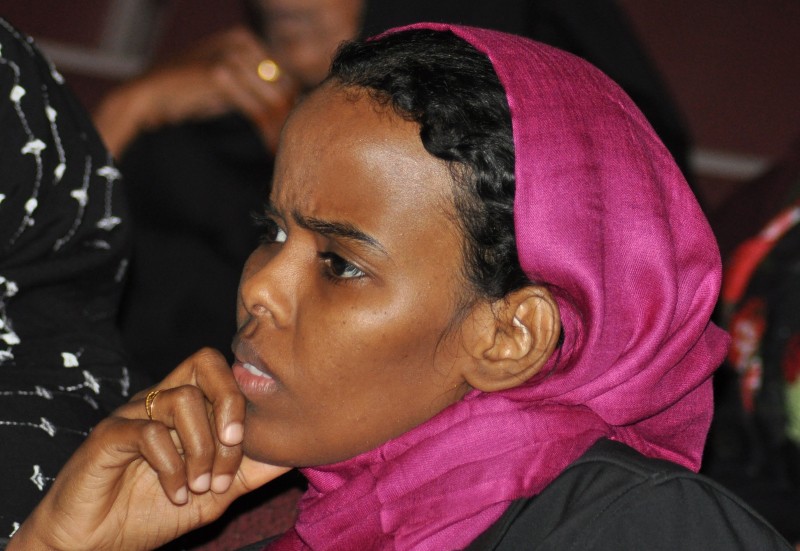
Saciido Shaie. Photo: Issa A. Mansaray/The AfricaPaper
Khalif said many women are suffering in silence, not knowing what to do or where to turn for help when their children are caught in the web of extremist recruiters. For many who are here without close relatives in the Twin Cities, and for single parents, the burden of finding lasting solutions is hard on them. Khalif briefly talked about one such woman.
“She’s afraid. And she told me, ‘I know my son is dead in Syria. He left last year.’ But she doesn’t know what’s going on, or how he ended up over there,” Khalif said. “But you know what, she wants to talk about [it], and advocate.”
“Though I thought I figured it out, I am worried every minute,” Saciido Shaie, a mother of three children, told the gathering. “I know the language. I read. I figure things out. Imagine parents who never figured out any of that, who when they go to the grocery don’t even know what they’re looking for because of the language barrier.”
Taskforce
To help the community address the recruitment problem and find solutions, the Somali-American Taskforce, a 15-member group, was created earlier this year. The group’s main goal is to end terror recruitment in Minnesota, but many Somali Minnesotans were skeptical about the program. At the town hall meeting Luger addressed the issue.
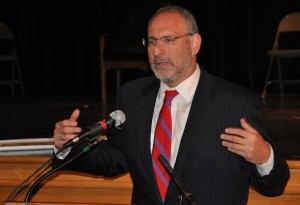
Andrew Luger, U.S. Attorney for Minnesota. Photo: Issa A. Mansaray/The AfricaPaper
“This pilot program has nothing to do with spying on the community,” said Luger. “And, if you have any doubt…if we wanted to use these programs to spy on the community, why on earth would we be up here talking about them?”
Though the program, formerly called Countering Violent Extremism, is federally funded, its critics and Somali Americans stressed that it unfairly targets and stigmatizes young Somalis, also claiming that it was an effort by the Justice Department to collect intelligence from their community. Luger completely disagreed with such claims, adding it was meant to support after-school programs for youth.
Role
For now, many have come to the conclusion that Somali mothers have a major role to play in stopping their children from joining extremist groups, and also ending terrorist recruiting in Minnesota.
“The mother in the Somali-American community is very strong, is very assertive in engaging the Somali American community in an open dialogue,” said Abdirizak Bihi, a community activist against extremist recruitment in the Twin Cities. “If the Somali mothers get engaged like this, I think we can see a huge reduction of those vulnerabilities of our youth.”
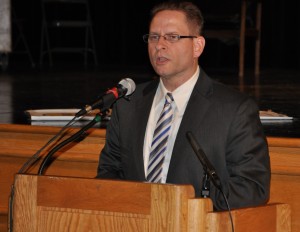
Richard Thornton, FBI Special Agent in Charge. Photo: Issa A. Mansaray/The AfricaPaper
Abroad
Meanwhile, law enforcement officials are still trying to find who is doing the recruiting, leading many youths to die abroad in foreign wars.
“There is no evidence that someone is pulling the strings. It is multifaceted. People here [in the Twin Cities] are traveling abroad. That is why it is so hard. If it is someone on the street corner doing that [recruiting], we can investigate,” said Thornton. “But it is friends-to-friends doing the recruiting and coming [from] overseas, through social media. Almost recruiting each other.” |TAP| Africa’s Newspaper of Record.
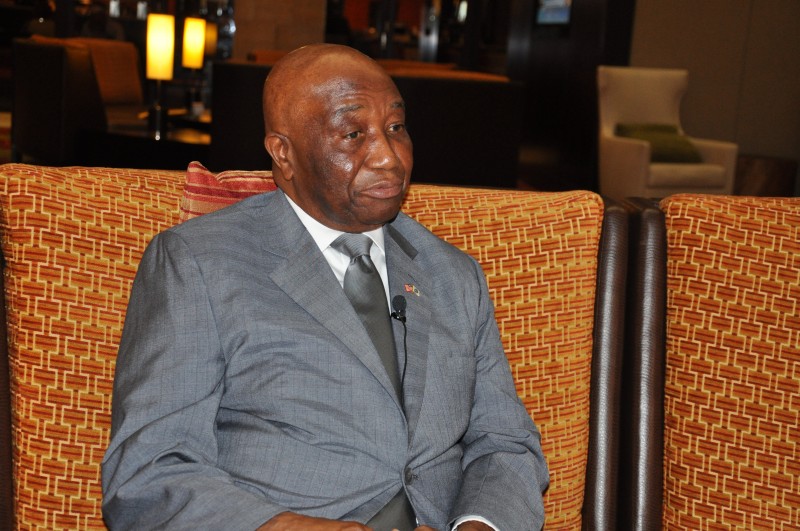
Liberian Vice President, Joseph N. Boakai. Photo: Issa A.Mansaray/The AfricaPaper
The AfricaPaper|News
Brooklyn Park, Minn – Liberian Vice President, Joseph N. Boakai, has arrived in the Twin Cities, home to more than 30,000 people of Liberian descent in the US.
The Vice President, who arrived in the Twin Cities on Wednesday on a week-long visit, will among other things meet with a cross section of Liberians in a Town Hall meeting on Friday at the Brooklyn Park City Hall.
Visit
Mr. Boakai is the highest ranking Liberia official to visit the Twin Cities since the Ebola crisis that ravaged the West African country. Accordingly, he will speak on the country’s post Ebola recovery and the current state of affairs in the Country.
In a brief interview with The AfricaPaper, Hon. Boakai expressed his government’s gratitude to Liberians in Minnesota as well as international partners in the Twin Cities for their various role in fighting Ebola in Liberia.
Outbreak
The Ebola outbreak in West Africa, which was first reported in March 2014, rapidly became the deadliest occurrence of the disease since its discovery in 1976. More than 11, 000 people died as a result of the outbreak. Liberia suffered the highest casualties with more than 4,800 fatalities in the country, according to the Centers for Disease Control and Prevention.
Liberia was declared free of the Ebola virus for the second time in early September by the World Health Organization and entered a 90-day period of heightened surveillance aimed at preventing a re-emergence of the disease.
Discussions
While in the Twin Cities, the Vice President will hold discussions with State and local officials including Governor Mike Dayton and the Mayors of Brooklyn Park and Brooklyn Center; two cities with predominant Liberian population.
Dinner
Meanwhile, the Patriots for Liberia’s Transformation, an interest group comprising volunteers, Liberians and friends of Liberia are planning a private dinner in honor of Vice President Boakai. According to Mrs. Georgette Gray, Coordinator of the Minnesota Chapter of the Patriots, funds raised from the dinner, which will take place on Sunday, Oct. 25 at the Passion Events Center in Fridley, will be used to transport Medical and Emergency supplies to Liberia.
Among individuals and groups expected to attend the dinner are Governor Mark Dayton, state and local officials, Liberia’s Ambassador to the United States. Hon. Jeremiah Solunteh, Liberia’s Acting Consul General in Minnesota, Hon Jackson George, Executives of the Organization of Liberians in Minnesota, Liberians and friends of Liberia.