Home Blog Page 5

FTC to Minnesotans: Everyone Has a Scam Story — Now’s the Time to Tell It

0

Moises’s salaried graphic production work in Minneapolis was earning him enough money to finally afford the opportunity to buy a good used car. As a favor, a friend at work offered him an introduction to a used car dealer who spoke Spanish.

A first-time buyer, Moises concedes that having someone who spoke Spanish to guide him through the transaction “made me feel more comfortable,” even as Moises raised questions about the chosen vehicle’s condition and reliability.

He accepted the dealer’s assurances, but within months, the car began shaking and made strange grinding noises. Moises soon felt it was unsafe to drive, especially with his mom or child on board, but the short-term warranty was not going to cover repair costs.

The entire transaction went downhill faster than the car could run, and if not for the intervention of Mid-Minnesota Legal Aid, Moises would have had 25 percent of his paycheck garnished to pay off the sale price debt incurred with the dealer.

Elizabeth Goodell, supervising attorney at Mid-Minnesota Legal Aid, appeared with Moises at a forum on consumer fraud for ethnic media in Minneapolis. The briefing, sponsored by the Federal Trade Commission and hosted by Ethnic Media Services, featured a panel of fraud-busting experts from the FTC, the state Attorney General’s office, and non-profit entities.  

Goodell said her primary focus is on consumer fraud writ large but, with a small staff, car fraud cases consume most of the office’s attention.

“Clients who have purchased a used car and the car stops working, and the car is repossessed, and then the client is sued for the rest of the debt owed on the car,” is a regular occurrence, Goodell explained.

A briefing sponsored by the Federal Trade Commission and hosted by Ethnic Media Services featured a panel of fraud-busting experts from the FTC, the state Attorney General’s office, and non-profit entities.  

The staggering toll of fraud in the U.S.

The scale of consumer fraud in the United States is staggering. Ted Kossow, Regional Director, USFTC, Midwest Region, said the amount of fraud reported in 2021 was $5.8 billion, a significant increase from the $3.2 billion from the previous year. COVID-19 scams for PPE, personal protection equipment, were partly to blame.  “Websites popped up, take your credit card and don’t deliver anything.”

Everyone has a story to share about scams, said Joannie Wei, Assistant Regional Director, FTC Midwest Region, recalling how on a recent cab ride her driver received two scam calls on his cell phone. “The first one was someone selling him an extended auto warranty. Ten minutes later, the second one was from ‘Amazon’ telling him that his account had unauthorized charges on it and they needed his account information to wire or send money back to him.”

Wei observed that scammers bombard the public through every available medium–social media, phone calls, and cellphone texts–to lure, entice, or coerce unsuspecting consumers. However, she added that the preponderance of the types of scams varies depending on the ethnic make-up of a community. Reporting fraud varies as well. “Latino communities don’t report fraud as much as Back or White communities,” she said.

Wei noted that the FTC, as the federal government’s primary consumer protection agency, also investigates other activities that though non-fraudulent–like a data breach or errors on a consumer’s credit record–can still wreak havoc on an individual’s financial status.

“Tell everybody you got scammed”

Bao Vang, Vice President, Better Business Bureau, provided a list of the top 10 scams plaguing Minnesota, the state where the BBB was founded 100 years ago. Imposter scams led the list, followed by identity theft and cryptocurrency scams.

During the give and take with the audience, Hmong community members discussed scams targeting legacy investments and the cultural barriers to reporting fraud, especially if that fraud was perpetrated by a member of the community.  There were observations from Somali community leaders about fundraisers for burials that prey on grieving families facing exorbitant costs for burials that comply with religious custom.

Also in attendance was Jessica Aliaga-Froelke, founder and president of Hispanic Solutions, LLC. A former debt collector and student loan counselor, Aliaga-Froelke established her company to focus on a Spanish-speaking clientele, including immigrants who, as she noted, are often the victims for the most egregious forms of predatory lending and interest rate inflation.

Jennifer Leach, Director of Consumer and Business Education for the FTC, advised the media to encourage their audiences to be more aggressive in reporting fraud. Her office generates consumer fraud awareness materials and has blog alerts that now reach 400,000 e-mail addresses.

“If we don’t know about it, we can’t do anything about it,” she remarked. “”This is the beginning of a conversation. We want to hear what you’re seeing. We want to be able to bring these cases,” she said, referring to the FTC attorneys as “the lawyers who sue the bad guys.”

Remarks by Kathryn Kelly, from Minnesota’s Attorney General Office, echoed the call to action to report fraud.

“Our number one tip for the public,” Kelly said, “is talk about what you’re seeing and talk about what’s happening to you because people feel a lot of shame when they get scammed. They shouldn’t, but we do. It’s natural. You feel like, I made a mistake. I don’t want to tell my family. I don’t want to tell my kids or my neighbor or my faith leader. But do. Tell everybody you got scammed. They might be able to help you, but even if they can’t, you can help them not get scammed.”

Five Ways to Avoid Health Scams


People spend billions each year on remedies they hope will improve their health. But a lot of that money goes to companies making fake claims that cheat people out of their money, time, and even their health. Before you buy a supplement or another health product: 

  • Always talk with a healthcare provider first. Even if a supplement claims to be FDA cleared or approved, it can interact with your prescriptions, making them less effective or too strong. Work with your healthcare provider to safely incorporate supplements into your treatment plan. 
  • Don’t stop taking your prescriptions without asking your healthcare provider. Your provider knows your health history and the right treatments for your condition.
  • Do some research. Search for the name of the supplement or product online, plus the words “review,” “complaint,” or “scam.” If any product guarantees miracle results, it may be a scam. 
  • Avoid products with “guarantees.” Strangers don’t know how your body will respond. 
  • Natural” doesn’t mean either safe or effective. In fact, “natural” can mean both harmful and ineffective. And some “natural” products might interfere with proven treatments recommended by your healthcare professional.

Learn more at ftc.gov/health. If you spot a scam, report it to the Federal Trade Commission at ReportFraud.ftc.gov

How to avoid spinning your wheels when shopping for a used car

Used cars have gotten more expensive during the pandemic. It pays to do some work upfront, so you’ll feel better driving out. In fact, start by researching the price of cars you’re interested in. Then, before you shop for the car, shop for financing. Check with banks, credit unions, and finance companies – you don’t have to finance a car through the dealer. 

When you think you’ve found the car you want:

  • Call the dealer. Make sure the car is really on the lot and get the out-the-door price in writing, before you head to the dealership.
  • Get a vehicle history report and check the Buyer’s Guide. The report will tell you that car’s history, and the Guide will tell you if has a warranty or is being sold “as is.”
  • Discuss the out-the-door price first if you want to talk financing with the dealer. That means the total price, before financing, including taxes and fees. 
  • It’s ok to say no to add-ons, or at least ask the price. Add-ons are extra things dealers offer along with the car, like extended warranties and service contracts. Make sure you know what they are, how much they cost, and how they’ll change your monthly payment.
  • Review the terms before you sign for the purchase and financing. Make sure everything you agreed to is in writing. Spoken promises are hard to enforce.

Learn more at ftc.gov/usedcars. If you spot a scam or bad business practice, report it to the Federal Trade Commission at ReportFraud.ftc.gov 

African Leaders Battle Third Virus Wave

By Alie Badara Sheriff | The AfricaPaper

Freetown, Sierra Leone – COVID 19 infections have increased in Africa for six consecutive months with cases rising faster than previous peaks, according to the World Health Organization (WHO).

COVID-19 Wave

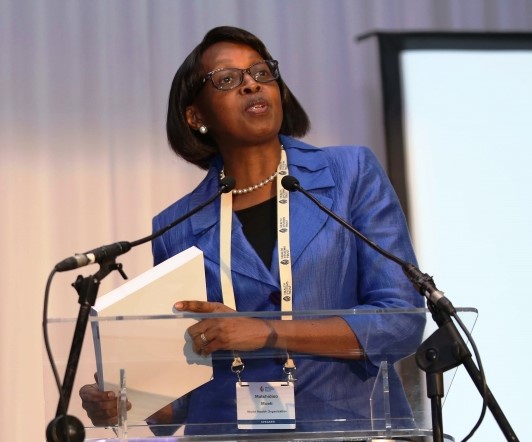
“The speed and scale of Africa’s third wave is like nothing we’ve seen before,” Matshidiso Moeti, WHO’s regional director for Africa, said.

The rise in the infection result was announced last week with WHO warning nations about Alpha, Beta, and the highly transmissible Delta variant.

A t is shown in the water.
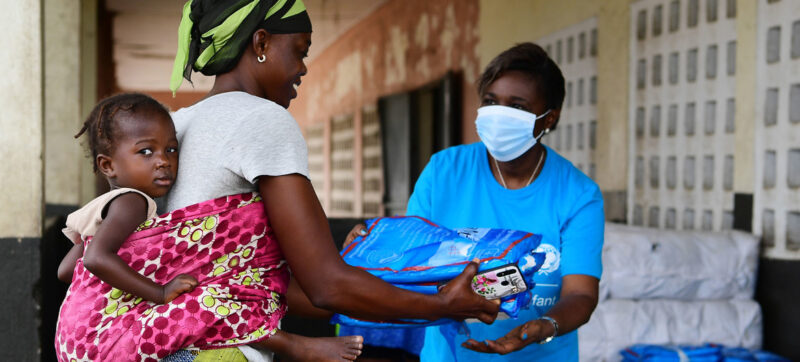
UNICEF is distributing critical supplies to families in Côte d’Ivoire during the COVID-19 pandemic. © UNICEF/Frank Dejongh

 “The rampant spread of more contagious variants pushes the threat to Africa up to a whole new level. More transmission means more serious illness and more deaths, so everyone must act now and boost prevention measures to stop an emergency becoming a tragedy, Dr. Moeti said.

Positive Cases

Infections are up 25% with 202,000 positive cases. The number of deaths rose by 15% across 38 countries in Africa to nearly 3,000 in recent months, according to WHO.

The leading global health organization also reported that the highly transmissible Delta variant, initially identified in India, is now dominant in places like South Africa, which accounts for more than half the infection in Africa. The virus was also detected in 97% of the samples obtained in Uganda, and 79% in the Democratic Republic of Congo, according to WHO experts.

Young Adults

A significant number of young adults are also among those affected. In Uganda, 66% of severe illness in people younger than 45, is attributed to Delta, according to WHO.

The Alpha and Beta variants have been identified in 32 and 27 countries. The former has been detected in north, west, and central Africa, while Beta is mostly concentrated in the south, according to WHO.

A t is shown in the water.
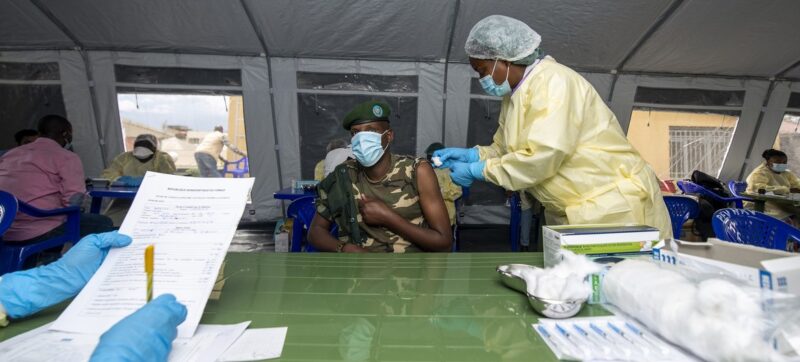
A nurse at North Kivu Provincial Hospital administers the first dose of the COVID-19 vaccine to a 45-year-old soldier in the Democratic Republic of the Congo. UNICEF/Arlette Bashizi

While there are rising cases and hospitalization across the continent, WHO estimates the demand for oxygen in Africa at 50%, more than the number reported for the first wave peak last year.

A mere 15 million people, 1.2% have been vaccinated in Africa, leaving the bulk of the population with limited or no access to the approved vaccines, according to WHO. 

Distribution Problem

At least eight vaccines for WHO emergency use listing have been approved, however, efforts to transport the much-needed medication have been difficult, according to WHO.

Across Africa, more and more countries are taking extra precautions to combat the spread of the life-threatening virus. In Sierra Leone, the country and its neighbors are considering closing borders and limiting travels between nations.

Curfew

On Thursday, the government of President Maada Bio announced a nationwide curfew and a ban on large gatherings starting this week.  Attendance at churches and mosques will be suspended. Social gatherings of more than 50 people are prohibited. However, bars and restaurants will remain open up to 9:00 pm

The country reported more than 5,000 cases since March last year. In a country, where access to Personal Protective Equipment is limited, many are worried about the rising cost of buying items like masks, personal hygiene products, and food supplies while the country remains on lockdown.

But Mr. Bio has steadfastly vowed to keep the 11 pm to 5 a.m., curfew in place, at least for now.   

“We believe we must take urgent and necessary steps to stem this third wave of the COVID 19 pandemic,” Mr. Bio said in a nationwide address. TAP – The AfricaPaper

OP-ED: Safely Educating Our Children During a Pandemic

An Op-ed by Governor Tim Walz on the Safe Learning Plan for 2020-21 school year that was sent to publish in respective newspapers with no rule of exclusivity.  

By Governor Tim Walz

As a classroom teacher for more than 20 years, I know firsthand how resilient, strong, and flexible our students and educators are. There’s nobody better suited for a challenge. But COVID-19 has posed unprecedented questions about the balance of public health and education that simply have no easy answers.

Worry

We know Minnesotans have conflicting feelings about the upcoming school year. Some families are afraid for the safety of our students and the families they go home to. Others are eager to get children back into the classroom, where our kids learn best. Many more feel a mixture of both and we all worry about the health of our teachers and school staff. As a former teacher for more than 20 years and the parent of a child in public school, I am committed to providing the best education to our students while keeping them and their educators safe.

I followed three principles as I worked with the Departments of Education and Health on a plan for the 2020-21 school year. First, our top priority was the safety, health, and well-being of students, staff, and families. Second, we continue to make data-driven decisions, leaning on science and research to make the best decisions for our state. And finally, we would respect the importance of local school districts, their expertise of their unique communities, and their commitment to making the best decisions for their students.

Approach

That is why we are taking a localized, data-driven approach to the 2020-21 school year that will put student and staff safety first. By bringing together the local education leaders who know their students, staff, and communities the best with the public health experts who know the virus the best, this plan will help determine a learning model that makes the most sense for each community.

School districts and charter schools will begin in one of three models: in-person, distance learning, or a hybrid model. Experts at the Departments of Health and Education will partner with local school districts and charter schools to help determine which learning model they should use to start the school year. While there are many factors to consider, the decision-making process will center on local data indicating the prevalence of COVID-19 in the surrounding county.

Flexible

A t is shown in the water.
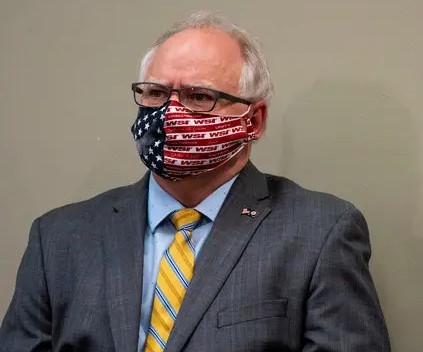
Gov. Tim Walz Credit FB Page

Throughout the school year, we will need to be flexible and adapt with the fluid nature of this pandemic. The Departments of Education and Health will work with school districts and local health professionals to consistently track the virus to determine if and when a school may need to adjust their learning plan. School districts and charter schools will be required to ensure all families have the option to choose distance learning for their students. Teachers and staff will be given similar flexibility to the extent possible. As we switch between models, the plan prioritizes keeping younger children in the classroom because transmission is less likely for younger children and in-person learning is particularly critical at their developmental stage.

Support

With an investment of more than $430 million, we will support our schools, educators, students, and families through this uncertain time. We will provide face coverings for every student, educator, and staff member. We will deploy a comprehensive testing plan for educators and staff. We will help cover costs for cleaning supplies and technology needs, and we will create strategies for child care throughout the state.

School districts and public health officials have a lot of important work to do, but the ultimate success of this process isn’t just up to them. It’s also in the hands of each and every Minnesotan. Our schools reflect their surrounding communities. For this to work, we need Minnesotans to come together to slow the spread of COVID-19. We need everyone to do their part to help get our kids and our teachers back in the classroom safely.

The AfricaPaper: Tim Walz is Minnesota’s 41st Governor, with public service in the military, serving students as a high-school teacher and football coach to serving the state in Congress.