Home Blog Page 44

Kenya: Anxiety at New Trial Date for President


kenyatta

Fears that further delay could jeopardise witness safety, and the case itself.

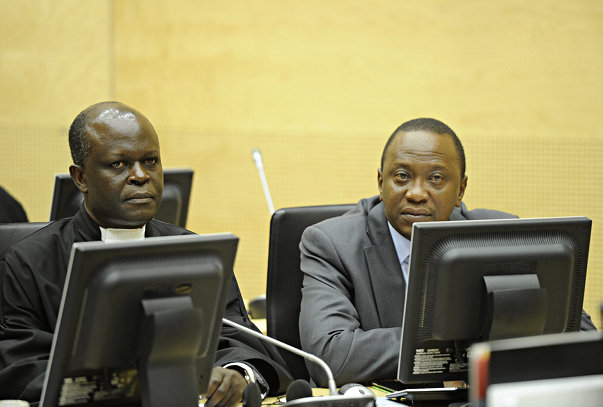
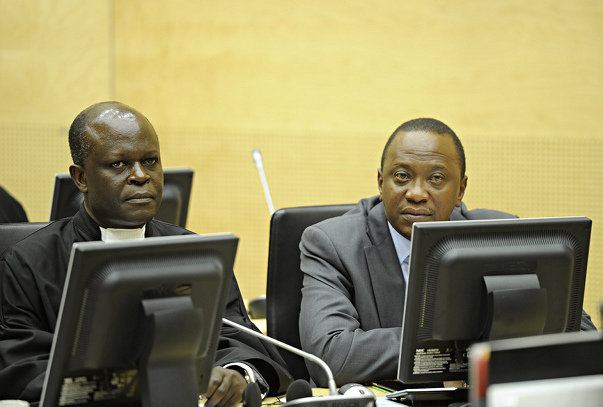
Kenyans who suffered directly in the violence that hit their country in the aftermath of a general election in December 2007 have criticised the latest postponement of President Uhuru Kenyatta’s trial in The Hague.

Trial

Judges at the International Criminal Court, ICC, have put the start date back for a second time to allow Kenyatta’s lawyers enough time to prepare their case, following a succession of failures by prosecutors to disclose evidence punctually.

As well as Kenyatta, Kenya’s deputy president William Ruto is also to go on trial at the ICC. Ruto is charged with journalist Joshua Arap Sang in a case separate from that of Kenyatta, because they were on opposing sides during the conflict.

All three face charges of crimes against humanity for orchestrating the ethnic violence that followed the disputed result of the 2007 presidential election.

More than 1,100 people were killed and around 650,000 others lost their homes in the violence.

People living in Kenya’s Rift Valley region, which was at the epicentre of the unrest in late 2007 and early 2008, are worried that the latest postponement will endanger witnesses, and could derail proceedings altogether.

Afraid

Some witnesses have informed the prosecution that they are afraid to testify against the suspects.

ICC Prosecutor Fatou Bensouda has repeatedly complained of interference in her work, and has criticised the Kenyan government for failing to take a stand against witness intimidation. (See Kenya Witnesses Face Harassment.)

In March, Bensouda had to drop proceedings against a fourth suspect, Francis Muthaura, after a witness admitting being bribed. Muthaura, formerly head of the Kenyan civil service, had been charged in the same case as Kenyatta.

Maurice, a resident of the town of Nakuru in the Rift Valley, expressed concerns about the delay which are shared by many.

“It’s legal that the defence must be given more time to prepare, but judges should also be aware that the accused in this case is a sitting president capable of using his power to delay or even stop justice,” he said.

“These postponements continue to subject witnesses and victims to intimidation and undue pressure for withdrawal from the case. The prosecution may eventually lose all those willing to testify against the president and his deputy, due to mounting pressure and threats from some highly-placed quarters.”

Kenyatta and Ruto, who were elected president and deputy president in a March 4 election, have denied interfering with witnesses and have repeatedly pledged to cooperate fully with the ICC.

Postponed

Kenyatta’s case was supposed to get under way on April 11 but judges delayed proceedings until July 9. In April, his lawyers told judges that the July 9 trial date was untenable, prompting the court to reconsider the start date again.

Defence lawyers argued that the trial should not start until January 2014 because they needed more time to investigate the allegations and the credibility of five prosecution witnesses whose identities and full testimonies had at that point not been disclosed to them.

They also raised concerns that the prosecution had failed to disclose what they said was “critical” evidence.

Prosecutors argued against such a lengthy postponement, pointing out that the defence had already benefited from the initial delay to July 9. They suggested that the trial start soon after the court’s recess, which ends in mid-August.

The prosecution also asked judges to consider the welfare of victims and witnesses in the case.

The legal representative of 231 victims in Kenyatta’s case, Fergal Gaynor, informed judges that of 51 victims who were consulted, 47 were opposed to any further postponement beyond July 9.

Slow Pace

Gaynor said the victims felt “frustration at the slow pace of the proceedings, as well as scepticism regarding the defence’s strategy in seeking an adjournment, and concerns as to their own security and the security of witnesses now that Kenyatta is in power”.

In their June 20 ruling, judges set November 12 as the new date, and agreed with Kenyatta’s lawyers on the need for a second delay because of “the volume of new evidence disclosed to the defence only in January 2013, and the delays in disclosing the identity of a significant proportion of the prosecution’s witnesses”.

The judges considered setting the start date in early October, but scheduling clashes with other ICC cases and a lack of courtroom space led them to conclude that proceedings could not begin until November.

Despite the clear legal reasons for the delay, victims in Kenya fear that the judges are making too many concessions to efforts to delay the case, and ultimately to get it thrown out altogether.

Criticized

Last month, the African Union sharply criticised the ICC and wrote to The Hague requesting that both cases – Kenyatta and Ruto/Sang – be sent back to Kenya to be dealt with by the courts there. That request came just two weeks after Kenya’s ambassador to the United Nations wrote to the Security Council asking it to get the two cases dropped completely.

“This government is clearly determined to do anything within its powers to abort the justice process,” Miriam, who lost her home in the electoral violence five years ago and still lives in the Naka displacement camp in the Rift Valley, told IWPR. “The court is more concerned about the reasons presented by the accused than the plight of victims in the twin criminal cases.”

Earlier this month, more than 90 victims represented in the case against Ruto and Sang pulled out of proceedings, claiming they were no longer confident that the process at the ICC was “beneficial” to them. (SeeKenyan Victims Withdraw From ICC Proceedings.)

The latest trial delay has made victims even more doubtful that they will see justice done for the 2007-08 bloodshed.

“While it’s the right for the accused and victims [to obtain] equal justice, the president and his deputy should accept to face the trials and clear their names once and for all,” Chege, a father of three at Naka camp, told IWPR.

The AfricaPaper: Robert Wanjala reports from Eldoret, in Kenya’s Rift Valley region.

This article was produced as part of a media development program implemented by IWPR and Wayamo Communication Foundation.
The Guardian: Small British paper makes big impact with NSA stories

0


Reporters_Treason.JPEG-0bf0f

By Paul Farhi

For a newspaper that’s small and underweight even by British standards, the Guardian has a knack for making some big noises, both in its home market and across the pond.

The venerable paper (founded in 1821) was one of five news organizations to publish stories based on WikiLeaks’s trove of leaked U.S. diplomatic cables in late 2010. The only American newspaper to publish the leaks, the New York Times, did so thanks to the generosity of the Guardian, which shared the documents.

Next, the Guardian’s revelations about the extent of illegal phone tapping by journalists at Rupert Murdoch’s News of the World in 2011 helped bring down the massively popular British tabloid and led to a wave of criminal prosecutions in Britain.

In late May, the Guardian was at it once more. The newspaper raced The Washington Post to break details of a massive National Security Agency surveillance program. It subsequently posted the first and only video interview with Edward Snowden, the young American security contractor who was the source of The Post’s and Guardian’s stories.

Not a bad run of scoops for a financially struggling, frankly liberal newspaper with a newsprint circulation of fewer than 160,000 copies daily (which makes it roughly the size of the Arkansas Democrat-Gazette) but with a significantly larger digital following worldwide.

Edward Snowden
Edward Snowden

The NSA stories, in particular, raised the Guardian’s profile to an Everest-like peak. Its video interview with Snowden, conducted by its star American columnist Glenn Greenwald, attracted nearly 7million unique views worldwide in one day. The total was a record for the paper’s Web site, which is already one of the world’s most heavily trafficked news sites with a high of 41 million unique monthly visitors.

The NSA and WikiLeaks revelations also raise a question: Why is a London-based news organization revealing so many secrets about the American government?

“We’re just doing what journalists do,” replies Alan Rusbridger, the Guardian’s longtime editor and architect of its global digital strategy. “We were contacted, just as The Washington Post was contacted, [by a source] with some very interesting documents. No journalist in the world wouldn’t have been interested in this.”

The Guardian, he points out, is equally dogged about domestic spying; it published revelations last month that the British equivalent of the NSA monitored the computers and phone calls of foreign officials during two G-20 summit meetings in London in 2009 – a story that embarrassed the British government on the eve of hosting another international summit.

Since 2008, the Guardian has been making a major push to appeal to the American market. After a bout of layoffs, it now employs 29 journalists in the United States, primarily in New York and Washington. Online visitors from the States are channeled to the Guardian’s U.S. edition, which features America-centric news. Monday’s page, for example, carried articles about the deaths of firefighters in Arizona and a retrospective of photos from the Battle of Gettysburg.

Along the way, the paper has hired a succession of American pundits such as Murdoch biographer Michael Wolff, NPR host Bob Garfield and former Wonkette blogger Ana Marie Cox.

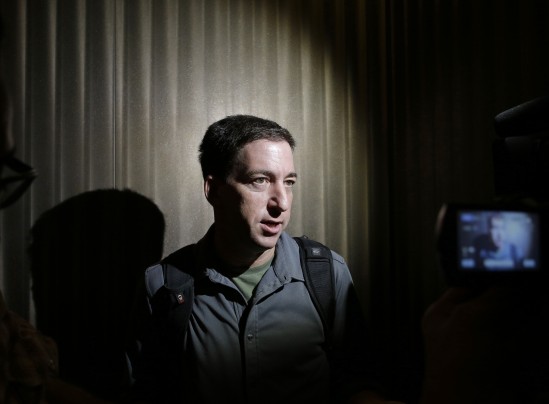
Its biggest hire, arguably, has been Greenwald, the crusading columnist who broke (along with The Washington Post’s Barton Gellman) the NSA surveillance stories.

Greenwald joined the Guardian as a regular columnist and blogger last August. He said the decisive factor in his decision to leave Salon.com for the Guardian wasn’t money, but rather the newspaper’s approach to the powerful.

“For at least a couple of years before I went there, I found myself citing Guardian articles quite frequently in the work I was doing,” Greenwald said in an exchange of e-mails from Rio de Janeiro, where he resides with his Brazilian husband. “They were extensively covering vital stories that most U.S. media outlets were either ignoring or downplaying in areas of U.S. foreign policy, civil liberties, secrecy, whistleblowing and the like.”

In Greenwald’s view, American media outlets “tend to be far more reverent of and accommodating to political power than British media outlets, including the Guardian.”

Then again, the Guardian has its own sacred cows. Unlike its American media cousins, which have traditionally sought neutrality in their news reporting, the Guardian hews to the British model of identifying with a political party. The paper has been liberal since its founding by Manchester mill owners and cotton merchants; in the last British elections it supported the minority Liberal Democrats.

It has played politics here, too. In 2004, it enlisted its readers to write to undecided voters in Ohio, advising them to vote against President George W. Bush. The campaign elicited a thunderous rebuke from American and British readers alike and was scrapped.

Rusbridger explains that some of the Guardian’s willingness to experiment, and much of its independence, is a result of its unusual ownership structure. The newspaper has been owned for decades by a charitable foundation, the Scott Trust Limited, whose “core purpose” is to secure the paper’s editorial independence “in perpetuity.” The trust also owns a sister newspaper, the Observer. (On Sunday, the Observer posted and then quickly withdrew a story that alleged the United States had worked with European Union countries to collect personal communications data; the piece was based solely on information from Wayne Madsen, an American conspiracy theorist who has suggested that President Obama is gay.)

For all its nominal success abroad, the Guardian is troubled at home. Circulation of its domestic print edition has tumbled by more than half since the beginning of 2006; according to British media accounts, the paper lost about $1 million a week from 2009 to 2012. It continues to lose money, according to Rusbridger. “We’ve been through lean times like everyone else,” he says. “Last year wasn’t great.”

But he notes that the paper is subsidized by other ventures owned by the trust, including Auto Trader, a highly profitable British car-sales site.

Rusbridger isn’t blind to the irony. The next round of globe-rattling government-secrecy revelations, he says, may be brought to you by “a secondhand car magazine.

The AfricaPaper: Many thanks to Paul Farhi and The Washington Post for this report.

News Analysis: The Next Phase of the Arab Spring


Coup in Eqypt

Analysis

The Arab Spring was an exercise in irony, nowhere more so than in Egypt. On the surface, it appeared to be the Arab equivalent of 1989 in Eastern Europe. There, the Soviet occupation suppressed a broad, if not universal desire for constitutional democracy modeled on Western Europe. The year 1989 shaped a generation’s thinking in the West, and when they saw the crowds in the Arab streets, they assumed that they were seeing Eastern Europe once again.

There were certainly constitutional democrats in the Arab streets in 2011, but they were not the main thrust.Looking back on the Arab Spring, it is striking how few personalities were replaced, how few regimes fell, and how much chaos was left in its wake. The uprising in Libya resulted in a Western military intervention that deposed former leader Moammar Gadhafi and replaced him with massive uncertainty. The uprising in Syria has not replaced Syrian President Bashar al Assad but instead sparked a war between him and an Islamist-dominated opposition. Elsewhere, revolts have been contained with relative ease. The irony of the Arab Spring was that in opening the door for popular discontent, it demonstrated that while the discontent was real, it was neither decisive nor clearly inclined toward constitutional democracy.

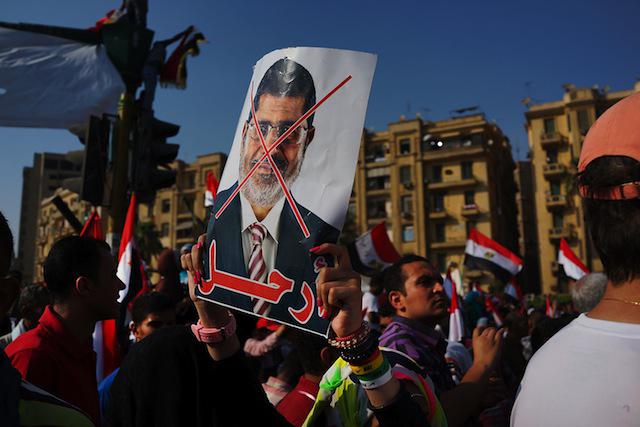
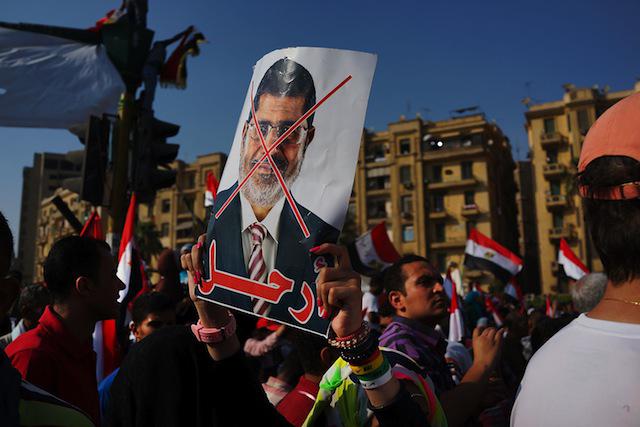
This is what makes Egypt so interesting. The Egyptian uprising has always been the most ambiguous even while being cited as the most decisive.It is true that former President Hosni Mubarak fell in 2011. It is also true that elections were held in 2012, when a leader of the Muslim Brotherhood‘s election as president highlighted the reality that a democratic election is not guaranteed to produce a liberal democratic result.In any case, the now-deposed president, Mohammed Morsi, won by only a slim margin and he was severely constrained as to what he could do.

But the real issue in Egypt has always been something else. Though a general was forced out of office in 2011, it was not clear that the military regime did not remain, if not in power, then certainly the ultimate arbiter of power in Egyptian politics. Over the past year, so long as Morsi remained the elected president, the argument could be made that the military had lost its power.But just as we argued that the fall of Hosni Mubarak had been engineered by the military in order to force a succession that the aging Mubarak resisted, we can also argue that while the military had faded into the background, it remained the decisive force in Egypt.

Modern Egypt was founded in 1952 in a military coup by Col. Gamal Abdel Nasser.Nasser was committed to modernizing Egypt, and he saw the army as the only real instrument of modernization.He was a secularist committed to the idea that Arab nations ought to be united, but not Islamist byany means. He was a socialist, but not a communist. Above all else, he was an Egyptian army officer committed to the principle that the military guaranteed the stability of the Egyptian nation.

When the uprisings of the Arab Spring came, Nasser’s successors used the unrest to force Mubarak out, and then they stepped back. It is interesting to consider whether they would have been content to retain their institutional position under a Muslim Brotherhood-led government. However, Morsi never really took control of the machinery of government, partly because he was politically weak, partly because the Muslim Brotherhood was not ready to govern, and partly because the military never quite let go.

This dynamic culminated in the demonstrations of this “Egyptian Summer.” The opposition leadership appears to support constitutional democracy. Whether the masses in the streets do as well or whether they simply dislike the Muslim Brotherhood is difficult to tell, but we suspect their interests are about food and jobs more than about the principles of liberalism. Still, there was an uprising, and once again the military put it to use.

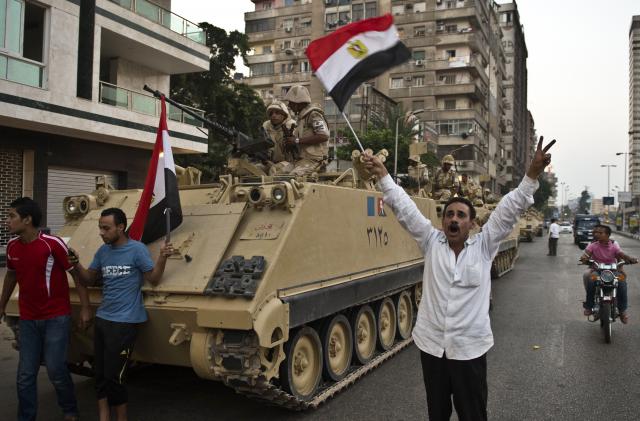
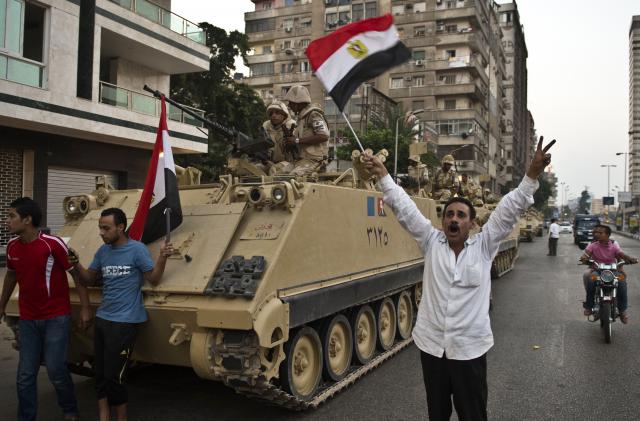
In part, the military did not want to see chaos, and it saw itself as responsible for averting it. In part, the military distrusted the Muslim Brotherhood and was happy to see it forced out of office. As in 2011, the army acted overtly to maintain order and simultaneously to shape the Egyptian political order. They deposed Morsi, effectively replacing him with a more secular and overtly liberal leadership.

But what must be kept in mind is that, just as in 2011, when the military was willing to pave the way for Morsi, so too is it now paving the way for his opposition. And this is the crucial point — while Egypt is increasingly unstable, the army is shaping what order might come out of it.The military is less interested in the ideology of the government than in containing chaos. Given this mission, it does not see itself as doing more than stepping back. It does not see itself as letting go.

The irony of the Egyptian Arab Spring is that while it brought forth new players, it has not changed the regime or the fundamental architecture of Egyptian politics.The military remains the dominant force, and while it is prepared to shape Egypt cleverly, what matters is that it will continue to shape Egypt.

Therefore, while it is legitimate to discuss a military coup, it is barely legitimate to do so. What is going on is that there is broad unhappiness in Egypt that is now free to announce its presence. This unhappiness takes many ideological paths, as well as many that have nothing to do with ideology. Standing on stage with the unhappiness is the military, manipulating, managing and containing it. Everyone else, all of the politicians, come and go, playing a short role and moving on — the military and the crowd caught in a long, complex and barely comprehensible dance.

The AfricaPaper: Egypt’s Atypical Military Coup is republished with permission of Stratfor.

Analysis: Egypt’s Atypical Military Coup


Egypt

Analysis

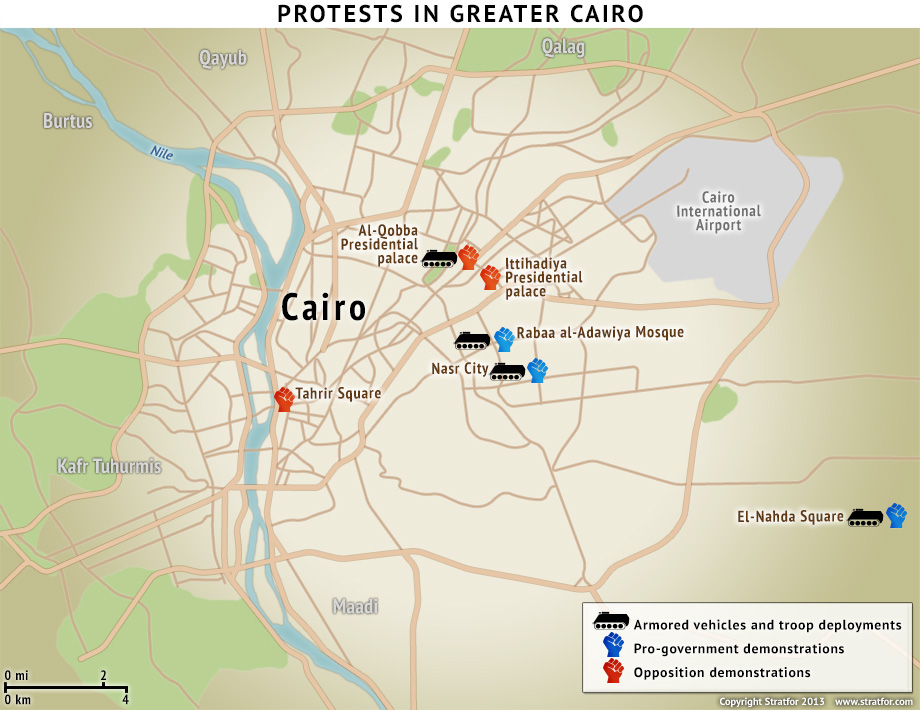
A debate is underway in Egypt on whether the move to oust President Mohammed Morsi is tantamount to a military coup. Considering that the Egyptian army is forcibly removing a democratically elected president in the wake of nation-wide unrest, the military intervention is indeed a coup. However, it differs from other coups in that direct military rule will not be imposed.

There is considerable public support for Morsi’s removal, so the provisional authority that will replace him likely will be a broad-based entity that includes representatives of the nation’s main political stakeholders. Indeed, the interim government likely will differ greatly from the one run by the Supreme Council of the Armed Forces, which governed the state after former President Hosni Mubarak was forced from office in 2011 and until Morsi came to power in June 2012.

Egypt_Cairo_clashes_2013

Herein lies the problem of the Egyptian military, which has been the mainstay of the regime since the founding of the modern republic in 1952. For most of its history, especially since after the end of the 1967 war, Egypt’s military has never directly governed the country; rather, it ruled from behind the scenes, except for the year when the Supreme Council of the Armed Forces ruled. Until the fall of Mubarak, this was achieved by means of single-party rule where the now-disbanded National Democratic Party administered at the behest of the military. The destruction of the National Democratic Party was a major dilemma for the military, which no longer had a civilian partner. This was further complicated by the onset of a multi-party era.

As the single largest, most coherent political force in the country, Morsi’s Muslim Brotherhood was able to benefit from the electoral process. With the election of Morsi as president last year, it appeared as though the military had found a replacement of sorts for the National Democratic Party — the ideological differences notwithstanding. What the military needed was a government that could manage the political economy of the country such that the state of unrest could remain limited.

Morsi’s government failed to do that. His focus on consolidating power for his group is what triggered the current massive public backlash. As a result, the army is once again without a civilian partner. There are no alternatives to the Muslim Brotherhood because the opposition is a large protest movement without any coherent core. However, it is notable that the impetus for these protests was the liberal and secular opposition, who for the first time demonstrated an ability to establish a united front. It is unclear whether the opposition will coalesce and whether Tamarod’s political wing, June 30 Front, represents a political alternative to the Brotherhood’s established social networks in the country. Mohammed ElBaradei’s appointment as the negotiator for much of the opposition could be a first step toward a political entity besides the Brotherhood that could wield civilian power.

The unrest generated by the opposition elements united under Tamarod, and to a lesser extent even among some Islamists, has forced the military to get rid of the Morsi presidency. After all, the president refused to resign, and the opposition would not accept his proposals for a compromise. But this is not the outcome the military preferred. It hoped Morsi could maintain control of the country while securing the military’s economic and political interests.

But the massive public outcry and the Brotherhood’s defiant stance left the military with no option but to follow through on its threat to remove the president. The outcome is not just the removal of a government; it is the collapse of a burgeoning democratic system. Furthermore, the forcible removal of the Morsi government will make it difficult to create a new civilian government because the political environment will be even more polarized. The move has no doubt angered the Muslim Brotherhood, which we expect to push back dramatically. But just as important, the military has set a precedent for giving in to mob violence.

Morsi’s downfall shows that the army’s decades-long strategy of ruling without governing is proving increasingly difficult to impose. It cannot impose military rule because doing so would only aggravate tensions. It also shows that the country needs a coalition government. Such a government would be extremely difficult to create. Even though Egypt is constrained by the different factions and pressures in the country, the military remains the ultimate source of power in the country.

The AfricaPaper: Egypt’s Atypical Military Coup is republished with permission of Stratfor.

Whoever drinks from the Nile will always return to it

0


Egypt-Africa

By Ahmed Kadry | The AfricaPaper

Disclaimer: I am fully aware as an Egyptian that what you read next may sound biased, utopian, out of touch with reality, and so on. But I am going to go ahead and write it anyway; firstly because I believe it to be true, and second, because with all the negativity that currently oozes around Egypt’s households, universities and coffee shops on the discontent, hardship and frustration the country is facing, a bit of optimism can go a long way. So here we go.

There is no mistaking it. Spend enough time in Egypt and you will soon realize that Egypt to Egyptians is special – something that must be protected, fought over, and loved. “Egypt” is not just a physical territory or the colour of the flag to Egyptians, but can be better viewed through the lens of an abstract ideal, and that was all prevalent well before there was ever something called the 25 January 2011 Revolution, which has since sent the bond between Egyptians and Egypt into over-drive.

Often linked to the ideology and discourse of “natives” who exclude and object to the growing multi-ethnic diversity of a country, nationalism in the Egyptian context is markedly different.

Beth Baron, an academic who works on nationalism and women’s rights explains:

“The nation, according to its proponents, was ‘one family’ descended from the same roots with shared blood. Young men, the foot soldiers of the nation, were its ‘sons,’ and young girls became its ‘daughters.’ At the head of the nationalist movement generally loomed a dominating ‘father’ figure or group of ‘founding fathers.’ Nationalists hoped to replicate the sense of belonging and loyalty experienced within the family on a national scale.”

The “father” figure persona of the leader of the nation could clearly be seen in the rhetoric of Nasser, Sadat, Mubarak, and now Mohamed Morsi. Various idiomatic sentiments within the Egyptian dialect of Arabic, such as, “Whoever drinks from the Nile will always return to it,” and “Egypt is the Mother of the World,” are examples of this surfacing of national pride.

One could argue that Nasser employed his nationalist rhetoric aggressively in the Arab-Israeli wars, but he was doing so in Egypt’s infancy years after colonialism and used the legacy of colonial oppression as a political tool to cement his leadership. On the ground, however, and particularly after the crushing defeat of 1967, there was growing discord, and as historian Derek Hopwood puts it, “there was some feeling that Egypt had suffered enough for the Arabs, and that Egyptians should rely primarily on themselves for their salvation.”

It would be remiss to suggest racism or prejudice does not exist in Egypt – and there is never any justification for that. Yet I would argue this is linked to wider political fear-mongering and suspicion bred from the Arab-Israel conflicts, and before it, colonialism, rather than something inherently sinister or racial like a national superiority complex. It is reactionary rather than pro-active. The good news is that this fear and consequent reaction is dying (literally) as older generations pass on, and their successive generations are children of globalisation who view foreigners with much less suspicion (unless of course you actually believe the president when he blames Egypt’s problems on foreign spies and not his own incompetence).

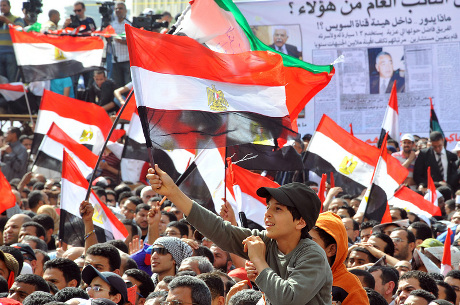
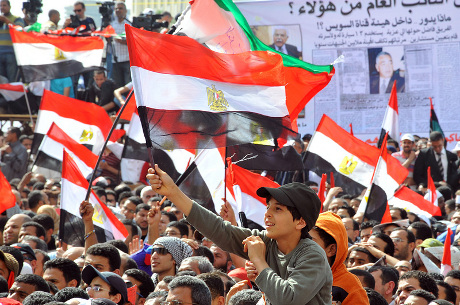
The question and debate over Egypt’s brand of nationalism is important today because it lies in flux. Perhaps the most celebrated aspect of the 2011 Egyptian Revolution was that it was the true coming together of a nation’s people – indeed the nation itself – morphing from an abstract ideal to a physical reality in Tahrir Square and around the country. Nationalism existed within Egyptian politics before 25 January 2011, but somewhere along the line it was lost. After all, no one for thirty years dared to speak up to the “father.”

But the good news, that Egyptians would do well to remember, particular in hard and frustrating times, is that the course is being corrected. Academics and political analysts have been splitting hairs about what to call January 2011. Some say “revolution” while others prefer “uprising.” I prefer to call it a “national movement,” because it was Egyptian nationalism giving a rebirth to its political child, and that child is now two and a half years old and not happy with the way its father is treating its mother. Egyptians love their country, and that’s a good thing.

The AfricaPaper: AhmedKadryis currently doing his PhD in Arab Cultural Studies at Imperial College London on Egyptiansocio-politicalfeminist identity anddiscourse in the 1952 and 2011 Egyptian Revolutions. He blogshereand tweets@ahmedkadry.