Home Blog Page 49

UN Conference Focus on Solutions for Reliable Energy Supplies


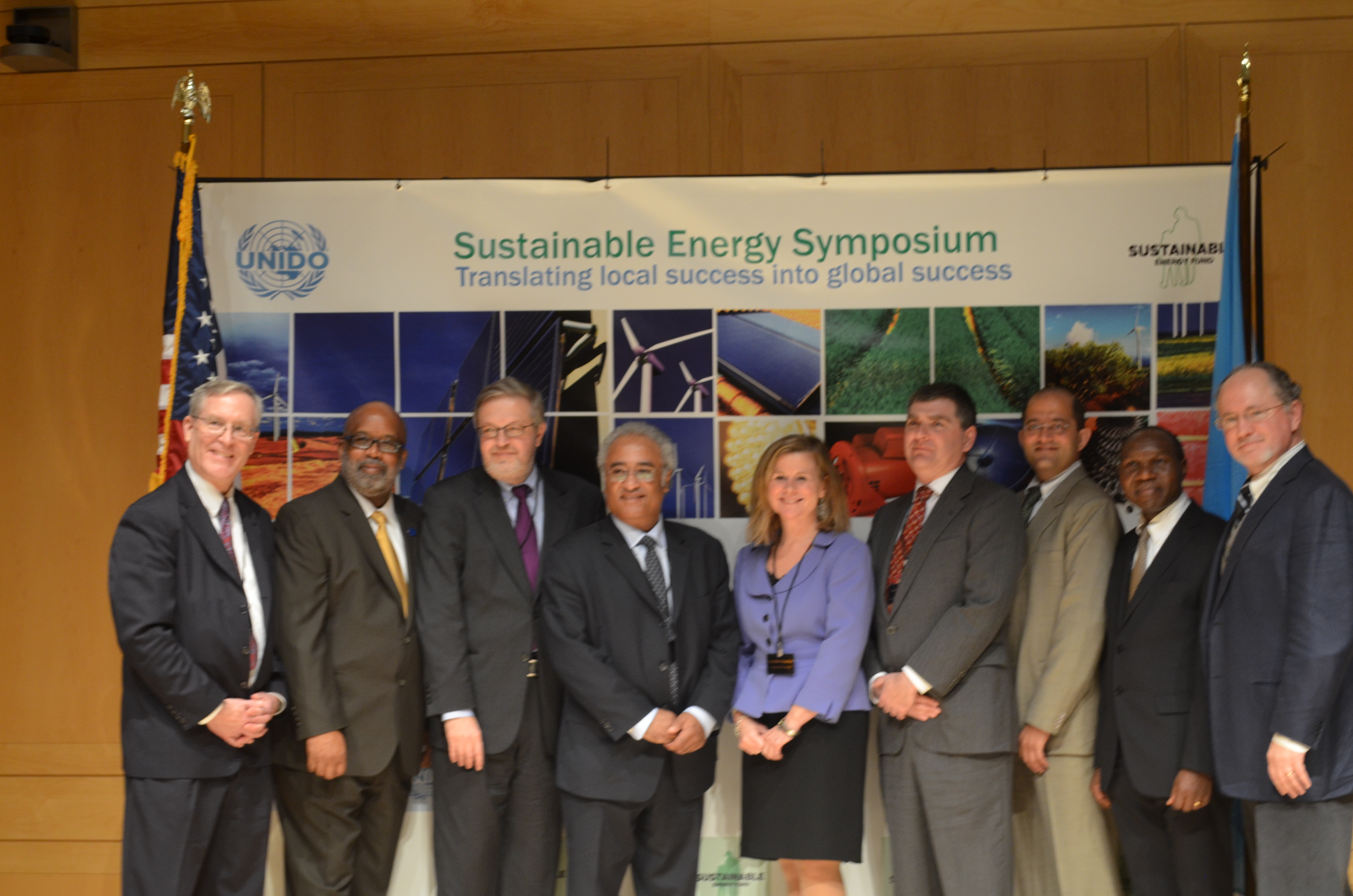
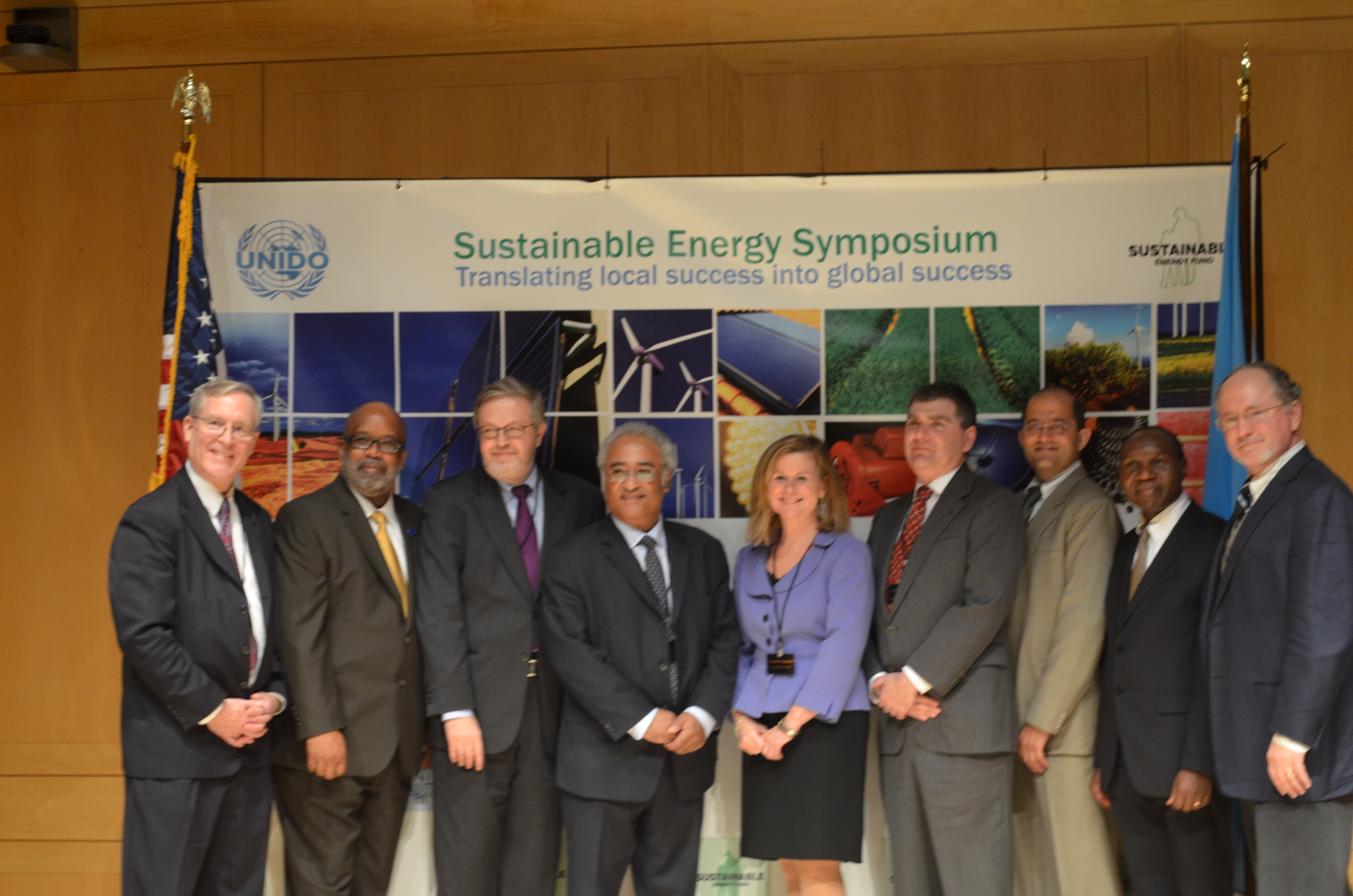
Group Photo of Panelists Photo: A. A. K. Kamara Jnr/ The AfricaPaper

Anthony A.K. Kamara Jnr. | The AfricaPaper


Philadelphia, PA – International energy experts and key actors working on sustainable energy in the United States met at Philadelphia’s National Constitution Center on Monday, Dec. 10 to affirm the importance of UN Secretary-General Ban Ki-moon’s Sustainable Energy for All (SE4ALL) initiative.

Organized by the UN Industrial Development Organization (UNIDO) in collaboration with the Sustainable Energy Fund (SEF), the symposium brought together UN representatives, the US State Department, development partners, the private sector, academia, civil society, state and local government officials all in an effort to find practical solutions to the “Challenges of Implementing Sustainable Energy for All at the Global and Local Levels.”

SE4ALL – “Green Energy”

Mr. Ban Ki-moon’s initiative seeks to confront the problems associated with energy poverty by meeting three ambitious yet achievable objectives of supporting the “green energy” revolution.

Through its unique and broad alliance of actors including governments, the private sector and civil society, the initiative aims to meet universal access to modern energy, improve energy efficiency and double the share of renewables by 2030.

Economic Growth

Secretary-General Ban Ki-moon has always reiterated his belief that “energy is the golden thread that connects economic growth, increases social equity and provides for an environment that allows the world to thrive.”

SE4ALL is one of the secretary-general’s five very important international initiatives that he has chosen to shape his global agenda for his second and last term in the hope that economic prosperity, freedom, justice and peace reign.
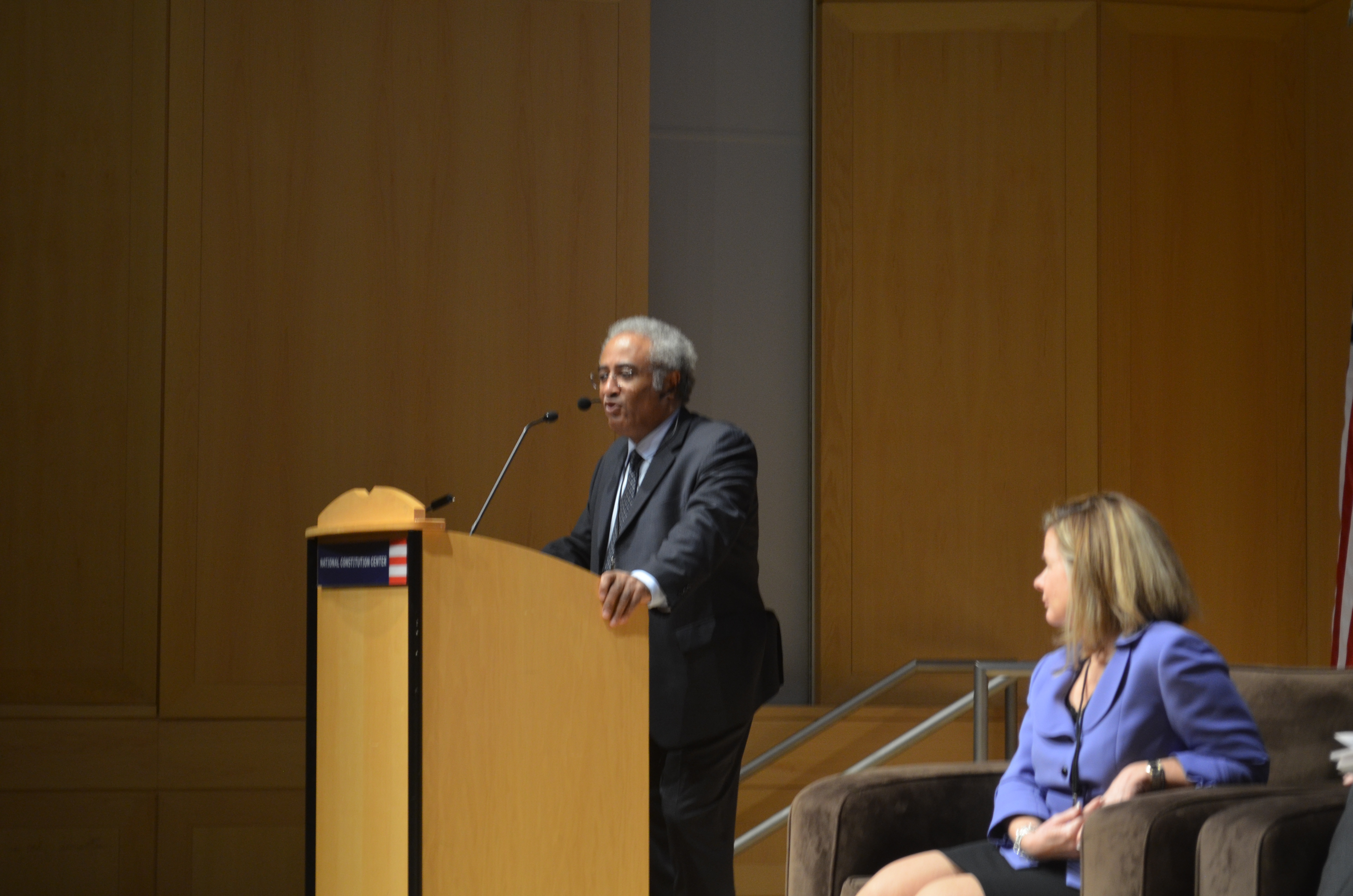
UNIDO Director George Assaf and Jennifer Hudson, President of SEF Photo: A. A. K. Kamara Jnr/TAP

Millennium Goals

“It is critical to the achievement of internationally agreed Millennium Development Goals (MDGs),” said George Assaf, UNIDO Director and Representative to the United Nations, who also serve other international organizations. “Without energy, achieving inclusive growth and sustainable development, environmental protection, political stability and gender equity would be increasingly difficult.”

National Security & Global Economy

At the conference, experts confirmed that while the benefits associated with energy access are in great demand in developing nations especially those in sub-Saharan Africa and South Asia, it is also true that developed nations such as the United States should learn valuable lessons from the recent Hurricane Sandy.

“It is a matter of national security and global stability. It’s at the heart of the global economy. It’s also an issue of democracy and human rights,” said Robert Ichord, deputy assistant secretary of state, Bureau of Energy Resources as he referred the audience to Secretary Clinton’s “Energy Diplomacy in the 21st Century” speech delivered at Georgetown University two weeks before Hurricane Sandy made landfall.

Hurricane Sandy & Climate Change

The after effects of Hurricane Sandy which left about 60 million people in the dark, with no access to electricity, is a reminder of the horrible lives that 1.3 billion people around the world [one in five people lack access] continue to live each and every day. It is further estimated that about 3 billion continue to rely on traditional energy sources such as wood, coal, charcoal or animal waste for cooking and heating purposes.

“This hurricane showed the vulnerability of humans to natural disaster even in the richest country in the world. It has also led to deep reflections on our preparedness against the effects of climate change in terms of adequacy of basic infrastructure, including transportation, water supply, and supporting urban planning. But the most striking that stood out in the midst of this tragedy was the critical importance of energy, and especially reliable energy supplies,” emphasized Dr. Assaf.

World Copyright 2012 – The AfricaPaper, USA. All rights reserved. Photos and text may not be published, broadcast, rewritten, redistributed or used in any form without the written permission of The AfricaPaper Media Corporation and AIIR.
 

UN Seeks Innovative Solutions to Sustainable Energy


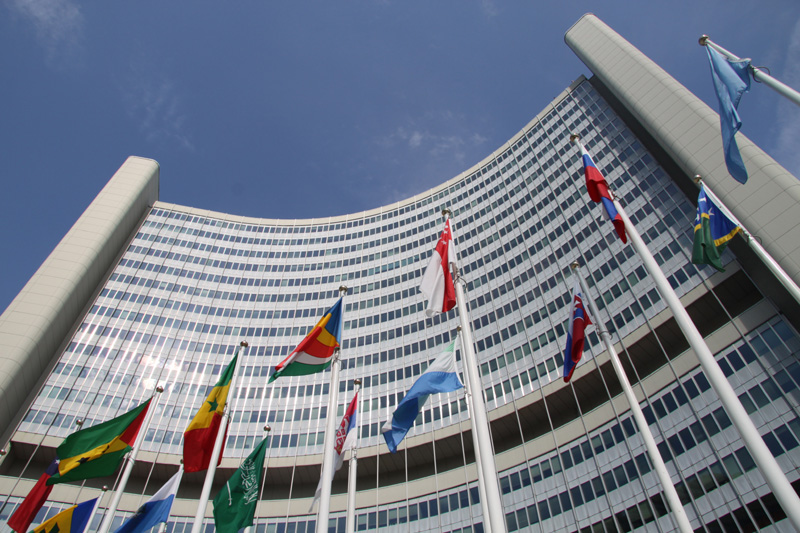
UNIDO Headquarters in Vienna, Photo: Mikhail Evstafiev/UNIDO


Anthony A.K. Kamara Jnr. | The AfricaPaper


PHILADELPHIA, PA – Representatives from the United Nations, the U.S Department of State, the private sector, academia and development partners will converge in Philadelphia on Monday, Dec. 10, to participate in a high–level panel discussion seeking solutions to the “Challenges of Implementing Sustainable Energy for All at the Global and Local Levels.”

Organized by the United Nations Industrial Development Organization (UNIDO) in partnership with the Sustainable Energy Fund (SEF), the symposium will be held at the Philadelphia’s National Constitution Center located in the historic section of the “City of Brotherly Love.” The United States Constitution was signed in Philadelphia in Sept. 17, 1787.

Unique

Dr. George Assaf, UNIDO Rep. in New York Photo: UNIDO

“The event is unique in that it seeks to effectively disseminate experiences and lessons learned at the global level to inform regional and local level implementation,” said Dr. George Assaf, UNIDO Director and Representative to the United Nations in New York who will be moderating the symposium. “It is essential to identify success stories at the local level, such as those from the U.S. and other countries, which have potential relevance across regions and states, as well as internationally.”

Energy experts will discuss and engage citizens at the local level to discuss innovative ways to meet the world’s growing demand for sustainable energy access at a time when reports suggest that one in five people worldwide lack access to electricity.

Sub-Saharan Africa

In Africa, 80 percent of the continent’s population continues to use traditional biomass and only 42 percent have access to electricity. The situation is even worse for Sub-Saharan Africa where only 31 percent have access to energy; the lowest rate of any region in the world as reports suggest. Lack of adequate, accessible and affordable energy does not promote economic growth and poses a challenge in satisfying basic human needs.

Energy advocates are convinced that social and economic development is only possible when access to modern and clean energy services is made available to the billions of people who continue to suffer from energy poverty.

SE4ALL & Purpose

Launched in 2011 by UN Secretary General Ban Ki-moon, the Sustainable Energy Access for ALL (SE4ALL) initiative seeks to bring governments, the private and public sectors and civil society in a meaningful partnership in an effort to achieve the three interrelated global targets of universal energy access, improving energy efficiency and growing the share of renewable energy – all by 2030.

Partnership

On her organization’s collaboration with UNIDO, SEF’s President, Jennifer Hopkins, stated that their organization is “very excited to be partnering with the United Nations and sharing the lessons we have learned more broadly over the last decade in translating the broad vision for the Sustainable Energy Fund into actual increases in energy efficiency and renewable energy.” She further noted that she looks forward to hearing from others and their experiences in implement the Sustainable Energy for All agenda.

About UNIDO & SEF

The UN Industrial Development Organization is the specialized agency of the United Nations that promotes industrial development for poverty reduction, inclusive globalization and

environmental sustainability. Sustainable Energy Fund (SEF) is a private nonprofit 501(c) (3) organization focused on reducing financial, educational and regulatory barriers to a sustainable energy future.

Anthony A.K. Kamara Jnr will continue coverage of the event for our readers.

World Copyright 2012 – The AfricaPaper, USA. All rights reserved. Photos and text may not be published, broadcast, rewritten, redistributed or used in any form without the written permission of The AfricaPaper Media Corporation and AIIR.
 

Ghana Polls a Close Contest Despite Boom

1


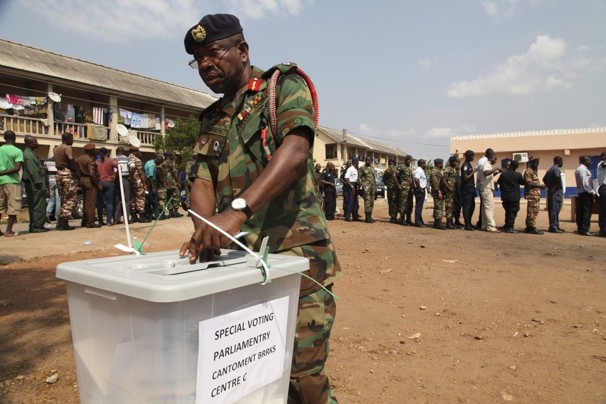
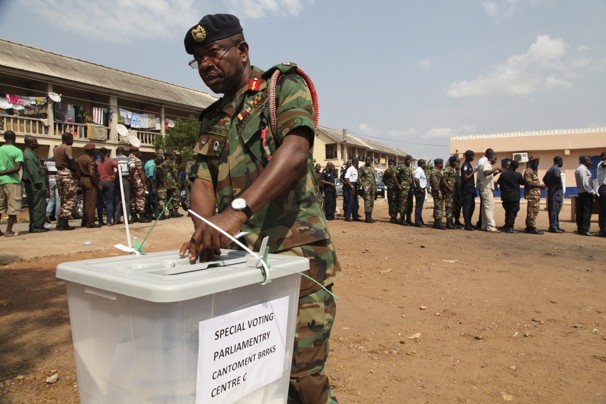
A soldier from Ghana casts his ballot during a special voting session for the military in the presidential elections in Accra, Ghana, on Dec. 4, 2012 – LEGNAN KOULA/EPA

By Xan Rice | Ghana


ACCRA – In a tiny shack along a railway line in Ghana’s capital, Kwadwo Taiwah scratches a living out of art.

He usually paints portraits of customers or their music or football heroes. In recent weeks, as fiercely contested elections in West Africa’s second-largest economy approached, Taiwah, 34, has turned his paintbrush to politics.

Promises

On one side of his studio door is a picture of President John Mahama. On the other is the main challenger, Nana Akufo-Addo, whose pledge to provide free secondary schooling has earned Taiwah’s vote and may yet shape the poll result.

“I didn’t get a good education,” Taiwah said, “because I had no money. If Nana comes in, I may go back to school.”

The presidential and parliamentary contests set for Friday are expected to be close. Under the winner-takes-all system, the prize is control over billions of dollars in oil and gas revenues expected to flow in the next four years, giving the victorious party the potential means not only to transform the economy but also to stay in power for a long time.

With Ghana’s economy booming – the International Monetary Fund predicts 8.2″‰percent growth this year, thanks to oil, cocoa and gold production and a strong construction and service sector – the ruling National Democratic Congress might be expected to have a strong advantage.

But perhaps uniquely in Africa, Ghana has developed a recent tradition of tight elections, with power changing hands from the nominally center-left NDC to the center-right New Patriotic Party in 2000 and back again in 2008, when the winning margin was only about 40,000 votes. The peaceful handovers have made the country something of a model for the continent and helped attract foreign investment.

Divided Parties

“Ghanaians are divided around two main parties just like the Democrats and Republicans in the U.S., so we always have a strong opposition,” said Bossman Asare, a political science lecturer at the University of Ghana. “Like in 2008, it’s very hard to predict a winner.”

Mahama, 54, who studied in the former Soviet Union, was vice president until the death in July of then-president, John Atta Mills. Affable and measured, Mahama has campaigned on the ruling party’s record of improving health care and education, and on the strong economy. Oil production commenced in 2010, the fiscal deficit has been cut and the country achieved lower middle-income status last year for the first time.

Mahama is setting a target of 8 percent growth until 2016. Even so, he says the opposition’s plan to provide free senior high school tuition is not financially or practically viable, a view echoed by some of his supporters.

“We have not yet got the schools and teachers to support it,” said Daniel Addo, a 38-year-old driver. “Let Mahama first improve the quality of schools and continue other good work.”

Internal divisions have hurt the NDC, which, if it loses, will be the first party in Ghana to exit after a single term. Party founder and former president Jerry Rawlings has been lukewarm in his support, and his wife, Nana Konadu Rawlings, has set up her own party. Perceptions of high-level corruption have also hurt the party.

Ghana’s Money

The NPP is regarded as the more pro-business, pro-western party. Akufo-Addo, 68, a lawyer and former attorney general, describes himself as “the man to trust with Ghana’s money.”

He says the country’s economic growth has created few jobs and few benefits for the majority of its 25 million people. Speaking to the Financial Times earlier this year, Akufo-Addo also promised to renegotiate the terms of a $3″‰billion loan from China.

Ethnic and regional factors will influence voting, but increasing urbanization and political awareness mean that policy is expected to play a bigger role than before. Akufo-Addo knows that a repeat of his 2008 loss could end his presidential ambitions.

“The NPP knows how the game is run, so it can’t wait to get their hands on the till,” said Emmanuel Gyimah-Boadi, executive director of the Ghana Center for Democratic Development. “The president controls all the political, economic and symbolic resources. That’s why the vote is so intense.”

Political Tension

Despite Ghana’s democratic credentials, the country’s politics are often acrimonious and vicious. Campaigning has been mostly peaceful but Gyimah-Boadi says the heightened political tension means violence after the vote is not impossible.

“We all have fears, but typical of us Ghanaians, we pray that they won’t happen,” he said.

Besides the main two candidates, there are six other presidential challengers. If no one wins 50 percent of the vote, a runoff will take place on Dec. 28.

In his studio by the railway tracks, Taiwah knows it may come to that. After posing for a photograph with his painting of Akufo-Addo, he asks to have one taken with his painting of Mahama, “just to be sure.”

The AfricaPaper: Our appreciation to Xan Rice from the Financial Times in Ghana for this report.

EU and UNIDO Promote Employment for Tunisian Youths


By Anthony A. K. Kamara Jnr. | The AfricaPaper


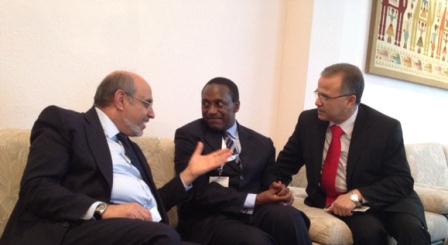
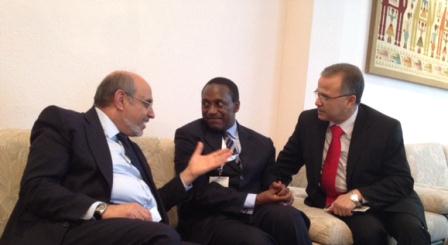
L to R – Tunisian Prime Minister Hamadi Jebali and UNIDO DG Yumkella Photo: UNIDO

TUNIS – Tunisian Prime Minister Hamadi Jebali has on behalf of the government and the people of Tunisia welcomed representatives of international organizations, governments and the private sector as they converged in Tunis for a two day international conference on productive capacity for youths.

The conference was organized by the European Union (EU) and the UN Industrial Development Organization (UNIDO). European Commission Vice President, Antonio Tajani led the EU delegation while Director General Kandeh Yumkella led the UNIDO delegation.

The summit which attracted about 700 participants discussed strategies geared towards developing and expanding the productive capacities of youths in the Middle East and North Africa (MENA) region. Participants also formulated recommendations that could boost productive and sustainable employment.

New Investment

Given Tunisia’s recent history with the Arab uprising, the recommendations are seen by many as an effort to develop and expand enterprises within Tunisia’s labor-intensive sectors.

At the conference, UNIDO, US Agency for International Development (USAID), Hewlett Packard Company (HP) and the government of Italy announced a new investment partnership to the sum of US $3.3 million to foster sustainable employment opportunities for young people in Tunisia.

“Our collaboration will also provide much needed technical assistance to targeted companies, particularly those in the agribusiness, environmental and other critical sectors of Tunisia’s varied economy,” said Mara Rudman, USAID Assistant Administrator.

Economic Development

The venture will provide an opportunity for the partnering organizations to focus on improving access and quality of services provided to predominantly young entrepreneurs by local institutions, and direct capacity-building for enterprises with high employment potential.

They will also seek to leverage small and medium enterprises (SMEs) as an effective avenue to facilitate economic development and foster entrepreneurship in order to drive new business creation in El Kef, Kairouan, Kasserine, and Sidi Bouzid.

Extensive Experience

As the implementing agency, UNIDO will draw on its extensive experience in the region to assist the creation and development of new businesses, especially for young people.

“Unemployment among educated youths emerges as a major challenge in Tunisia and collaborations like ours that put a strong emphasis on creating employment opportunities for young people entering the workforce will help empower and equip them well into the future,” said Dr. Yumkella, UNIDO Director General Yumkella.

World Copyright 2012 – The AfricaPaper, USA. All rights reserved. Photos and text may not be published, broadcast, rewritten, redistributed or used in any form without the written permission of The AfricaPaper Media Corporation and AIIR.
Pope Names Nigerian Archbishop as New Cardinal

1


By Anthony A. K. Kamara, Jnr. | The AfricaPaper

VATICAN CITY – John Olorunfemi Onaiyekan, 68, Archbishop of Abuja, Nigeria was one of the six new cardinals that Pope Benedict XVI named on Saturday, Nov. 24.

“Clergy of Rome”

Pope Benedict XVI presided over the ceremony in St. Peter’s Basilica at the Vatican that brings a more geographically diverse representation into the European-dominated College of Cardinals, also known as the “Clergy of Rome.”

The College of Cardinals is charged with the responsibility of electing the Pope as the Bishop of Rome and successor to St. Peter, the Vicar of Christ on Earth and the universal pastor of the Universal Church.

Peoples’ Church

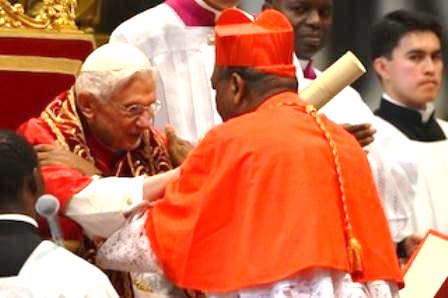
Nigeria’s John Onaiyekan receives a scroll that bears the name of his honorary parish in the diocese of Rome. Photo: AFP

A ceremony both joyful and emotional, the Pope reminded his congregation that the Catholic Church belong to people of all races and not just one group. The congregation, friends and families in the pew cheered and applauded as Benedict read each name in Latin.

Among the newly elevated “princes of the church” at the consistory [cardinal-making ceremony] in order are: US Archbishop James M. Harvey, 63, Prefect of the Papal Household; His Beatitude Bechara Boutros Raï, 72, Maronite Patriarch of Antioch in Lebanon; His Beatitude Baselios Cleemis Thottunkal, 53, Major Archbishop of Trivandrum in India and head of the Syro-Malankara Catholic Church; Archbishop Ruben Salazar Gomez, 70, of Bogotá, Colombia; and Archbishop Luis Antonio Tagle, 55, of Manila, Philippines.

New Identity and Responsibility

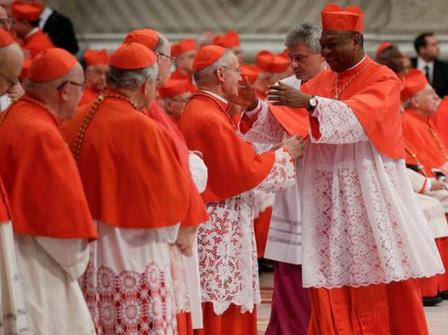
Effective from the day of the ceremony, the elevated Cardinals don their new scarlet robes designed exclusively for their new identity and responsibility. They also received new symbols each including a gold ring, the skull cap also known as “zucchetto,” and the three-cornered red hat or biretta. Documents specifically stating the name of the cardinal’s titular church in Rome and their membership to the clergy of Rome were handed to the six Cardinals.

Love for God

The new Cardinals pledged to serve generously and professed love for God, his church and an absolute and unconditional love for their brothers and sisters even if it means shedding their blood in service to the church.

“The fact that the Church is the Church of all peoples, and so she speaks in the various cultures of the different continents,” said Pope Benedict in his homily, and extended brotherly greetings to all who gathered in St. Peter’s to witness the solemn occasion from around the world and representing different cultures that form the universal church, highlighted.

Emotions

Archbishop Tagle choked up as he knelt before Pope Benedict to receive his biretta. He wiped his tears as he returned to his seat. Archbishop Onaiyekan was more jovial and chat with each of the dozens of Cardinals as he exchange the traditional peace-greetings that follows the elevation ceremony.

Supreme Value

In administering the oath to the Cardinals, Benedict XVI underscored “the supreme value of fidelity” which comes with their new responsibilities.

“Indeed, the oath that you are about to take, venerable brothers, contains words filled with profound spiritual and ecclesiastical significance,” said Pope Benedict. “I promise and I swear, from now on and for as long as I live, to remain faithful to Christ and his Gospel, constantly obedient to the Holy Apostolic Roman Church.”

Exclusive Club

In addition, he affirmed the image that the College of Cardinals has always been associated with an exclusive club in the Catholic Church. Anyone chosen to be a member is informally, at least, considered a potential candidate to be elected Pope and lead the universal church should the need arise.

“From now on, you will be even more closely and intimately linked to the See of Peter: the titles and deaconries of the churches of Rome will remind you of the bond that joins you, as members by a very special title, to this Church of Rome, which presides in universal charity,” said Pope Benedict. “Particularly through the work you do for the Dicasteries of the Roman Curia, you will be my valued co-workers, first and foremost in my apostolic ministry for the fullness of catholicity, as Pastor of the whole flock of Christ and prime guarantor of its doctrine, discipline and morals.”

Aging Cardinals

In earlier February, Pope Benedict also elevated 22 Cardinals who were mostly Europeans. The College of Cardinals is still dominated by Europeans even with the addition of the six new non–European Cardinals. Reportedly, 120 cardinals are under age 80, thus eligible to vote in a future conclave to elect a new pope, but more than half (62) are European.

Vatican observers believe that the pontiff seeks to bring a more global, diverse and inclusive membership to the College. Critics say the “Clergy of Rome” no longer represents the Catholic Church that continues to grow in Africa and Asia, but faces crisis in many parts of Europe.

Furthermore, the pontiff’s action aims to replace aging Cardinals (at age 80) who are excluded from entering the secret conclave and therefore no longer eligible to participate in the election of a Pope.

“You must be prepared to conduct yourselves with fortitude, even to the shedding of your blood for the increase of the Christian faith, for the peace and well-being of the people of God,” stressed Pope Benedict.

The AfricaPaper team welcomes Anthony Abdul Karim Kamara, Jnr. as one of its new reporters covering Africa and overseas.

World Copyright 2012 – The AfricaPaper, USA. All rights reserved. Photos and text may not be published, broadcast, rewritten, redistributed or used in any form without the written permission of The AfricaPaper Media Corporation and AIIR.