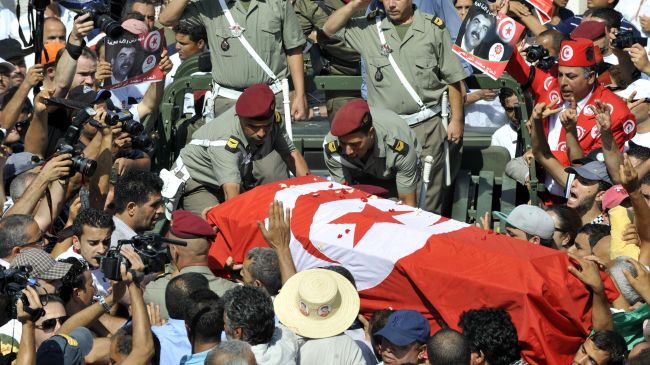
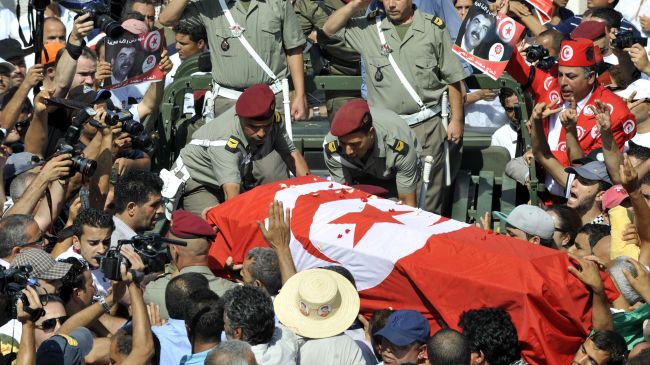
Tunisia’s second high-profile political assassination highlights the gravest shortcoming of the nascent Islamist government: the inability to contain the violence that increasingly threatens Tunisia’s fragile transition – a violence set to divide loyalties and destroy social cohesion, foreclosing any prospects of a viable democracy or a stable society.
Assassinated opposition leader Mohamed Brahmi was shot 11 times
Shot 11 Times
On Thursday morning, fifty-eight year old Mohammed Brahmi was shot 11 times outside his home in front of his daughter and his wife in Tunis. Constituting the second high-profile political killing this year, Brahmi was a secular opposition leader and a member of Tunisia’s National Constituent Assembly, the body responsible for writing the constitution. Brahmi’s death is the latest in a string of violent acts committed against government critics in the last year. Crimes include physical attacks on secular politicians and journalists, the lynching of politician Lotfi Nagdh in October 2012, and the assassination of fellow opposition leader Chokri Belaid in early February 2013. The latter event triggered nationwide protests both for and against Ennahda’s rule, nearly destabilising the government in the process.
Suspicions
As in the case of Belaid’s murder, many Tunisians critical of the Islamist regime believe that Ennahda was responsible for ordering the assassination of Brahmi. Suspicions will likely be raised over the participation of the League for the Protection of the Revolution, a group that portrays itself as a bastion against former Ben Ali supporters, but which has been implicated in numerous incidences involving verbal and physical attacks against Ennahda’s opponents. Indeed, among some circles, the League is perceived as the militant hand of the Islamist party, suppressing ‘subversive’ anti-regime elements in society. A list of suspects will also likely include members of radical Salafist groups that have been empowered by Ennahda’s rule and are alleged to have committed violent acts such as the 2012 attack on the US Embassy in Tunis.
Systematic Violence
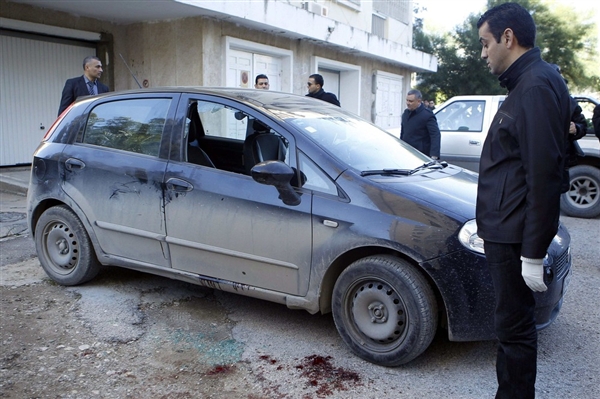
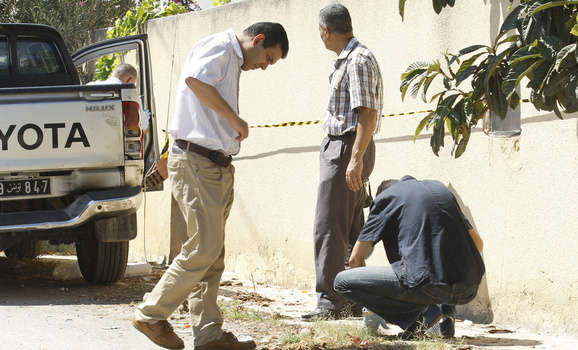
Forensic inspectors examine the area near the car of a Tunisian
While not all Tunisians directly fault Ennahda for Brahmi’s death, many others indirectly blame the party for failing to dispel the pervasive “climate of systematic violence” in the country. Specifically, the party is criticised for its inability to protect its citizens from verbal and physical harm and to ensure that the perpetrators of intimidating or violent crimes are checked and brought to justice. Within this, government critics assert that Ennahda has enabled extremist individuals and groups to act with impunity, exemplified by numerous accounts of harassment and assaults on opposition politicians. Indeed, in July 2012, several religious leaders openly called for the assassination of Tunisians critical of Ennahda, seemingly without consequences.
Risk
As in neighbouring Egypt, politically-inspired violence can most probably only further delegitimise Tunisia’s current political organisation, due to the state’s inability or unwillingness to protect the basic components to a democracy; most notably, the rights of the opposition. Nevertheless, Brahmi’s death presents a crucial opportunity for Ennahda to restore its legitimacy, which ultimately lies in its ability to restore law and order and enshrine the right of all Tunisians to speak freely without risk of verbal or physical intimidation.
Increasingly Polarised
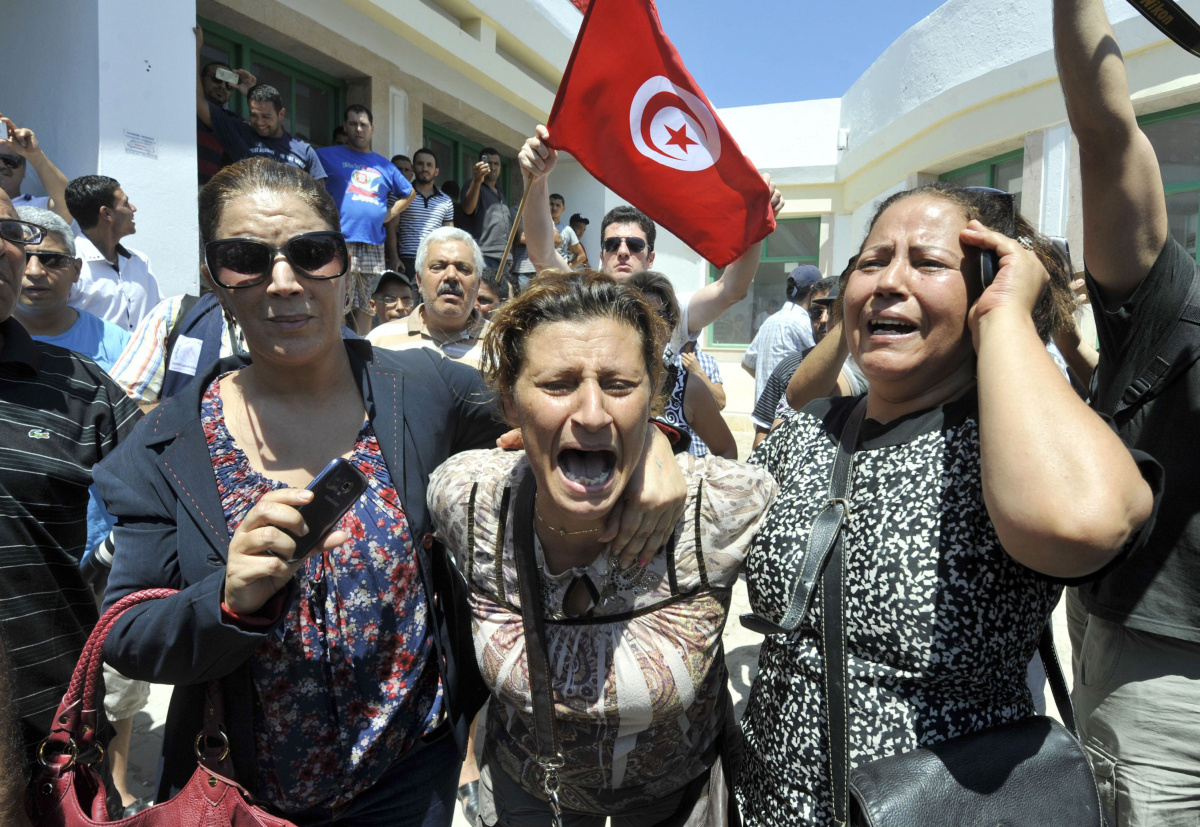
Tunisians react outside a hospital after the killing of the opposition politician Mohamed Brahmi on July 25, 2013 in Ariana,
An important step has already been made in this direction following a statement of Ennahda’s party leader, Rachid al-Ghannouchi, which declared the assassination a “crime against the democratic transition” and called on all parties to show “responsibility and restraint at this sensitive time”. However, strong words will need to be supported by strong actions. Arguably the only way for Ennahda to restore its legitimacy in the eyes of many Tunisians is to bring justice to Brahmi’s family and supporters and to other victims of political violence, while implementing political and regulatory protections to ensure that freedom of expression is enjoyed by all Tunisians, without fear of verbal or physical retribution. Similarly, calls for violence against individuals critical of Ennahda or any other group may not be tolerated and must be dealt with objectively and rationally, irrespective of political affiliations with the ruling regime. Thus far, such actions have not yet been implemented. Yet without them, Tunisia risks evolving towards an increasingly polarised society divided along secular and religious convictions, with grave consequences for a peaceful and democratic future.
Blocking Roads
Like Egypt, government-inspired frustrations following Brahmi’s death have manifested themselves in violence on the streets, as reports flood in of protestors blocking roads, setting tyres alight, and attacking government buildings and Ennahda offices, while others gathered outside of the hospital where Brahmi died, chanting “Down with the rule of the Islamists”.
The assassination has also prompted the cancellation of all flights to and from Tunisia on Friday as part of a general strike in protest of Brahmi’s death. Such actions may well exacerbate the growing rift between Islamist supporters and citizens disillusioned with the ruling regime, paving a similar route to that of Egypt’s side-lined and divideddemocracy.
“Tammarod”, or “Rebellion”
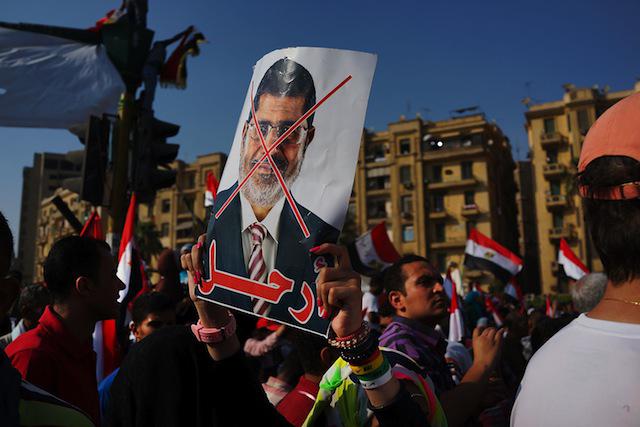
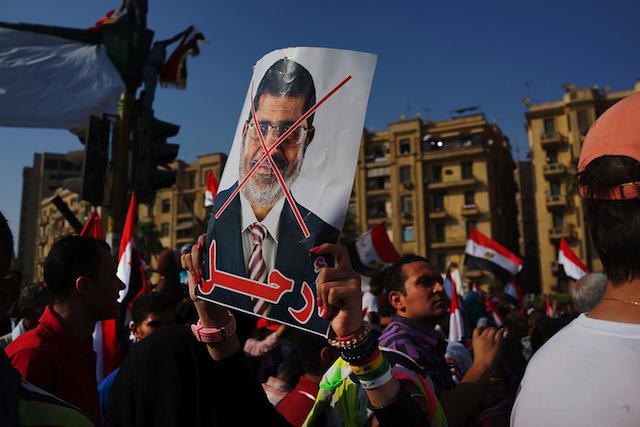
Indeed, individuals inspired by Egypt’s “Tammarod”, or “Rebellion” group that aided the overthrow of Islamist president Mohamed Morsi have already called for mass protests to demand the dissolution of the Tunisian parliament. Yet arguably the more worrying precedent lies with neighbouring Algeria, where a military coup thwarted a potential Islamist electoral victory in 1991 and triggered a decade-long civil war. Responsible for an estimated 200,000 deaths, the Algerian civil war serves as a cautionary tale to the dangers of societal polarisation between religion and secularism.
Le Monde Warned
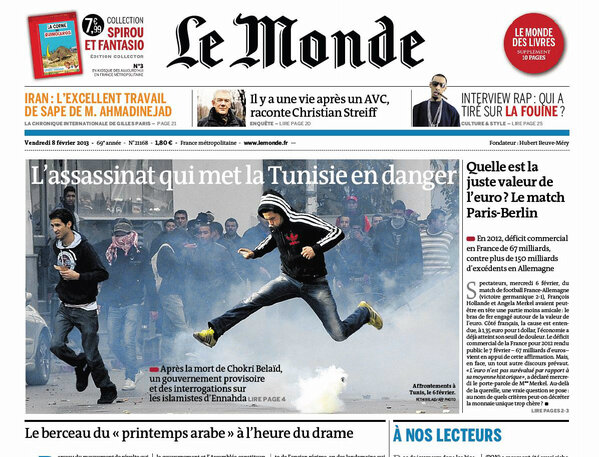
Fortunately, Tunisia has yet to reach this moment. Nevertheless, as a recent editorial from Le Mondewarned, “Thursday, it was not just a man who fell. It was Tunisian democracy and pluralism that have been targeted”. Tunisia’s government has a unique opportunity to pull its country back from the precipice; without significant action, the nation’s first democratically elected regime may unleash the forces that could end its democratic experiment for the current generation. TAP
The AfricaPaper: Our special thanks to Genevieve Theodorakis for this article. Genevieve Theodorakis graduated from the LSE in December 2012 with an MSc in Global Politics, specializing in the Political Economy of the Middle East and North Africa. She currently works as an analyst for a global publishing company with a focus on the Middle East and Francophone Africa.
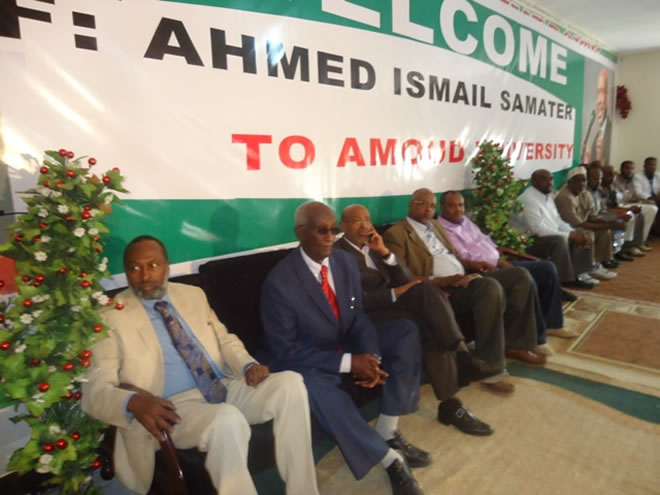
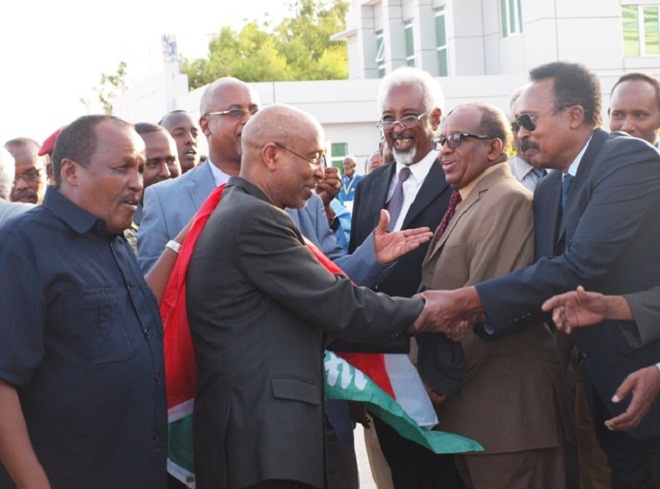
Hargeisa, Somaliland –Professor Ahmed Samatar represents different things to different people, but one thing that undeniably dominates his character is that he is an eminent scholar seeking to revive common decency and good values in the Somali people. However, the rapturous welcome and adulation that he received during his much awaited homecoming to Somaliland may have raised more questions than they answered. The root cause of such bewilderment is the different expectations that the various sectors of the Somali people have about the outcome of the professor’s country-wide tour and the rationale behind his decision to visit Somaliland despite his well known political position as an ardent advocate of Somali unity.
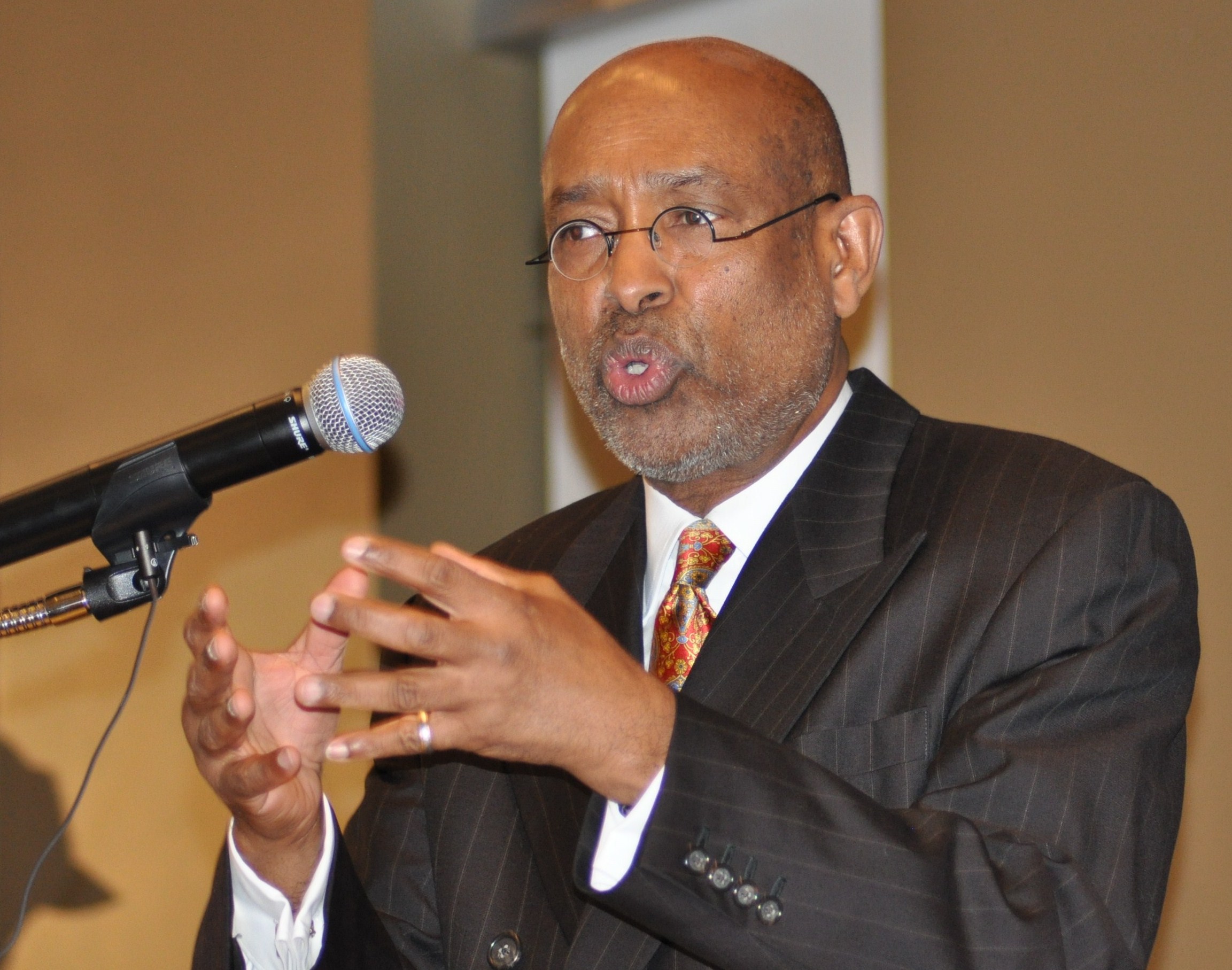
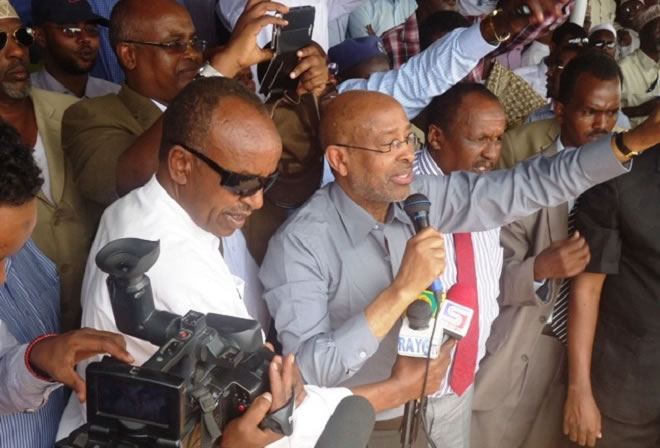
Prof. Samatar in Borma
Famous for his unmatched eloquence and brilliant scholarship, Ahmed Samatar has until now skirted the thorny issues and instead concentrated on his long term mission of bringing political and cultural enlightenment to the Somali people, particularly by engaging with local universities, community leaders and women and charming them with his suave manners and Aristotelian persuasion.
I will, therefore, try in this piece to look at the different perspectives that the different sectors of the Somali people might have regarding Ahmed Samatar’s visit.
The Professor’s Fox Perspective:
Inspired by the Greek poet Archilochus who said: ‘The fox knows many things, but the hedgehog knows one big thing’, Isaiah Berlin, the eminent 20th century social and political theorist, had categorized people into “hedgehogs” or “foxes” in his famous essay entitled “The Hedgehog and the Fox”.
In real life, according to Berlin’s theory, we know that when in danger the hedgehog rolls into a ball, exposing its pointed spikes outward as a defense mechanism, but the fox uses many tricks to deal with threats and to fight for its survival. This means that some people like to deal with the world as it is, in one single approach. They fear change.
Such people like to be ensconced in their comfort zone, even if the comfort zone is proved to be an illusionary one. These are the hedgehogs. On the other hand are people who take a liberal and multidimensional approach to the world. They are ready to change when new realities unfold and when they gain new information that is more credible than the one they had before.
Accordingly, I could say that Ahmed Samatar belongs to the Fox category as he looks at the Somali issue through a liberal and pluralist prism and refuses to tie himself to a procrustean view.
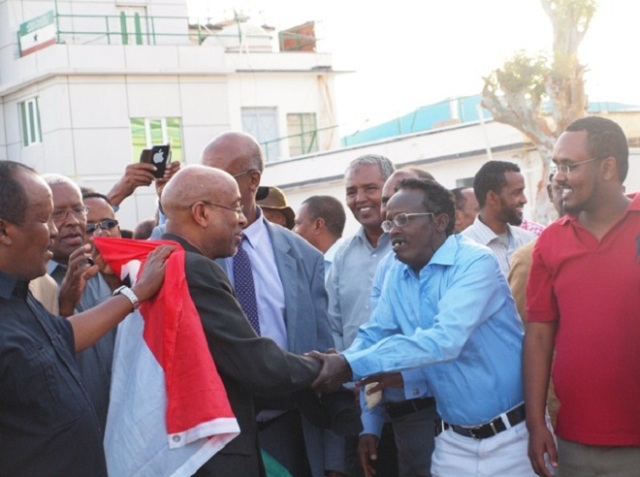
Dr. Samatar among his people in Somaliland
He stood for and I believe still stands for not only the unity of the Somali people but also for advocating the establishment of justice, liberalism and democratic norms as well as common decency in the body politic of the Somali nation.
But since he started his herculean enlightenment mission among the Somali people he has worked under the assumption that the key to the solution of the Somali problem was to be found in Mogadishu. He saw Mogadishu as the head of the Somali body and thought that if a magic cure was found for the head then the rest of the body would regain its health and strength. But when he ran for Somalia’s presidency in September 2012, he witnessed the messy, corrupt, and harshly nomadic way of practicing politics in Mogadishu. He then realized that Mogadishu after all was not the key to the solution but indeed the root cause of the Somali plight. This was a crucial moment for Ahmed Samatar’s relentless political advocacy for the Somali cause.
Naturally, two options could have crossed his mind; to quit politics for good or to change course and being a conscientious scholar who couldn’t just sit down and watch his people wander lost in a political wilderness, he chose the second option; to change direction. Remember as a thinker of the fox category who looks at issues from different approaches and different perspectives, Ahmed Samatar knows how to make a detour when he faces a dead-end. The decision was neither an easy one nor an expedient and a sudden change of heart as some people might like to think. But it was a hard decision that came to fruition after a long deliberation and cautious research.
There is an anecdote that when John Maynard Keynes, seen as the most influential economist of the 20th century, was once accused of changing his positions on economic issues , he is attributed to have said: “When the facts change, I change my mind. What do you do, sir?” and a Somali proverb says: “Laba tallaabo dhexdooda ayey talo ka dhalata,” or “War la helyaaba, Talo la hel.”
Ahmed Samatar decided rightly and boldly to go to Somaliland to achieve several objectives.; First, to educate himself about the reality of Somaliland; to see, hear and witness how deeply and passionately the Somalilanders feel about their secession claim and secondly, to explore how strong the foundations were of Somaliland’s unique experience with democracy and government building. Lastly, the trip was more of a personal healing for him than a political adventure as he wanted to relive his childhood memories of the country.
Somaliland’s Hedgehog Perspective:
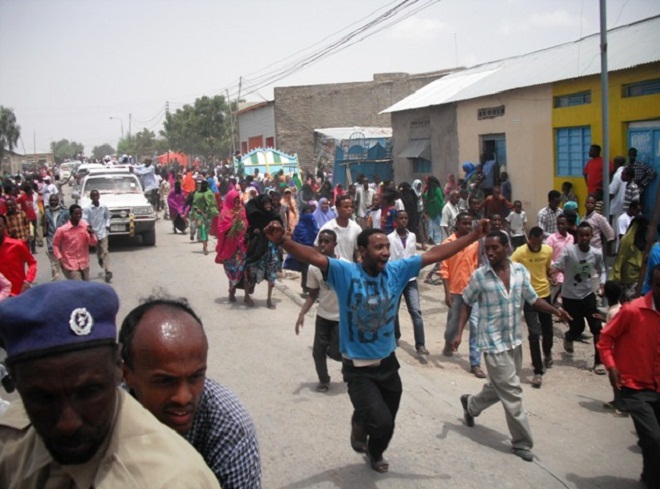
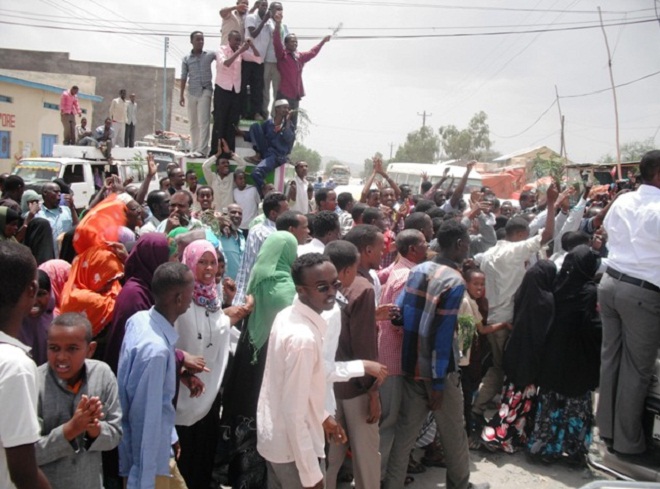
Hero’s welcome: Somalilanders run to see Dr. Samatar
Due to their intransigence and fixation on independence, the people of Hargeisa and central regions can be counted in the category of the hedgehog. Just like the hedgehog they have only one big issue in mind: the recognition of Somaliland. This is why they saw Ahmed Samatar’s visit as a moment of victory. History shows that political causes rarely take off the ground if they don’t win the advocacy of prominent and visionary scholars of international standing. Ahmed Samatar is on par with scholars such Noam Chomsky, who gallantly campaigned for the cause of East Timor, Edward Said who popularized the Palestinian and Arab causes through his heroic scholarship, Eric Reeves who untiringly fought for the independence of Southern Sudan and others. This is why many people in Somaliland saw that winning Ahmed Samatar’s voice and scholarship on their side was akin to winning international recognition for their independence and would deal a blow to Mogadishu’s credibility.
The Professor’s homecoming, however, has exposed a great psychological abyss between the Awdal communities and those of Somaliland’s central regions.
The communities of Somaliland’s central regions are known for their directness and clarity. They either love you passionately or hate you passionately. Their character is black and white, and has a little or no gray areas in between, what you see is what you get. They are very generous with their feelings and very forgiving once misunderstandings are sorted out. Remember (Kal laxeeba baan leeyihiyo laabta xuunshada…). They are straightforward and loud with their intentions. They all came out to welcome the Professor but they made their intentions clear to him without any reservations. Hence, teasing him with Somaliland’s flag was not for a joke.
The people of Awdal on the other hand are all about gray areas. You will never know whether they love you or hate you (Allahayow nin ii daran maxaan daafta hore seexshay…). They are stingy with their feelings, opaque and reserved with their intentions. The fact that they carried no Somaliland flags while welcoming the Professor but they all chanted in unison with him when he shouted “Somaliland ha noolaato” (Long Life to Somaliland) is itself a good example of their enigmatic personality. Are they loyal Somalilanders or are they not, the jury is still out.
Awdal Community’s Fox Perspective
Somalilanders waited to welcome for Prof. Samatar
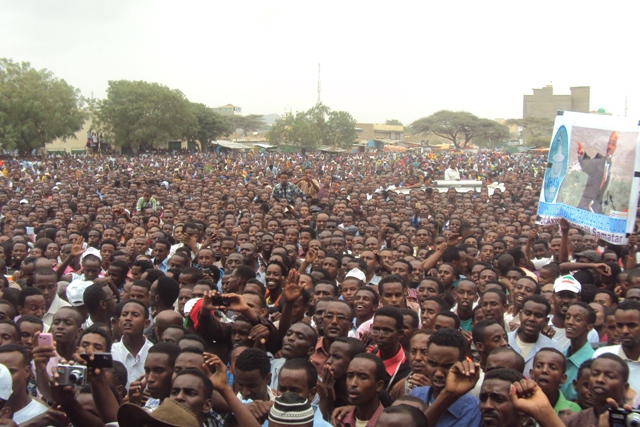
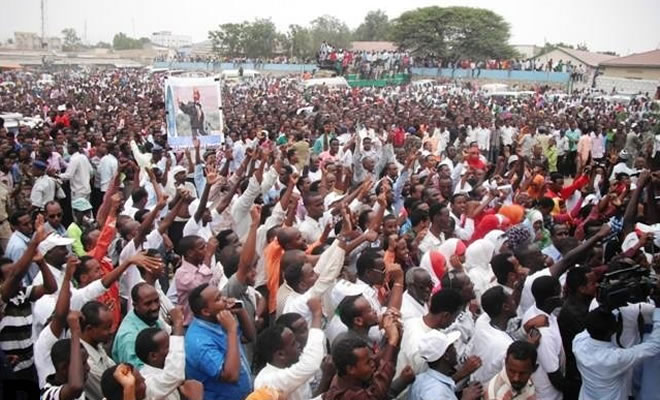
The people of Awdal gave a hero’s welcome to Ahmed Samatar as they thronged out in their thousands to the streets, singing, dancing and carrying his pictures. The ecstatic crowds that filled the streets in the villages and towns on the main highway from Dilla to Borama city was a strong political statement with multiple messages or “Dhagaxaan tuurow, todoba dilow, toddoba duqood” as a friend who called me from there described the feeling of the people.
First, it was a show of force and a strong message to Mogadishu where the Professor failed in his bid for Somalia’s presidency despite being a formidable candidate with a powerful political agenda and vision for Somalia.
Second, it was a candid expression of admiration for what they saw as his courage and principled stance over the years in being an advocate for Somali unity, a secret yearning that most Awdalians keep close to their heart despite their ostentatious support for Somaliland, part of Awdal people’s enigmatic character.
Third, the Professor’s arrival has cemented the unity of the Awdal community and has given them the hope that he would be a powerful voice to champion their rights in Somaliland and beyond.
The Professor’s Message to Somalia
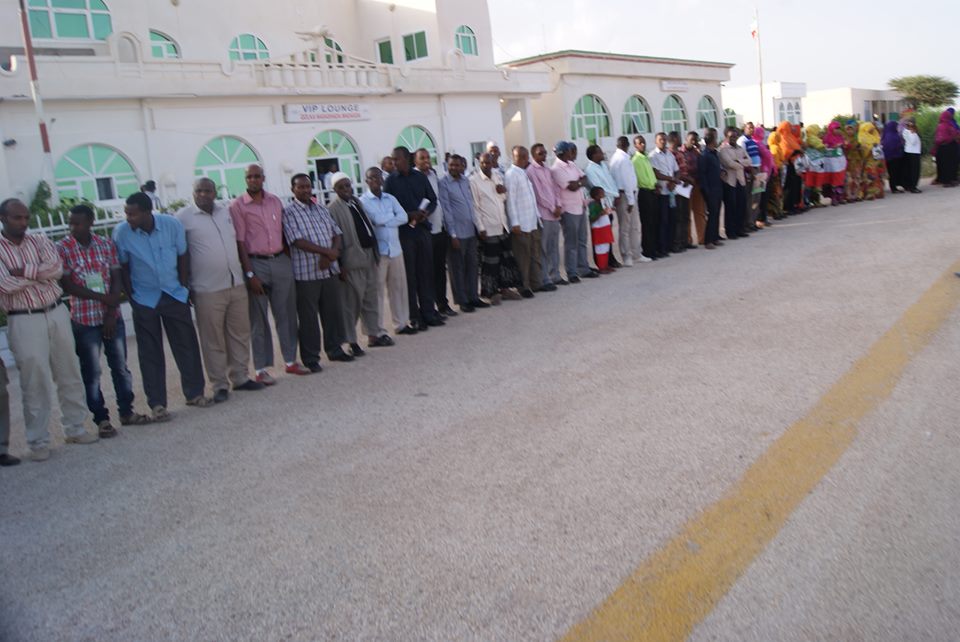
Dr. Samatar and his people
Finally, Professor Ahmed Samatar’s return to Somaliland sends a strong message to Somalia that Mogadishu cannot have it both ways. It cannot be the capital of Somalia and project an image of inclusiveness and national identity to the outside world while at the same time it practices a politics of exclusion and clan profiling. It says Mogadishu has a choice to make; to be a place where every Somali child no matter where he is born can have the right to dream to rise to its leadership or permanently doom Somalia to its current fate of cantonization.
Obviously in Somaliland, Professor Ahmed Samatar has a tightrope to walk. Time will tell whether the hedgehog will win with its fortified wall of spikes or whether the fox will outmaneuver and blunt the spikes one after another. However, on Somalia, the Professor has already won the debate. And I hope our brothers in Mogadishu would heed the lesson.
The AfricaPaper: We are delighted to welcome Bashir Goth to The AfricaPaper. Mr. Goth will be covering Somaliland, Somolia, and the Horn of Africa for The AfricaPaper and its parent organization the Africa Institute for International Reporting (AIIR).
There is a certain kind of man who, in unspeakable human suffering and chaos, sees an opportunity to make himself rich. Take, for instance, the diamond war of Sierra Leone. Nick Karras couldn’t get there fast enough. And just look what happened to him.
HOW MANY BOTTLES OF WINE?How many Irish coffees? And that immense plate of seafood and the jazz band and the two pretty blond waitresses and Stan the bodyguard talking about beating down the gates of love’s palace with his purple-headed love monster. It’s a cool July night at the Green Dolphin restaurant in Cape Town, South Africa, and Nick Karras has been telling us about his private plane and his polo team and his motorcycle-racing team and his homes in California and London and his real estate development in Barbados and his twenty-two diamond mines and his “family holdings in South America” and the whole story of fishing with his father off the coast of South America all summer long until the old man went down with the boat and thirty men and someday Nick is going to sink his own boat at the very same longitude and latitude–but only after bringing the family back together and buying up the rest of the orchards in Corinth and starting a winery to revive the family tradition. And he orders another bottle of wine and tells us to eat more prawns and detours into a locker-room story about “the twins,” those little perpetual-motion machines. And finally he works his way back around to Sierra Leone, the matter at hand, where we are headed next week. With its diamonds and fish and shrimp and farmland and rutile and the most gorgeous coastline all just waiting for someone to reach in and grab it. “The UN isn’t gonna take it, the British aren’t gonna take it, we know the Sierra Leone army isn’t gonna take it,” Nick says. “It’s gotta be done privately. It’s gotta he a business.”
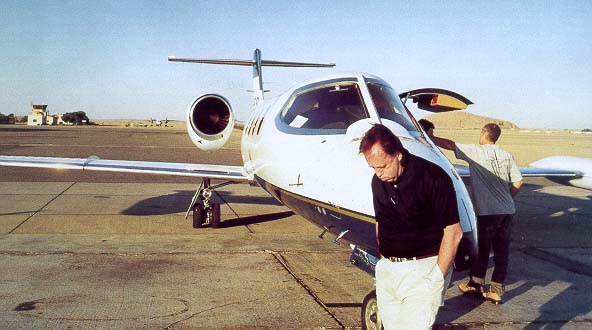
Nick pensive at a refueling stop in the African desert. The plane costs 32800 for two days but every great actor needs his props.
We are approaching Nick’s dark side. Earlier he was talking about how much the people have suffered and how much he wants to help them and all the computers and medical equipment that he’s donated. But now he’s in the mood where he says things like, “Think of them as hairless monkeys, it makes them easier to kill.” And tells (again) the story of the time that little do-gooder aid-worker girl got on his case about the diamond trade and kept saying, “Don’t you know there’s blood on those diamonds?” And finally Nick got fed up and told her, “Yeah; but it washes right off.”
He loves that line. He laughs and says it again. “Yeah, but it washes right off!”
It’s probably the wine. Which would also explain why he’s waving his hand over the giant seafood plate and insisting that no matter what happens, he’s going to carve out his piece of diamond territory and take care of things himself, establish a perimeter and plant the flag for his diamond business, Anaconda Worldwide Ltd. “Somebody’s gonna have to do it. I can tell you right now, this little area we’re gonna carve out will be done soon.”
Nick’s bodyguards, Stan and Pete, are both serious warriors, graduates of the British special services with combat experience in battlegrounds from Iraq to Bosnia. His Africa hand, James Pryor, a striking man with long hair and a personal uniform that tends toward green green fatigues, was with an elite unit of the South African army before moving to London to do political work for the prime minister he calls “Maggie.” So it definitely seems like more than bar talk when the last bottle gets low and Nick starts hinting at mysterious business with someone named Nils, something about a gunship and “a commitment to give him some money to straighten out some stuff.”
That’s when James leans forward and says, “Let’s change the subject. What is a green dolphin, anyway?”
IN THE MORNING, Nick throws back six aspirin and comes down to breakfast wearing shorts and a Hugo Boss golf shirt with his silver Dunhill pen slipped sideways between the buttons. Stan hands him an abstract of the bad news: The UN has decreed an embargo on diamonds from Sierra Leone. As of today. “Fuck it,” Nick says. “They can’t ban shit.”
He goes on about it. You can sell diamonds anywhere, sell them in New York or Israel. You can hide a million dollars’ worth in a cigarette pack and still have room left for most of the cigarettes. This is just more UN bullshit, like the five hundred blue helmets who were “captured” two months ago, who probably just dropped their weapons and ran into the woods. Because everybody knows “niggers can’t fight.” But after breakfast he goes right up to his hotel room and hunches over his laptop, skimming the latest reports. The war in Sierra Leone has been dragging on for ten years with no end in sight, a morass of banditry and regional meddling and feckless government troops all tangled around Sierra Leone’s national curse: the diamonds lying right there in the dirt, so close to the surface that all it takes to get them is a shovel and a guy with a gun to watch your back. Which is why the UN and various peace organizations came up with the label “blood diamonds” for the stones mined by the rebel armies and started publicity campaigns about how the rebels pack their wounds with cocaine to make them more frenzied and cut hands off children and babies and how they even practice cannibalism–one time, supposedly, the rebels cut slices off some guy’s face and ate them while he was still alive. They run that Cry Freetown film on CNN all the time, all those horrible images of the rebels shooting up the capital back in 1999, like it’s on regular rotation or something. The damn thing’s two years old already! And sure there’s a bit of war going on right now, but it’s really not that bad.
Or so Nick says. Because it’s bad for business. Because it’s messing with his plan. As I eventually put the story together, he was just shy of fifty, living in southern California with his wife and two kids, when he decided his personal deadline was approaching. So he added up exactly how much he would need to buy a boat at least 140 feet long, plus twenty more feet for a helicopter, plus the helicopter. Then he added a half million a year for operating expenses for thirty years and some more for living expenses and then doubled it. And then he sold everything he owned, his advertising business and home and boat and the family diamond dredges in South America, rolled all the money into a stake, and headed to Africa. He started in Guinea, but there were too many ex-communists shoving their hands into his pockets. Then he discovered Sierra Leone–man, what a country. Gorgeous diamonds. The most beautiful colored diamonds in the world. And the place was wide-open, there for the taking, just waiting for a guy like Nick Karras to come along and milk it. Ever since then he’s been racking up the frequent-flier miles from Freetown to London to Antwerp to Tel Aviv to New York, spending around half a million to as much as $2 or $3 million a trip. For every million he lays out, he makes maybe 150 grand profit. Does everything legally and pays all the fees and taxes and figures it will take him three years to make his number-if he doesn’t get killed first. He figures he has an 80 percent chance of that. But what the hell. That’s what makes it fun.
Nick closes his laptop and straps on his bulletproof vest. He’s going to meet a diamond dealer, he says. “You can’t go on this one,” he tells me. “A lot of these guys, they don’t want anyone to know when they’re doing business. They don’t even want people to know they’re in the business.”
Stan and Pete are wearing earpieces. Pete hangs behind, keeping an eye out.
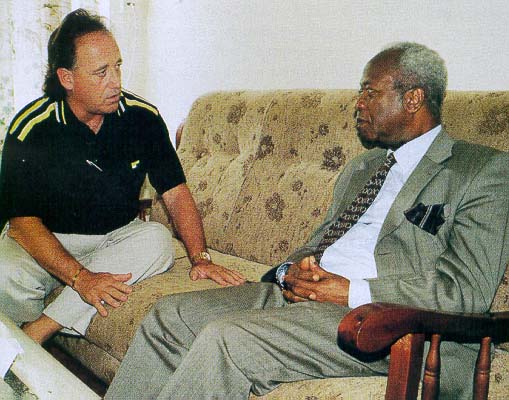
THE NEXT MORNING, Nick spends hours trying to reach Septimus Kaikai, a former economics professor at a community college outside Washington, D. C., who is now the official spokesman of the president of Sierra Leone. Nick met him a year ago and treated him and his nephew to a trip to the U. S., and they’ve been close ever since.
He comes to the table frowning. There’s no real news, he says. “The professor can’t talk on the lines because there are so many people listening.”
“Who’s listening?”
“You name it–CIA, Liberians, British. Try the springbok. It’s delicious.”
NEXT TO EATING AND DRINKING, Nick loves telling stories. Like the time he took a step into the jungle with a bag full of money and a bag full of diamonds and bumped right into natives with guns. And another time down in the Ivory Coast when some very sophisticated bandits in suits shadowed them for a couple of days and turned up in the hotel elevator, so his guys hustled him into a stairwell and gave him a gun. “And the deal is that if somebody walks through that door, start shooting, you know?”
“How much money did you have?”
“I don’t know, maybe $3 million. Not much.”
Nick’s stories go on and on and loop back on one another, weaving ing variations of Brave White Hunter around his big gut and sagging eye bags, with just enough glints of truth that you start to think Africa really does need guys like him, manly to-the-moon hustlers with the drive to will their dreams into existence. And when there are gaps in the Nickalogue, James and Stan and Pete throw in stories of their own. James telling about helicopter attacks with the Three-Two Battalion and his campaign work with the Inkatha Freedom party and Pete talking about getting stalked by a lion in Thailand and Stan–in the most droll Irish accent imaginable–throwing out glimpses of headless bodies and river pirates who attack in long canoes. And have you heard of that exciting new sport, the African high jump? “You’ve got to get all the body parts across the line,” Stan says. “Oops! It doesn’t count, you left your foot there.”
“It’s exciting,” Nick says. “It’s real exciting. You get out in the jungle sometimes at night and you wonder why you’re out there, why you’re doing it. But you’re dealing with the most precious commodity on the face of the earth and everybody wants it. A little coffee cup can hold a couple million dollars’ worth, you know? It’s exciting. I’m addicted.”
BACK IN HIS HOTEL ROOM, Nick calls me over to the window. He’s holding a piece of white tissue paper with about twenty pebbles piled in the center. They are chalky white, like something you’d find in the surf. The largest is a brownish stone about the size of a piece of pea gravel.
“This is worth probably $3,000 a carat,” Nick says.
“How many carats?”
“Twenty-two.”
“Nice,” I say. “It’s colored?”
“No, it’s just the skin on it that looks brownish like that. And here, you see that little black spot? That’s a pique, which is actually just a piece of coal.”
This is the kind of thing you can find in the riverbank gravel in Sierra Leone, Nick reminds me. The Star of Sierra Leone weighed in at 968.9 carats. Imagine living in one of the poorest countries in the world and digging up something like that. He gives me a quick lecture on the four C’s. “You can buy a round one-carat diamond for $700 or $30,000,” he says. “It’s the color, the clarity, the carat weight, and the cut. That’s what it’s all about.”
He holds up another pebble. “See how white this one is, and clear and clean?” he says. “Look at that. Look right through there. Hold it up to the light.”
AT LUNCH THE NEXT DAY, Nick tells us the plan. This is something he enjoys and does frequently. “Tuesday morning we’re taking a private jet to Sierra Leone. It’s a really nice jet, a Learjet with a stand-up cabin, private head, the whole thing. We’re gonna make one stop on this little Portuguese island called Sao Tome It’s about 150 miles off the coast. It’s really a nice little island.” And why are we stopping there?
“To eat lunch and have a drink, man. What do you think? We got women there, you know.”
By this time, I’ve figured out that at least half of what Nick says is bullshit. When I first met him, he said he owned a private plane. Now he’s leasing one. And he said his family owned twenty-two diamond mines, but it turns out they just invested in them. Now it seems he doesn’t have a license to export diamonds from South Africa, so what he was doing with those stones in his hotel room I have no idea. The stories come too thick and fast and there’s too much food and too much drink and now we’re hitting the road in two white Mercedeses with Global Positioning Systems on the dashboards and Stan and Pete in constant touch on walkie-talkies and Nick digging around in his bag. “What have I got here?”
He pulls out a stack of greenbacks three bricks thick–$100,000.
James turns around. “Is that the money? I can smell it.”
“It’s the best smell in the world,” Stan says.
Everywhere we go, Stan carries a trauma kit stuffed with medicine and field dressings. Nick says it’s so they can stabilize him and radio the jet they keep on call. “It’s a Challenger 601,” he says. “It was actually Nelson Mandela’s private jet. And then Pavarotti used it, and then I picked it up.”
Whatever. Where’s the next bar?
At a tiny town called Taung, Nick meets with some black landowners looking for someone to help them mine their land. Nick launches into his pitch about how his family has been in the diamond-mining business for fifty-five years and they owned diamond dredges in Guyana and Venezuela and twenty-two mines and when he took over the company in 1997 he came to Africa and started in Guinea and he’d still be there if there wasn’t so much corruption, so he moved to Sierra Leone and the people love him there–he’s given equipment to hospitals and schools–and with any luck they’re going to make him the official exporter for the whole country. And last year he came down here to South Africa to start a polishing school where he’s going to teach underprivileged black people how to work diamonds and it will be bigger than anything De Beers has ever done for the people and the beginning of true integration for the diamond industry and the biggest thing the country has ever seen. Margaret Thatcher and Nelson Mandela are going to come for the opening celebration and it’s going to be huge. “We make a lot of money, and we pay a lot of taxes, but we get involved with the people personally,” Nick gushes. “It’s just the way my family’s been. When we go into a community, we do things for the hospital, for the schools, bringing in food and clothes. Sometimes it’s a lot of money, but sometimes it’s not. It’s more the thought and the spirit of what you’re doing than anything.”
Never mind that Margaret Thatcher and Nelson Mandela will be showing up for an Inkatha Freedom party celebration (if at all) and not for Nick’s factory opening, Nick keeps rubbing the word under-privileged against diamonds until they both shine bright enough to blind you. He weaves so much verbiage around his little pique of truth that it actually seems to grow into some kind of fabulous gemstone before your eyes. And maybe he even sells himself.
But it turns out that the landowners want a big investment, heavy machinery that will cost almost $3 million. That’s not what Nick had in mind. “We’d like to start with existing operations and work our way back,” Nick says. “I’m sure you understand what I’m saying. I’d like to buy some diamonds today.”
He laughs and everyone laughs with him. Then one of the landowners speaks in a soft, solemn voice. “But you see, Niko, when our MP said you were coming, we said, Thank God, now we are free. Because our land is very rich but we cannot work it. The banks say we have no experience and will not lend us the money.”
Nick backs and fills and grouses about banks but holds his ground. “You can have all the land in Africa and I can have one diamond, and I’m a richer man than you are,” he says. “You talk about being free? Money is freedom.”
IN ANTWERP TODAY, they seized a package of Sierra Leone diamonds. Which shows they’re serious about this diamond ban. And the rebels are still holding UN soldiers hostage.
And Nick is sitting down to another lunch. Back when he was in advertising, he says, the big shots used to talk down to him. “I’d say, ‘You want to continue this conversation on my boat? Maybe we could continue on your boat? You don’t have a boat? Fuck you.'”
Same thing in the diamond business. When he told his father-in-law his idea about buying in bulk, the old man told him it couldn’t be done, couldn’t be done, he’d been in this business for fifty-five years. Hell, there are Lebanese diamond dealers who wait for weeks in an office for a single stone. “We would have screaming fights,” Nick says. “I would tell him, ‘You fucking wetback. It’s a good thing your daughter’s not as big a shit as you are.’ Now he works for me.”
By the time we meet that night at the casino bar, Nick’s Evinrudes are cranked into the red. “The country is just there for the taking,” he says. “A hundred guys and a pair of gunships and you could clean out that jungle in two weeks. A month tops. It wouldn’t even cost that much.”
When Nick gets worked up like this, his head starts to twitch to the side like a dog straining at an invisible leash. He sits back with his big belly bulging into his silk golf shirt, with the fat silver Dunhill pen and the Bulgari watch and the Tiffany bracelet that comes with its own gold screwdriver, and it’s no surprise that he had his first heart attack at thirty-two, while working three phones from a bar stool. “I want to be king,” he says, cupping his balls.
As the gamblers behind us drop coins into the slots, their metronomic obsession a perfect counterpoint, Nick drinks and rants and drinks some more, gassing on about the incompetence of the UN and the uselessness of women newscasters and all the ridiculous PC bullshit regulations that stifle anyone with a little hustle-like that lazy little bitch who hauled him into court to pay her pregnancy leave and he told the judge, Why the hell should I pay for it? I didn’t knock her up!–and most especially the entire fucked-up continent of Africa, where nothing ever gets done right because it’s filled with these useless incompetents who can barely shit, shave, and shampoo without detailed instructions. “Those little islands called the United Kingdom, they conquered the whole fucking world. You know why Africa can’t do that? ‘Cause they can’t.”
By this time he’s twitching pretty hard. When he stops to breathe, he admits the whole Sierra Leone situation has got him a little stressed. “The thing is we’re on a plateau of all this shit happening,” he says, “and I’m so frustrated I just want to get my boat and check out.”
IF HE HAD HIS WAY, Nick would force the Sierra Leone government to hire mercenaries and clean out the rebels. Failing that, he has this plan–which he keeps dribbling out in mysterious hints–to hire someone to secure the area where he owns an interest in some rich mines.
The idea itself isn’t completely implausible. In 1995, a mercenary force called Executive Outcomes pushed the rebels to the border with just two hundred men. But there are a few minor sticking points. A few years ago, for instance, the rebels captured another mercenary leader named Colonel Bob McKenzie and tortured him for a few days, then ate him. Or so the story goes. I mention this to Nick in the car.
“Yeah, well, shit happens.”
Then Stan speaks up from the driver’s seat, saying that Executive Outcomes doesn’t exist anymore and we can fantasize all we want about mercenary armies but “it’s joost a lie.”
Nick leans over to confide in a low voice, “What Stan is concerned about is, we’re talking about some badass people, and it might not make me any money to shoot my mouth off. It might get me killed.”
He twitches and cups his balls.
AT BREAKFAST, Nick has a Bloody Mary. Then he has another. At lunch, he suddenly rips his menu in half.
At the mall an hour later, Nick holds up a cheap camera and asks the clerk, “Is this strong?” Just as the clerk starts to answer, Nick drops the camera onto the counter. It clatters violently on the glass.
Yesterday a diamond dealer was arrested in Congo with a million bucks and some diamonds. They took his diamonds and money and accused him of espionage. That makes Nick nervous. It makes me nervous, too. It occurs to me that tomorrow I leave for a war zone with someone who lies as often as a priest says amen. I decide that before we leave, we need to have a long and meaningful talk.
NEXT DAY, AT THE CAPE TOWN AIRPORT, Nick bristles with masculine rich-guy authority. “I do this all the time,” he tells the customs lady. “We always load the luggage directly onto the plane.” The plane is a long and sleek Lear 35 and it’s costing Nick thirty grand to rent, but it’s a hell of a way to make a splashy entrance into one of the poorest countries in the world.
We spend the night on Silo Tome and then get back on the plane, and this time there are no Bloody Marys. Instead Nick starts talking about how beautiful Sierra Leone is and how kind the people are and how much terrible suffering they have endured–and he seems to mean it. “That’s why I get off on these tangents about finishing it off,” he says. “I believe in finishing.”
As we approach Freetown, he takes out a string of silver beads and wraps-them around his hands and closes his eyes. He’s praying. The son of a bitch is praying.
And there’s the coastline of Sierra Leone, dead ahead.
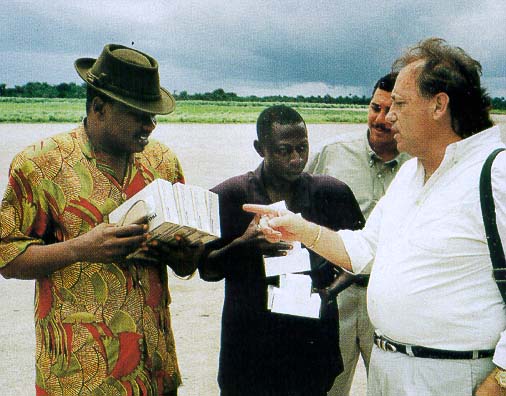
NICK STEPS OFF THE LEAR JET into a crowd of immigration and police and luggage guys and hugs and hellos and handshakes and double handshakes. “I’ve got those walkie-talkies for your guys,” he says. “Four walkie-talkies with five different channels. And who wanted the sunglasses?”
The air is moist and tropical and the warm tarmac gives off an airport smell. The landing field bustles with soldiers and UN helicopters, the pregnant kind with blades that flop over like sagging palm trees.
“And here are the battery chargers,” Nick says. “They run on rechargeable batteries, so charge ’em all night. If you don’t charge ’em all the way, then the batteries won’t last as long.”
Nick spent about $150 on these walkie-talkies, but they’re going down here like loaves and fishes. The crowd buzzes around him as if he’s Elvis Jesus Gandhi, eventually getting so big that an official comes up to protest. “This is not right, sir. This is not right, sir.
There’s no way to rationalize this.”
To break it up, Nick pushes a wad of cash on the headman. “Everybody gets small-small,” he says.
Over to the side, a group of men in uniform linger. “We’re the junior boys. He’s the senior man. We won’t get any.”
YESTERDAY THERE WAS A SKIRMISHnear here. There’s also persistent trouble with a breakaway group of army soldiers called the West Side Boys. So the best way into town is a big old troop helicopter. Everybody dons headgear to mute the roar. Through the thick little windows, Freetown is a jumble of rusted tin roofs tumbling down green hills into the curve of a beautiful beach. People are lined up in the sand, hauling in fishing nets.
At the heliport, more hugs and hellos. A slender African official takes Nick’s hand in both of his. “Hello, we have so much love for you,” he says.
“I got your e-mail,” Nick says.
“I heard what you did for the man out at Lungi airport. You must do the same thing for us here. We need the communications. It is good for the development of the country.”
In Sierra Leone an American bearing gifts is everybody’s friend. The private jet helps. Small-small for everyone says the big man.
Normally Nick would spend a day in Freetown checking in with Professor Kaikai and then head up to a mountain town called Kenema, where he keeps an office run by a wild Ukrainian who lives with six local women. He’ll sit in the office for days while miners and brokers bring diamonds. But with the diamond ban on, he has no choice but to focus all his attention on his other plan: He wants to become Sierra Leone’s official business spokesman and also its official diamond exporter. He’s been talking about these schemes for days now, how he’s going to promote the wonders of Sierra Leone all over the world and also control every diamond that goes out of the country, raking millions off the top. And it seemed like just more Nickalogue. But now everything about him is serious and focused. Accompanied by his local fixers, a Guinean named Ibrahim Ghussein and Maya Kaikai, the professor’s nephew, he makes a quick stop at the hotel and heads straight downtown to meet the minister of mines-first on a long list of government officials Nick hopes to win over. He’s so intent, he’s like another person.
And Freetown is just how Nick described it. Where I expected CNN’s bullet-riddled shambles, the windy, jumbled streets are full of people and roadside stands and children playing. We pass a Catholic school that looks well tended and a Mobil station full of cars. The green hillsides are cut by hundreds of building plots waiting for new houses. This is a war zone?
But the energy sags when we get to the Ministry of Mineral Resources. Three soldiers loiter at the gate, a rooster struts in the courtyard, and the elevator can’t be trusted, so we walk up six flights of dank stairs and everywhere we look, people sit slumped over, staring into space. There seem to be at least two people at every post. A guard sleeps with his head on another guard’s shoulder.
But when they see Nick, smiles break out, followed by big hellos and hearty handshakes. Without even a moment of waiting, he goes right in to meet the minister, who sits stiffly and nods along as Nick weaves his verbal arabesques. Either he’s very tired or bored out of his mind or both. But he seems to want to make Nick happy, promising that the diamonds will certainly start flowing again by the end of the month and mentioning the possibility of restricting export licenses to “a few people or a few groups.”
It’s not exactly a promise to make Nick the official Sierra Leone exporter, but it’s in the same universe. So I ask the minister directly if he means to suggest that one of those “few people” will in fact be Nick.
He just laughs. “I’m not saying. He has applied and we’ll look at his papers alongside the Africans’.”
OUTSIDE THE OFFICE, Nick reviews. “They’re very nervous. They’re being pulled in so many different directions, they don’t want to make any commitments. And they really don’t have any money. This country is literally down to nothing.”
In fact, he says, they’re so broke they just asked him for a small contribution, something to help them attend the Diamond Council meeting in Antwerp on Monday. Just a few plane tickets. “We’re talking about basics here,” he says.
Then it’s downstairs to meet the minister of trade and industry, a thin, dignified man who seems to have a perpetual vague smile on his face. This is supposedly the man who is going to make Nick the country’s international business spokesman, so Nick launches into the whole pitch about how he came to Sierra Leone and fell in love with the place and the beauty and the people who are so gentle and how he wants to do something for them. “Not just the diamond business, but other business. Like this polishing factory that we’re doing in South Africa. We want to open a diamond-polishing factory here.”
“Mmm-hmm,” the minister says.
“And that’s going to have a trickle-down effect. I mean, we’re gonna have to supply those polishing factories, and they’re gonna have to have roads made and people are gonna need other supplies and equipment and repairs in cars and roads and trains and everything.”
“Mmm-hmm,” the minister says.
“But I’m also in the development business, the real estate development business. We’re talking about developing a couple of hotels down here, which is not a difficult thing to do for me in this country. I mean the natural beauty is incredible here.”
The minister seems mildly bemused by Nick–this oddball American with the big belly and Bulgari watch and Dunhill pen and salesman’s spiel. But he also seems–yes, he really does–to be fond of him. He’s soaking up all Nick’s horseshit like an indulgent father.
“Are you really going to make Nick an official representative of the Sierra Leone government?” I ask. “Oh, sure,” he says.
“Really?” I say. “In what capacity?”
Nick jumps in, grinning. “I wanted to be king, but he said no.” The minister frowns at me and speaks firmly, as if eager to correct my cynicism. “In the capacity of somebody who’s shared our aspirations at this very critical moment,” he says.
And that’s when it hits me–in this context, in this raped and abandoned country, a guy like Nick must seem almost lovable. After all, how many international diamond dealers parade through government offices bragging about all the money they have? How many give even a penny away? How many even bother to say a kind word?
“The exact position is gonna be determined in the very near future,” Nick says.
The minister gives him another indulgent smile. In the hallway a few minutes later, Nick heaves a satisfied sigh. Tomorrow, he sees the minister of foreign affairs. Then the vice-president. And the day after that, with any luck, the president himself. “Now we’re gonna go back to the hotel and drink,” he says.
JUST A SHORT WALK from the hotel along the crescent of the harbor is a perfect seaside bar with palm trees and a thatched roof and a patio overlooking the sand. The owner is a bluff Dutchman in a T-shirt and crew cut who brags that he closed only half a day when the rebels attacked Freetown in ’99. We lean back in white plastic chairs and admire the view. “Ah, Sierra Leone,” Stan says. “The sound of generators humming in the night.”
The service is incredibly slow, sparking various jabs at African work habits. The batik vendors who won’t go away spark a few more. Ibrahim and Maya Kaikai sit through it without a word. Just before dinner comes, a compact little man in thick glasses strolls over to say hello. He looks like a meter inspector. “This is that pilot I was telling you about,” Nick says.
It’s Nils, the gunship pilot Nick was going to pay to straighten out some stuff. Someone says something complimentary and Nils shrugs. “I’m a white man in Africa. I’m nothing.”
He tells Nick he’ll see him tomorrow at the hotel.
Over grilled fish, Nick relaxes. “Look at this cove. Can you imagine just filling this full of restaurants? They’ve got the second-largest rutile deposit in the world; if they could just get peace, in a year there’d be six or seven companies in here. In five years they’d be exporting fish, shrimp.”
IN THE MORNING, Nick goes for a walk on the beach. This is a kind of tradition with him, a declaration of purpose, a chance to represent the good life. Anyway, that’s how he explained it. Today he knocks on my door as he goes past and I jump into the shower and hurry after. As I get through the gate, a tall man in shorts approaches me. “Where’s Mr. Karras? Every morning he goes down on the beach with Stan.”
“I think they’ve already gone,” I say.
We walk together. He says his name is Guzman and he’s in the diamond business, that every morning dealers and buyers walk up and down the beach doing business. “I have a big stone,” he says. “Seventy-five carats.”
“Seventy-five carats? You have it here?”
“No, not here. I go get it. I go get it from the rebels. They’re hungry. They need to sell something and buy some weapons.”
A moment later, he bends over to show me the scar on his head. “They did this to me,” he says. “I don’t even have shoes. Nothing else. They killed my family. Everything gone. But I still hold my mind.”
Up ahead Nick is walking in his khaki shorts with his shirt open, exposing his sultanic belly, moving in the deliberate way of men who take possession of a place by walking through it. We catch up and Guzman talks to Stan for a moment and then drops behind ten paces. He seems disappointed.
THE CAPE SIERRA HOTEL is a desolate cement pile out on a well-guarded point, perhaps the safest place in all of Freetown. This is where the diamond dealers and mercenaries stay, where the journalists gather whenever the war gets particularly exciting. Every night, beautiful young prostitutes gather in the bar and if you are even vaguely polite, they will follow you halfway to your room. The patio is unfinished and there’s mold on the tennis court and out by the pool there’s a bathroom sink sitting in the grass.
This is where Nick does much of his business. This morning, he’s waiting for Nils. He won’t say what for. Apparently I have asked one too many questions about his plan to “secure an area.” And it’s possible that he got offended back in Cape Town when we had that deep and meaningful conversation and I called him a brazen, bold-faced, low-life liar. All he’ll tell me is that Nils has family in South Africa and they’re going to talk about something personal-in private. A few minutes later he slips away.
Ten minutes after that, I find him upstairs in the restaurant. I give him a big smile and sit down.
Five minutes later, he says he’s going to his room for a while. A few minutes after that, I see him walking through the lobby with Nils–off for that private chat.
THE MINISTER OF FOREIGN AFFAIRS sits stiffly on the sofa, staring at the coffee table, not even looking at Nick.
Nick just sells harder. He goes through the whole pitch about his family holdings in South America and his polishing factory in South Africa and all the things he’s donated, the computers and the radios, and he just bought a sonogram machine and an X-ray machine and a heart monitor and he’s going to bring them very soon. “I want to do what I can,” he says. “I have a lot of influential, very powerful friends. I know some of the biggest businesspeople in the world. We just donated eight million leones for the war effort three weeks ago. So I wanted to let you know that I’m doing whatever I can and I’m not gonna leave you alone. I feel part of Sierra Leone.”
When there’s a lull, the minister says in the mildest of voices that his government wants to be honest. “We will not tolerate the fly-by-night businesspeople who deal with the fellows in the hotels and then fly off.”
Nick nods his head eagerly. “Like I said, I’m a businessman. If you want me to do something or go see somebody, I’ll do that. We have a very large presence in South Africa. We have an office in Cape Town. We’re spending more than a million dollars on this polishing factory. And it’s not just a polishing factory for us to polish diamonds, it’s a school for the black-empowerment movement.”
The minister smiles and asks us to sign his visitor book.
THE VICE-PRESIDENTis in a meeting, so we go to a chicken place called the Crown Bakery to wait. An hour goes by and then a stunning young woman with blond cornrows walks up to the counter. “You want her?” Nick says. “I’ll buy her for you. Ten dollars. She’s yours.”
Out on the street, you can buy hardware and building materials, and the sidewalks are overflowing with busy people. I spot a foreign woman haggling over a pair of tin snips, completely at home in an African dress. She says her name is Susan and she’s Russian and she’s been living at the Cape Sierra for three years.
“What are you doing here?” I ask.
“Business,” she says.
“The diamond business?”
“Business,” she repeats.
Back at the restaurant, Nick is giving an interview to one of the local newspapers about the walkie-talkies he donated. Then word comes from the vice-president’s office and we hop into the cars and head up into the hills, past the American embassy and the big houses overlooking the bay. The vice-president’s house is a graceless white box with an empty pool and a sandbag pillbox. A dozen soldiers guard the door. Nick goes right in.
Half an hour later, he says it went very well. “He understands the problem. We’re gonna travel together, go to meetings together-business meetings.”
Every night, people come to the Cape Sierra hoping to see Nick, some with appointments and some who press notes into your hands and look desperate. The official who estimates diamonds for the government comes once. The diamond officer from the heliport shows up two nights running, slender and solemn and glistening in the heat, talking to anyone who will listen about how much he admires Nick. “He was able to donate some amount of money, eight million leones, to the war effort,” he tells me, “and now I hear that he’s donated communication equipment to the monitoring unit of the Ministry of Mineral Resources. It is the very first time in my own capacity as an employee of the Ministry of Mineral Resources that somebody has donated such valuable equipment that can be used for the benefit of this country.”
Tonight it’s Professor Kaikai’s turn. He’s tall and lean and looks sophisticated, a man of the world. He goes straight to Nick’s suite. They talk privately for a long time. When I join them, he tells me he thinks that the diamond embargo will be lifted very soon and things are on the verge of turning around and when they do, Nick is going to be a major part of it. “He’s the kind of businessman we need in this country. He could be someplace else investing his money. He could be someplace else with his energies and his time. But he’s seen the potential in the country and he’s willing to invest a lot of his time and his money in a place like this. The fact that he was able to see the vice-president today is testimony to that.”
It’s almost like a policy statement, and Kaikai is almost too smooth, the kind of man who looks at the world through half-lidded eyes and keeps his real opinions to himself.
But there does seem to be some kind of real intimacy between them, oddly matched as they are. He mentions the day Nick donated money and computers to the vocational school and the computer he gave to the local government and the eight million leones for the war effort. Sure, that’s only about $4,000 American, but there’s another way of looking at it. “To put that in perspective,” Kaikai says, “the entire Lebanese community only donated twenty-five million leones.” It’s as if something in Nick’s blustering, hungry energy has actually touched him, not because Nick employs his nephew or because he’s fool enough to think everything Nick says is true, but because the vast effort Nick puts into coming up with all his ridiculous bullshit represents some kind of hope. “There are very few businesspeople who come into a place like this and start doing something for the people,” Kaikai tells me. “To think in terms of the people in the country and to try to actualize that is the thing I find fascinating about him.”
In the morning, Nick says the meeting with the president is up in the air. “You know, it’s the difference between ‘now-now’ and ‘just now.’ ‘Just now’ means ‘I’ll do it right now.’ ‘Now-now’ means ‘at some point.’ This is Africa, you know.”
So Nick’s going to take it easy, do some paperwork. I spend the day in town, talking to local businessmen and to a couple of newspaper editors. In contrast to the government officials I’ve been meeting with Nick, all are very fatalistic. They say the government is too weak to do anything and that diamonds corrupt every armed group that gets anywhere near them, including government troops. Including the government. Because the distinction between rebel “blood” diamonds and “legitimate” government diamonds is a fiction. Because the rebels don’t just smuggle their diamonds through Liberia, they also sell stones to the licensed diamond brokers who sell to people like Nick. The rebels control 90 percent of the diamond fields, so where else would the “legitimate” diamonds come from? They say all this in a matter-of-fact way, as if everyone knows it. Which means that for all of Nick’s talk about wanting to do good, and despite doing everything legally, he’s almost certainly been dealing in blood diamonds.
Later that day, a group of prominent local engineers laugh when I tell them Nick thinks he’s going to be Sierra Leone’s official diamond exporter. There’s no way the export licenses will be limited to one person, they say. There will be at least five. And there is some formidable competition, among them an international diamond-dealing company called the Rappaport Group, which is like Exxon to Nick’s lone rig.
That night at the hotel bar, just before dinner, the professor shows up again. Since Nick’s running a little late, I take the opportunity to ask a few rude questions. Like, isn’t it a little questionable for Nick to buy plane tickets for government officials who will vote on his export license? Kaikai smiles. “How is that different from a congressman in the United States being flown around on a corporate jet?” he says. “This is part of international business. As long as it’s up and above and there’s no strings attached, it’s all right.”
And what about the Rappaport Group? Is Nick fooling himself with this export-license thing?
He smiles again. “Let me put it to you this way,” he says. “When we were in the midst of our troubles, what did any of those people do for us? Did they contribute? Maybe they did. I’m not aware of it. De Beers was here. Did they contribute? Maybe they did. I’m not aware of it. So when you consider a smaller person who’s demonstrated an interest in the country…”
At dinner, Nils shows up with a beautiful African girl on his arm.
In the parking lot, Nick pulls Nils aside and mutters something. Nils nods and says, “Okay, get me a phone number.”
Nils’s real name is Neall Ellis and he’s fifty years old and he fought with the South African army in Angola and Rhodesia and a little bit of Mozambique but then peace brought too much paperwork and he came to Sierra Leone with Executive Outcomes. That was in ’95. He came back in ’98 with another private outfit called Sandline, him and a Lebanese guy called Hassan and an Ethiopian named Sindaba and Juba the copilot and Fred the sixty-year-old gunner. When Sandline decided to pull out, it offered them the helicopter in lieu of outstanding salaries. So they stayed and for two years they were the only helicopter gunship in Sierra Leone-maybe the only thing here as hard and real as a diamond. And Nils is pretty hard and real himself. He makes no unnecessary motions. He has a quick little smile that seems oddly disconnected down there under his thick glasses. And he seems to have very little patience for bullshit of any kind. “Until the diamond business is regulated, properly regulated, then this war will carry on,” he says flatly. “And it’s going to be very difficult to stop. I mean, even the ECOMOG and the UNAMSIL people are involved in diamond mining.”
Really? The UN troops? The troops from neighboring countries? Even the local journalists didn’t go that far.
“Well, look, I’m not saying that I’ve got proof for sure. But this is Sierra Leone. And diamonds is what makes this country talk.”
Nils is such a straight shooter that I decide to just blurt out the question on my mind. “The other day, when you and Nick went off, did Nick talk to you about securing a diamond area?”
“It depends on what you mean by securing a diamond area,” he says.
Heavy rains in the night leave a damp smell of cement rot in the hotel and all the phone lines in Freetown dead, even the lines into the army. It’ll be a slow war today. But Nick comes to breakfast saying he wants to buy a house near Cape Town that’s just unbelievable, four bedrooms and a gorgeous garden and the mountains with the grapevines and just half a million dollars and he’s going to buy some polo ponies down in Argentina-buy two hundred polo ponies and ship them to Florida and sell 180 of them and then he’d have twenty for free, see, and he’d ship those to California. And a couple to Cape Town. And look, here’s an article about him in today’s paper. “In a big move to enhancing the smooth and effective operations of the Mines Monitoring Officers in the Ministry of Mineral Resources, a United States investor Wednesday donated five handsets worth thousands of U. S. dollars…”
Then it’s time to go. At the heliport, the diamond officer who kept coming to the hotel to see Nick stands behind a rickety wooden desk in a stick hut. “He needs a new office,” Nick says. “We’re gonna build another one.”
“Please,” says the diamond officer. He waves us through.
Then the minister of mines comes in and nods to Nick and they usher him through to a private place and right behind him comes Susan, the Russian woman I ran into in the market. She’s escorting a beautiful milk-chocolate girl in chic clothes that are very tight. Then we all turn in our hand-carved wooden boarding passes and get on the helicopter, and when we get to the airport, Nick goes through another gantlet of eager baggage handlers and government officials-there’s the head of the army police and the head of the airport diamond office and Nick takes a moment with each of them, passing out money and telling the headman to give everybody small-small. An hour later we’re in Gambia.
Nick kicks back at the outdoor bar. Ahh, civlization. The Lebanese built this airport back when Gambia was a big nothing like Sierra Leone, there for the taking. Which gets Nick talking about the shrimp and the fishing and the rutile and the diamonds and his boat. And the deck where he will land his helicopter. And the helicopter. And most of all–because this is what it’s really about–the pure feeling of being a thousand miles out to sea with nothing between the sky and the water but a little speck of Nick Karras. Back in Sierra Leone he needed to care about the suffering people and so he did care about the suffering people. He really did. Nick can talk himself into anything. But that was then and this is Gambia and right now he feels gloriously free and freedom, baby, is what it’s really about. “Three years and I’m out of here,” he says. “A citizen of the world.”
Three months later, the diamond embargo was lifted, and Nick Karras was issued the very first export certificate by the government of Sierra Leone–number 000001.
The AfricaPaper: John H. Richardson was born in Washington D.C. Grew up in Athens, Manila, Saigon, Washington, Seoul, Honolulu, Los Angeles. University of Southern California ’77, Columbia University ’82. Worked at the Albuquerque Tribune, The Los Angeles Daily News, Premiere Magazine, New York Magazine, Esquire Magazine. Taught at the Columbia University, the University of New Mexico, and Purchase College. Currently Writer At Large at Esquire Magazine. Author of three books.
The Opportunist was first published in January 2001 in Esquire.
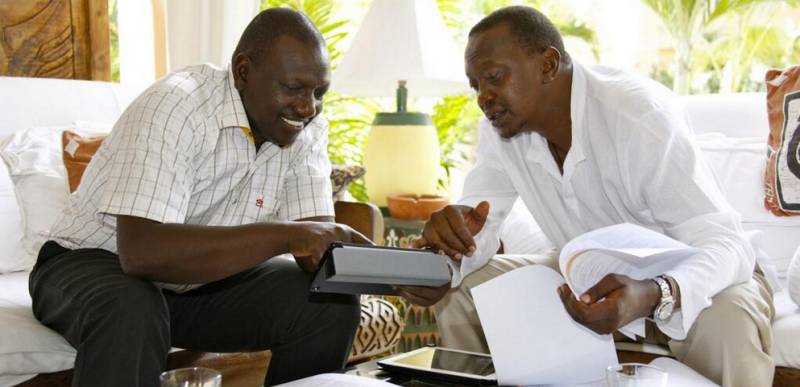
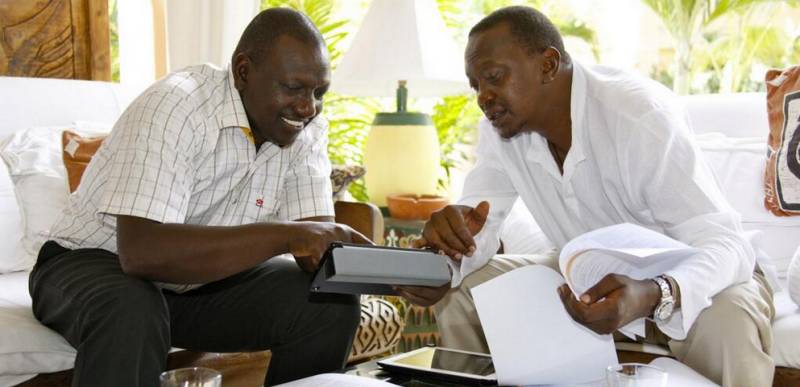
Judges accused of bowing to political pressure after deciding that Kenya’s deputy president can stay away from most of his trial.
By Felix Olick | Kenya, and Simon Jennings | ICC
International legal experts and human rights groups in Kenya have strongly criticised a decision by judges at the International Criminal Court, ICC, for their decision to allow the country’s deputy president, William Ruto, not to attend most of his trial in The Hague for crimes against humanity.
Questions
Some lawyers question the legal basis of the judges’ ruling on June 18, which permits Ruto to absent himself from most of the proceedings. He will still have to be present in court at certain key points, including the opening and closing statements by all parties, sessions at which victims of the crimes in question present their concerns in person, the judgement, and any sentencing hearings.
The judges issued their decision after Ruto’s lawyers requested that rather than their client having to be present in The Hague throughout the trial, he should be allowed to remain in Kenya so that he can attend to his duties as deputy head of state.
1,100 Kenyans Dead
President Uhuru Kenyatta, too, faces trial at the ICC for orchestrating the bloodshed that brought Kenya to its knees following the disputed result of the 2007 presidential election. A third defendant, journalist Joshua Arap Sang, is similarly charged with responsibility for the violence which left 1,100 Kenyans dead and around 650,000 displaced from their homes.
One case, involving Ruto and Sang, is scheduled to start on September 10. Kenyatta’s will start on November 12.
Kenyatta and Ruto were elected in a presidential ballot held on March 4.
Making Concessions
Rights groups are concerned that following the pressure put on the court and the international community by the Kenyan government and the African Union to halt the cases in The Hague, this decision gives the impression that the court is making concessions to the new state leaders.
The judges’ ruling stated that allowing Ruto to be absent from his trial “was strictly for purposes of accommodating the demanding functions of his office as deputy head of state of Kenya and not merely to gratify the dignity of his own occupation”.
“Few tasks are more important and extraordinary in their dimension as to have a principal role in the management of the affairs and destiny of a state and all its people, and their relationship with the world,” the judges wrote.
Appeal
Prosecutor Fatou Bensouda has asked the judges for permission to appeal against the decision.
The decision has drawn criticism from legal experts who believe the judges have bypassed a clause in the court’s founding treaty, the Rome Statute, which states that defendants “shall be present during trial”.
Despite the provision, two of the three judges ruled that it was possible to grant an exception based on Ruto’s specific circumstances. The two – Judge Chile Eboe-Osuji and Judge Robert Fremr – emphasised the presumption of innocence and ruled that rather than enforce the provision, it was more important to do what is “fair, reasonable and just” under the court’s procedures.
The third judge, Olga Herrera Carbuccia from the Dominican Republic, disagreed with her colleagues and said the Rome State provision could not be ignored.
Danya Chaikel of the International Bar Association in The Hague questioned the judges’ decision to apply a flexible interpretation to the rule that makes it plain that defendants “shall be present during trial”.
“In legal drafting ‘shall’ normally imposes a duty, not a right,” Chaikel said. She also that a second rule makes it a right for the accused to be present at trial.
“This means presence is both a duty and a right [for defendants], meaning a trial shall not carry on if an accused is not present, whether they wish to be so or not,” she said.
Chaikel pointed out that while the Rome Statute provides for suspects to be absent during the pre-trial stage of proceedings, there is no such provision when it comes to the actual trial.
“The drafters [of the Rome Statute] said suspects can waive their right to attend proceedings for pre-trial proceedings, so it seems highly unlikely that the drafters forgot to add a parallel provision for the trial phase,” she said. “Whether justified or not, the drafters of the Rome Statute clearly decided to include this duty to be present during the trial, and it is for the ICC’s states parties to amend if they decide to do so.”
Ruto’s Special Treatment
The judges’ reasoning that Ruto warrants special treatment because he is deputy president has worried many legal experts.
The judges stressed that heads of state and other senior government officials were not immune from prosecution at the ICC, but said this did not prevent concessions being made on the grounds that a defendant was in public office. They cited “the traditional concern of international law to avoid undue hindrance of heads of state and senior state officials in their performance of legitimate functions on behalf of their states”.
However, lawyers are concerned that taking Ruto’s new status as deputy president into account violates another provision in the Rome Statute that says the court will treat all defendants equally, with no exceptions for those in senior government positions.
Judge Herrera Carbuccia disagreed with her colleagues on that point, too.
“Mr Ruto should not be given a different legal status on the basis of his personal position as deputy president of the Republic of Kenya,” she wrote.
According to Chaikel, Ruto is no different to other defendants who come before the court.
“All suspects and accused persons sacrifice employment and personal commitments to attend trials that can go on for years and years,” Chaikel said. “To say this is a special case because of Mr Ruto’s political status seems to go against the principle that all accused persons are treated equally.”
ICC Cases Longer Valid?
Since Kenyatta and Ruto were elected, the Kenyan government has argued that the ICC cases are no longer valid, given that the two men have been democratically endorsed by the Kenyan electorate.
For its part, the ICC has gone to great pains to point out that the outcome of the March election will have no effect on the trials of Kenyatta and Ruto in The Hague.
Esther Waweru, legal affairs programme officer at the Kenya Human Rights Commission, says the new decision can only be interpreted as the court bending its own rules to accommodate those in powerful positions.
“The Rome Statute is clear that at the time of trial, the accused must be present throughout,” she told IWPR. “So for us, that decision can only mean that for so long as you are in high office, even the legal provision of the ICC can be twisted.”
Waweru points out that if Kenyatta were to make a similar request to the court, it would most probably be granted because the reasoning is analogous. That would leave Sang facing trial in The Hague on his own.
David Donat Cattin of the NGO Parliamentarians for Global Action argues that even if appeals judges uphold the decision to allow Ruto not to attend the trial, it is “very important” that they provide a sounder argument for doing so, in other words a different reason that would not appear to flout the Rome Statute.
“The appeals chamber should be very firm,” he said.
“Extraordinary Situation”
Donat Cattin believes that the seeds of the June 18 ruling were sown when pre-trial judges took a decision in March 2011 not to issue arrest warrants for the Kenyan suspects, who were instead asked to appear voluntarily before the court whenever requested to do so.
He believes that this “extraordinary situation”, where senior officials accused of mass crimes are allowed to remain at large, has placed the judges in a tight spot, and that they decided to grant Ruto’s request in order to secure his further cooperation with the ICC process.
“[The judges] sort of gave in partially to this request to keep this presumption of cooperation valid,” Donat Cattin told IWPR. “With this decision the majority of the judges are saying, ‘Let’s see how far we can go in ensuring the full cooperation of the accused.'”
So far, all three accused have pledged to cooperate with the court.
Recent Request
In Kenya, some suspect that the judges were swayed by the recent requests from the Kenyan government and the African Union for the cases at the ICC to be halted altogether.
“It appears the court is finally curving to political pressure,” Godfrey Musila, an international lawyer in Nairobi, told IWPR.
Speaking during a trip to Nairobi last week, ICC spokesman Fadi El-Abdallah dismissed such claims.
“ICC judges only consider the merits of an application and cannot be swayed by political declarations. ICC proceedings are purely a judicial process,” El-Abdallah said. “No one can be above the law simply because they won an election. The excusal was simply to accommodate the demanding functions of his [Ruto’s] office.”
The decision has also led some to worry about its impact on the process of justice more generally in The Hague. Chaikel fears the decision could diminish the quality of justice meted out in the Ruto case.
Less Confident
“If the accused isn’t in court during the presentation of evidence and he isn’t addressing issues as they come up, how is this going to affect the completeness of the evidence, since the judges may not hear the accused’s full version of the events?” she asked.
Others believe Ruto’s absence will make those who suffered in the post-election violence less confident that justice is being done.
Phil Clark, an expert in international justice at London School of Oriental and African Studies, told IWPR that “a trial without Ruto attending in person will certainly be devalued”.
Victims
Victims groups in Kenya have been similarly critical.
“We are asking the appeals chamber to overturn that ruling,” Ken Wafula, who heads the National Association of Human Rights Activists, said. “Ruto should be made to attend his trial for justice to be done. He has to be present in court.”
Clark also sees wider dangers that go beyond the two Kenyan cases, particularly where other senior figures indicted by the ICC have been uncooperative.
Most African states with cases before the ICC, he argues, “have only cooperated as much as they needed to, to get the results they wanted”.
Bowing to leaders’ requests for special treatment in order to secure their cooperation could be a slippery path.
“This [decision] highlights the inherent weaknesses of the ICC, especially when faced with African leaders who are extremely savvy when dealing with inexperienced outsiders,” Clark said.
The AfricaPaper: Felix Olick is a reporter for ReportingKenya.net and The Standardnewspaper in Nairobi. Simon Jennings is IWPR’s Africa Editor. This article was produced as part of a media development program by IWPR and Wayamo Communication Foundation in partnership with The Standard.
While both pro- and anti- Morsi supporters are united in their desire to see Egypt take an independent path, the political leaderships ostensibly representing the two sides clearly rely upon the patronage of the United States, suggesting that no-one is willing or able to meet public demand.
By Reza Pankhurst | Egypt
Bassem Youssef is the kind of Egyptian people in the west can relate to. He was feted in western media as a cause celebre for freedom of speech after an arrest warrant was issued against him during March, in the wake of numerous libel suits brought against him by members of the public (initially beginning from one of his own work colleagues) and culminating in a charge that he insulted the President and Islam on his popular television program “El Bernameg”– an Egyptian version of Daily Politics. His final show filmed and broadcast before the huge demonstrations in Egypt which resulted in the military coup on 3 July was almost entirely a mockfest of then President Morsi and his supporters, with little criticism of its opposition. Listed as one of the world’s top 100 influential personalities by Time magazine earlier this year, he has been credited with helping turn public opinion against the Muslim Brotherhood and their allies.
Media Clampdown
After the coup which removed Morsi, a number of media channels were immediately closed down under the justification that they were inciting violence, including the branch of Al-Jazeera Egypt along with numerous other satellite stations with a connection to Islamic movements and personalities. Given his own recent history and liberal politics, it might be considered surprising that Youssef was supportive of the media clampdown, which included the arrests of several employees of the various stations, despite it being carried out by the military with no due process.
Killing More Than 50 Protestors
His public pronouncements on Twitter (where he has more than 1.7 million followers) since 3 July include the following,”The MB regime was about to close down channels and target media and politicians” (it should be noted that the vast majority of independent Egyptian satellite channels are funded by secular and liberal opposition), “Instead of writing numerous tweets here’s one to sum it all up MB are the new form of Nazis got it? I said it on the show and saying it now” and on 5 July that “MB leadership sending its youths to die at army HQs to victimize themselves against the world. Blood for publicity. Cheap. #not_a_coup.” Having indulged in both apologism and victim-blaming, he made no comment other than “Kifaya” (enough) after the killing of more than 50 protestors in front of the Republican Guard headquarters who were gunned down by the army on the morning of 7 July.
While Youssef was extremely vocal against what he considered attempts to silence him by the Morsi presidency as well as some of the inflammatory rhetoric emanating from the pro-Morsi camp, he appears to have no public stance against either the independent media clampdown or the killing of protesters. This liberal hypocrisy summed up in the stance taken by Bassem Youssef is one of the most characteristic features of the political events in Egypt at the moment, from both within and outside.
“Recalled” Candidate
First and foremost among the liberal hypocrites would be Mohammad el-Baradei, the Nobel prize winning former IAEA inspector. In an interview with CNN on 4 July, he claimed that the removal of the president by the military was not a coup but rather the equivalent of a recall (with the recalled candidate and close associates since being held incommunicado by the military), supported the closure of independent media as a necessary step for the immediate future, and made no comment other than “violence begets violence” after the killing of those protesting the continued imprisonment of their “recalled” candidate. Given his previous statement that he had, “emphasized to all the security authorities here that everything has to be done in due process,” and that “I would be the first one to shout loud and clearly if I see any sign of regression in terms of democracy,” his response could generously be described as underwhelming.
Mubarak-era Style Press Conference
His political party, the National Salvation Front, issued a statement which condemned “all acts of violence,” including assaults on military barracks and army officers – a nod to the acceptance of the military’s narrative that the killings were in fact the result of “a terrorist group” trying to storm the building (an assertion not backed by any witness statements, but accepted without question at the eerily Mubarak-era style press conference held after the event). This at least was somewhat better than the response of the leftist former presidential candidate Hamdeen Sabahi who stated that the only beneficiaries of the event were those who wanted to drive the country into civil war, and – the Muslim Brotherhood.
“Begging” the IMF for Loans
While this hypocrisy has become ever more apparent as the events in Egypt unfold, a step back finds that the movement against the former president appears to be predicated on the same type of dishonesty. The Tamarrod campaign built popular support based upon a petition that complained about worsening security and economic conditions, along with prominent complaints that the country was “begging” the IMF for loans and continuing to “follow in the footsteps” of America.
“Prisoner” to the IMF
Though there is room for debate as to how much responsibility the Morsi government had given the lack of real control over state institutions and the hangover of more than sixty years of dictatorship, these are all valid grievances that are justification for widespread discontent and demonstrations. The same points were continuously raised by the spokesperson for the campaign, a young Nasiri activist called Mahmoud Badry, who consistently complained how the country was a “prisoner” to the IMF, an organisation that only wanted ill for the country. He demanded an independent Egypt – the Egypt of Abdul Nasser (an apt allusion given that he was the first Egyptian dictator to move decisively and harshly against the Muslim Brotherhood in the early 1950’s).
Little Street Support in Egypt
And yet, Tamarrod‘s candidate for Prime Minister was none other than el-Baradei, a supporter of private enterprise and a believer in the austerity that Egypt would have to implement to pay for the IMF loan, a position he has consistently maintained. He is also hardly a figure who would take Egypt away from its position as a close US ally, spending time on the phone with Secretary of State John Kerry the day before the coup took place, apparently in order to convince him of its necessity. A man with little street support in Egypt, he polled in single figures at the time of the presidential elections, and is widely seen as a favourite of the western media. Whether el-Baradei is manipulating Tamarrod, or Tamarrod is manipulating el-Baradei, or they are both manipulating the public, is up for discussion, but what is clear is that the grievances and demands that gathered the people in Tahrir square appear to have little to do with the machinations taking place.
Hypocrisy
This hypocrisy is not limited to liberal Egypt, with the statements from the EU, Britain and the United States in the wake of the coup effectively accepting the events without much reserve. The Obama administration’s refusal to use the word “coup” due to the financial aid implications involved is further testimony to lack of principle on all sides. Details have since emerged in the American media of the extent of the government’s knowledge and support of the moves by the Egyptian army in the week leading to the formal removal of Morsi – and while both pro- and anti- Morsi supporters are united in their desire to see Egypt take an independent path, the political leaderships ostensibly representing the two sides clearly rely upon the patronage of the United States, evidence of its continuing hegemony over the politics of the country, and the fact that no-one is willing or able to meet public demand.
200 Arrest Warrants
It appears in the immediate aftermath of events that the side that has benefited the most is the military and other remnants of the previous regime. Adly Mansour, the current president installed by the military was previously the head of the constitutional court, and headed the constitutional hearings in 2012 that scrapped the “political isolation” law, which prohibited members of the old regime from contesting elections. The re-installed attorney general Abdel Meguid Mahmoud was previously removed by Morsi as a result of the acquittal of those accused of the “camel battle” episode, when Tahrir square was stormed during the revolution in January 25. Since being re-installed he has offered his resignation stating that he wanted “all of the public prosecution’s decisions to be free of any doubt or suspicion,” but not before he had issued more than 200 arrest warrants and travel bans for Muslim Brotherhood members. Along with these stalwarts of the previous regime, the hated police force has also taken the opportunity to rebuild its image as a “protector of the people,” a novel re-invention for one of the institutions whose widespread torture and abuse was one of the major grievances leading to the uprising against the Mubarak regime back in 2011.
Liberal Elements
As Egypt slips back into the era of Mubarak, who was formerly a close ally of the west and seen as a strong bulwark against Islamic movements, the liberal elements cheer on from the sidelines. Unable to win any open election, presidential, parliamentary or otherwise, they are now riding into government on the back of tanks called out by popular demonstrations that were gathered upon a platform they themselves do not agree wholeheartedly with, but were happy to co-opt. Variously applauding and assenting to the clampdown upon their opposition, as Bassem Youssef admitted in his own opinion piece written earlier this June – Egyptian liberals and secularists “have all become fascists.” While he contended that this occurred as a result of the Morsi presidency, the events of the last few days suggest that the problem lies deeper.
The AfricaPaper: Reza Pankhurst (Twitter: @rezapankhurst) is a political scientist and historian, specializing in the Middle East and Islamic movements. His latest book, The Inevitable Caliphate? A History of the Struggle for Global Islamic Union, 1924 to the Present, is published by Hurst and available now. He was formerly a political prisoner of the Mubarak regime.